






Adama seeks cutting edge Israeli agtech to complement its crop protection products
The chemical giant, together with GrowingIL, is holding a contest to find solutions to help farmers keep afloat and feed the globe despite natural and regulatory hurdles
12:0214.01.21
Israel-based crop protection giant Adama Agricultural Solutions Ltd. has launched a competition calling on local agtech enterprises to apply for an opportunity to collaborate with the multinational company on solutions for increasing farmers’ crop yields in environmentally friendly ways. Adama, together with government-backed GrowingIL, a non-profit organization promoting the development of the Israeli agtech market, have embarked on a months-long contest at the end of which the winners will be selected for a proof of concept field test funded by Adama.
“Farmers today face an enormous challenge to produce food for an ever-growing population while coping with a wide range of natural and regulatory obstacles,” explained Sharon Moshe, Adama’s Chief Information and Digital Officer in an interview with CTech. “Climate change has led to a decrease in arable land for crop production as well as water scarcity. In addition, governments have increased regulations on the types and amounts of chemicals they can use to protect their plants from predators and weeds. We need to support the farmers with new services and solutions that can improve efficiency, optimize yields, and reduce costs, in order to secure the global food supply.”

Sharon Moshe. Photo: Adama
“When we talk about agtech, we’re talking about things like drones, sensors, robots, satellite imaging, agriculture big data capabilities, and artificial intelligence,” said Moshe. Adama, which is owned by Chem-China, China’s national chemical company and part of the Sygenta Group of agricultural companies, is the seventh-largest crop protection company in the world, active in 100 countries and employing 8,000 people. “In the last five years, we developed together with tech companies more than 20 innovative agtech technologies across more than 30 countries around the world. We use agtech solutions as a complement to our core product.”
Moshe stressed that unlike other major crop protection companies, Adama approaches agtech solutions with a farmer-centric strategy. “We meet with the farmers before we do anything else. We know that farmers have to make multiple agronomic decisions while considering costs, efficiency, and possible environmental risks. We believe that there is no one-size-fits-all solution. It means that we deploy solutions based on different use cases and we do it by joint ventures with multiple tech companies.”
In Israel, it seems that Adama is spoiled for choice, with around 500 agtech startups of various sizes and scales making up a vibrant ecosystem of innovation.
Related articles
Moshe shared examples of two successful agtech collaborations Adama had already taken part in. The first is in the field of threat detection, a collaboration with Slovenian company TrapView, which monitors insect populations by taking images and providing digital recognition of pests lured to traps in the field, processing the data and sharing it directly with the user.
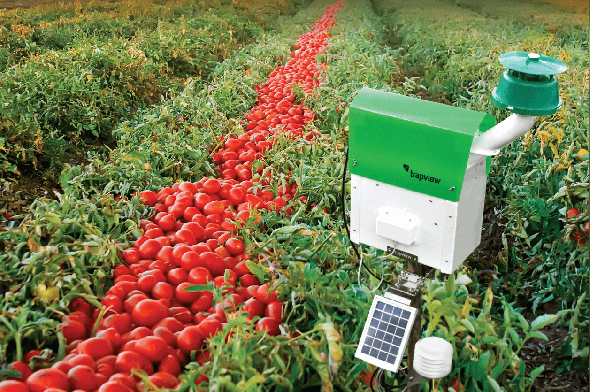
TrapView's solution being used in the field. Photo: PR: צילום: PR
Another use case Moshe shared involves a product called BreviSmart, a decision support tool to maximize the efficacy of Adama’s Brevis thinning product on apple and pear orchards. Thinning is a process used to dilute the amount of fruit that a tree produces in order for the end product to be of the highest quality possible. BreviSmart, a collaboration of Adama, a team of European fruit-thinning experts, and IBM’s The Weather Company, calculates a number of variables, including solar radiation, temperature, fruitlet size, and variety, to determine the best time to apply the product.
“Fruit thinning is a very common task for farmers, they use it to manage the quality and size of their fruit To minimize the high costs of manual thinning, you need a material to do the thinning. Adama developed a combination thinning tool for use by advisors, which if used, can recognize the optimal application time and reduce the risk of over-thinning,” Moshe said.
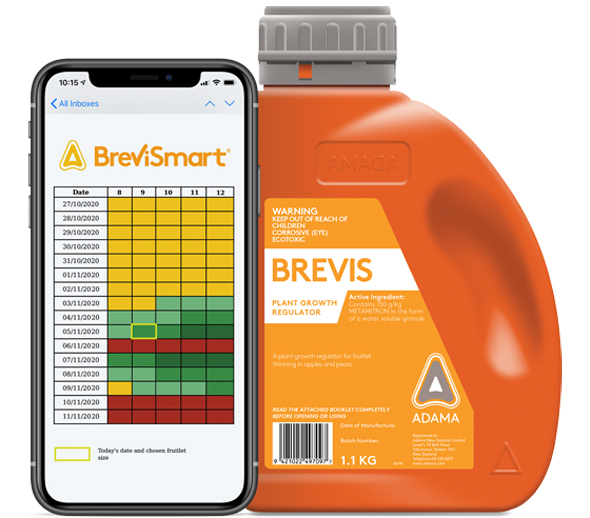
BreviSmart's app. Photo: PRצילום: PR
“After we complete the proof of concept stage, we will embark on a validation process to re-create the results at a larger and more diverse scale. After that comes the commercialization process, where Adama can provide the agtech companies with access to a wide range of markets and build a joint business model, adding the solution to Adama’s basket of services,” Moshe said.
Moshe said the contest was a great way for Adama to better get to know the cutting edge work being done in the Israeli agtech sector, as by virtue of the sector’s size it is impossible to know every single company and solution. He sees it as an opportunity for the companies to bring their products forward and perhaps gain a chance to have their solution tested (field studies are an expensive process) and proved, which could lead to them breaking into the global market.
For Adama, whose market for its core chemical products is shrinking due to expanding government regulations on their use, particularly in Europe and North America, opening up to technology is almost a necessity as it seeks ways to help farmers make the best use of the materials they are allowed to deploy.
Where better than in Israel, which has long been a pioneer in agricultural innovation, to find out-of-the-box solutions for problems that impact the food that we all end up encountering on our plates?
