










The economic engine of airlines is not just in the planes
El Al loyalty club valued at over $880 million, representing a fifth of the carrier’s market cap.
The updated valuation of El Al’s frequent flyer club has reached NIS 2.74 billion ($884 million), more than double the NIS 1.3 billion ($419 million) valuation at which the airline sold a stake in the club to Phoenix in June 2022. The new figure appears in an approval received by Phoenix, a company listed on the Tel Aviv Stock Exchange, to distribute shares as a dividend.
Phoenix currently holds 19.9% of the frequent flyer club and estimates the value of this stake at approximately NIS 140 million ($45 million). The company also holds an option to purchase an additional 5.1%, and its board has decided to distribute these shares as a dividend in kind to Phoenix shareholders. After the option is exercised, El Al will retain 75% ownership of the club, with its share valued at about NIS 2.06 billion ($665 million) based on the new assessment. This represents roughly one-fifth of El Al’s total market capitalization, which currently stands at around NIS 10 billion ($3.23 billion).
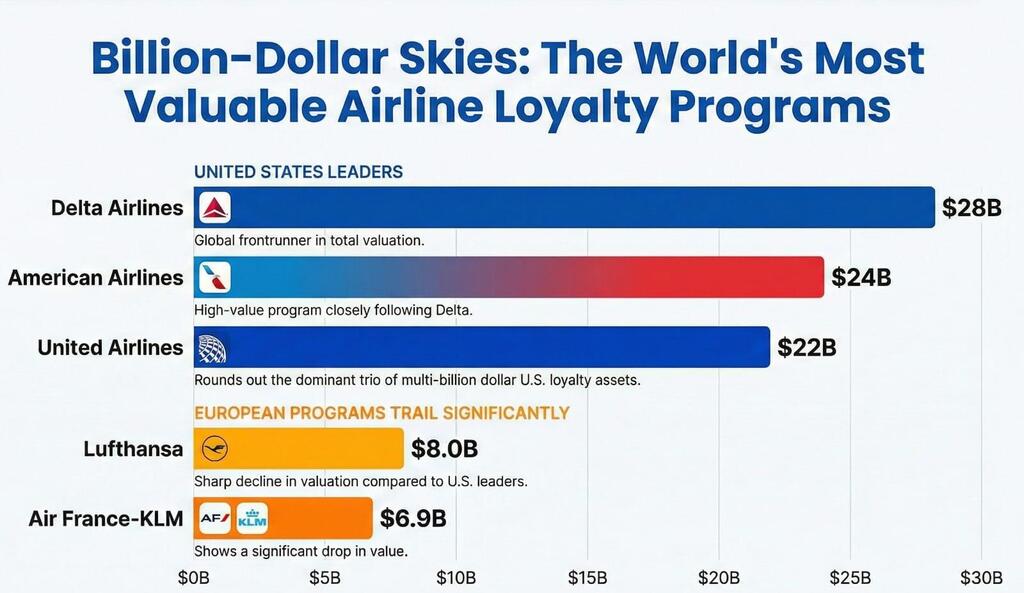
The strong performance of El Al’s loyalty program is striking in the Israeli market, though it reflects a broader global trend. Nearly every major airline operates a loyalty club whose value is estimated in the tens of billions of dollars. Delta’s SkyMiles program is valued at $28 billion, American Airlines’ AAdvantage at $24 billion, and United’s MileagePlus at $22 billion. European carriers show similar dynamics: Lufthansa’s Miles & More is valued at about $8 billion, British Airways’ IAG Avios at $7 billion, and Air France–KLM’s Flying Blue at a comparable level.
El Al’s frequent flyer revenues are driven largely by the FlyCard credit card, which allows customers to accumulate points with every purchase and redeem them for flights, upgrades, and additional services. Members also earn points through flights and promotions. The company sells points to partners such as airlines, car rental firms, and hotels, which provide them to their customers as benefits. El Al also operates an online marketplace where products can be purchased using points. A significant source of profitability comes from points that are never redeemed or are used for seats with low marginal cost. This model generates immediate cash flow and has turned the frequent flyer club into a stable financial asset, one that increasingly resembles a payments and financing business more than a traditional aviation product.
According to El Al’s reports, the club recorded a net profit of $48.4 million in the first nine months of 2025, a 3.6-fold increase compared with the entire year of 2024, when net profit was $13.4 million. The profit for the period reflects an earnings multiple of 14 under the new valuation. At the end of 2024, the frequent flyer club was carried on El Al’s books at a negative value of NIS 119.4 million (–$38.5 million), but the updated valuation may enable the airline to recognize the subsidiary at a positive value, reshaping its balance sheet.
In its third-quarter 2025 report, El Al said the club had 3.47 million members and 498,000 FlyCard credit cards. Membership has grown by about 10% over the past year, while the number of credit cards has risen by 17%. The company expects membership to reach 4.2 million by 2030, a trajectory that would further entrench the loyalty division as one of the airline’s main growth engines.
The sharp rise in the club’s revenue mirrors the broader surge in El Al’s business over the past two years, driven largely by the war. The withdrawal of many foreign airlines from Israel allowed El Al to consolidate its position as the carrier with the largest market share at Ben Gurion Airport. Whether due to limited alternatives or concerns about relying on foreign airlines, more Israelis have flown with El Al, and many have joined the loyalty program. Benefits granted to reserve soldiers also boosted membership, as recipients were required to join the club to verify their eligibility.
In 2024, El Al’s revenues reached an estimated $3.4 billion, a 37% increase from $2.5 billion in 2023. The third quarter of 2025 delivered a net profit of $202.6 million, compared with $187.4 million in the same quarter a year earlier.



