










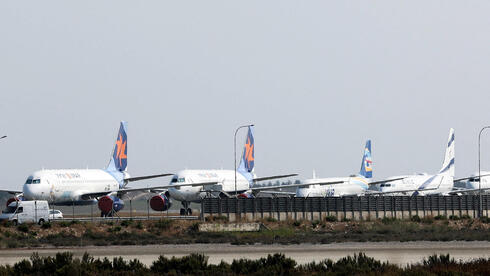
Airport congestion pushes Israel to relocate American aircraft
Parking shortages at Ben Gurion Airport force carriers to base planes abroad.
The Ministry of Transportation has established a committee to examine reimbursing Israeli airlines for the cost of grounding aircraft abroad since the start of Operation “Roaring Lion,” while simultaneously working to relocate American aircraft from Ben Gurion Airport to Ramon Airport in order to free up parking space.
At the start of Operation “Roaring Lion,” Israeli airlines - including El Al, Israir and Arkia - were instructed to relocate their aircraft to foreign airports and base them abroad. Even after a ceasefire was declared, security officials continued to prohibit the airlines from parking aircraft in Israel. The situation has created major operational challenges and significant costs for the carriers.
1 View gallery
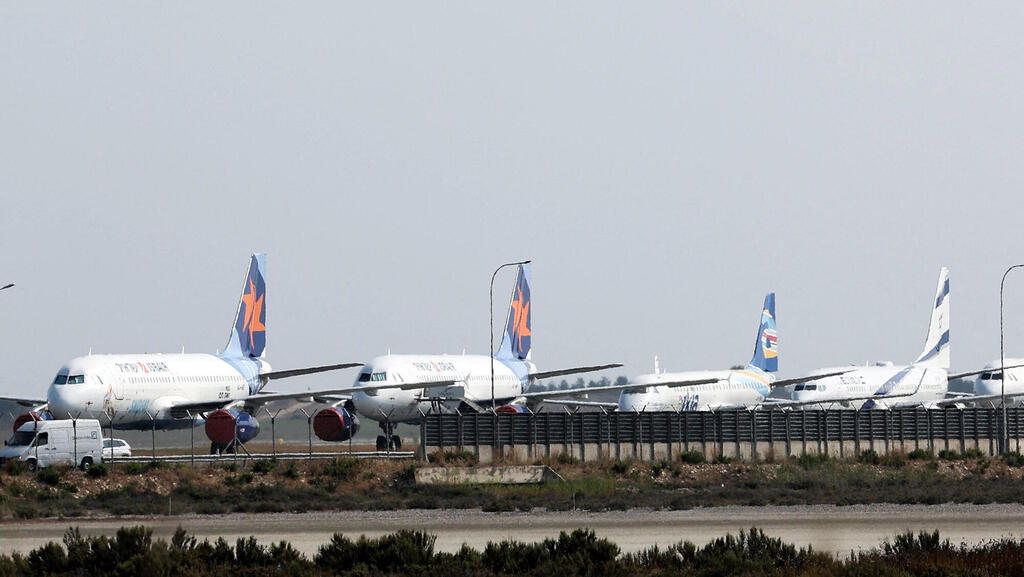
Israeli planes parked in Larnaca, Cyprus, during Operation Rising Lion.
(Reuters/Yiannis Kourtoglou)
According to estimates, the cost of keeping the aircraft abroad has exceeded NIS 60 million ($20 million), excluding additional losses related to disrupted flight schedules.
Beyond the security concerns, Israeli airlines have also faced a severe shortage of parking space at Ben Gurion Airport because American aircraft continue to occupy parts of the airport. In an effort to ease the congestion, the Ministry of Transportation pushed for the evacuation of some of the American aircraft.
Transportation Minister Miri Regev raised the issue with security officials, who, after lengthy discussions, approved the relocation of 12 American aircraft from Ben Gurion Airport to another location this week, freeing up parking spots for Israeli carriers.
In addition, Ben Gurion Airport is examining, under instructions from the Transportation Ministry, possible changes to flight routes that would allow some aircraft to use shorter routes, thereby creating additional parking capacity.
At the same time, the CEOs of the Israeli airlines are demanding state compensation for the costs incurred by keeping aircraft abroad. Regev, who has previously criticized the airlines over high ticket prices, has reportedly shown understanding toward their position.
Officials at the ministry argue that just as residents evacuated from Kiryat Shmona are entitled to reimbursement for accommodation expenses, airlines should also receive compensation for costs imposed on them by state security directives.
Following a meeting earlier this week with airline representatives, the Transportation Ministry decided to establish a committee headed by the ministry’s Director General, Moshe Ben Zaken, to examine the issue. The airlines were asked to provide detailed financial data, with the committee expected to reach conclusions within 30 days.
Any compensation decision would require funding approval from the Ministry of Finance. Regev is therefore expected to raise the issue with the prime minister, while the ministry is also considering submitting a formal proposal for government approval.
Israeli airlines have spent tens of millions of shekels on overseas parking arrangements in recent months, and costs are now rising further as the summer tourism season increases demand for parking space at foreign airports.
In addition to parking fees, airlines are also paying for security, maintenance and air crews stationed abroad, while the situation continues to complicate flight operations.
For example, El Al has reportedly been forced to operate flights to nearby destinations on Fridays using large Dreamliner aircraft that remain partially empty, simply to keep the planes close enough to return to Ben Gurion Airport the following day for long-haul Saturday night departures.



