










Cyber startup Jazz raises $43 million Series A to tackle AI-era data leaks
The Israeli startup argues traditional DLP systems struggle to handle AI-driven data risks.
Cybersecurity company Jazz has raised $43 million in a Series A round led by Glilot Capital Partners and Team8, with participation from Ten Eleven Ventures (1011vc), MassMutual, Merlin Ventures, and leading cyber and AI entrepreneurs, including the founders of Decart, Tenzai, and Oligo Security.
The company’s total funding now stands at $61 million, including an $18 million Seed round.
According to Ido Livneh, co-founder and CEO of Jazz, the rise of artificial intelligence is rapidly intensifying the problem of data leakage inside organizations.
“Every week there are new channels through which data can leak,” Livneh said in a conversation with Calcalist. “These include AI tools such as chatbots and other automated systems. At the same time, there are waves of layoffs in the tech industry, and AI has created new incentives for employees to copy or store data.”
Livneh said that developers can now rebuild internal products using AI tools and potentially use that knowledge elsewhere, including at competing companies. Sensitive information such as financial results or proprietary code can also be exposed more easily.
“AI also creates situations where employees try to protect themselves against potential layoffs by collecting information they might use later,” he said. “This has become a growing concern for boards of directors.”
Livneh added that while many security solutions exist, most organizations deploy them only because they are required to do so by regulation.
“There is a wave of modern players who are taking the old approach, adding a bit of AI, and repackaging the same problem,” he said. “We started from a different question: how should this problem be solved in the AI era?”
Jazz has developed a Data Loss Prevention (DLP) platform designed to autonomously understand how, why, and where organizational data is used. The system analyzes the movement of data across an organization and provides security teams with a clearer view of potential risks.
“Our system behaves more like a human researcher than a technical robot,” Livneh said. “It studies the organization, understands the systems and the data in depth, and analyzes how information moves inside the company.”
The company currently has 15 paying customers, along with additional organizations evaluating the product.
Jazz plans to expand its workforce but intends to remain relatively lean.
“Today, each person we hire can do the work of ten people in the past,” Livneh said. “Thanks to AI, companies like ours can compete with much larger and more established players.”
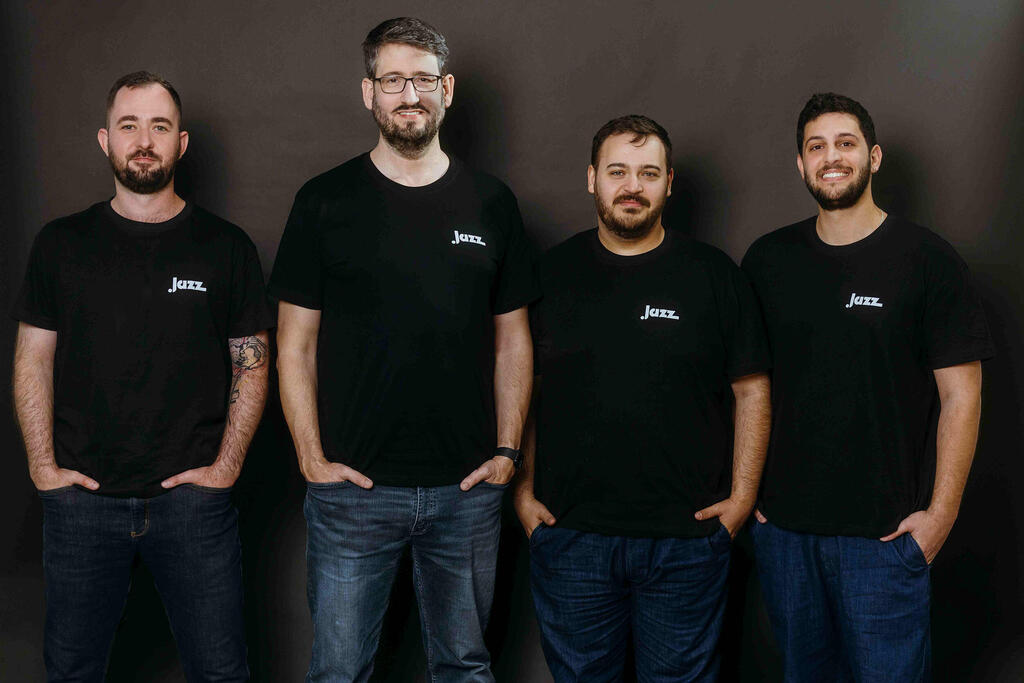
Jazz was founded in late 2024 by Livneh (CEO), Jake Tuertskey (Chief AI Officer), Noam Issachar (CBO), and Yonatan Zohar (CTO), veterans of Unit 81 and alumni of companies including Axonius and Laminar.
The company currently employs 45 people, most of them at its development center in Israel, with the rest based in the United States.
Data Loss Prevention (DLP) tools are designed to stop the leakage of sensitive organizational information, ranging from intellectual property and customer data to financial documents and internal software code.
Leaks often occur during routine activities, such as sharing files in the wrong location, using AI tools without proper controls, or transferring information to unsecured applications.
For more than two decades, the DLP market has relied primarily on rules-based systems designed to detect anomalies. In practice, these systems often generate large volumes of false alerts and require constant manual adjustments, frequently at the expense of identifying real risks in real time.
According to Verizon’s 2025 Data Breach Investigations Report, the human factor is involved in roughly 60% of data leakage incidents, whether through mistakes, external manipulation, or malicious insider activity.
This creates a difficult challenge for security teams: how to reduce the risk of data leakage without disrupting normal business operations.
As a result, many organizations take one of two approaches. Some deploy traditional DLP systems mainly to meet regulatory requirements, accepting their limited effectiveness. Others avoid implementing dedicated tools altogether and instead accept the risk of potential data leaks.



