










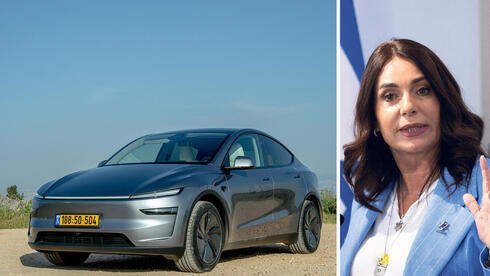
Why is Israel rushing to approve Tesla’s self-driving tech?
With safety investigations piling up abroad, critics question the transport minister’s decision to prioritize a luxury feature for a few thousand drivers.
In early 2021, Israel’s Ministry of Transportation announced that Tesla had received approval to market its cars in the country, complete with unusually enthusiastic remarks from then-Transportation Minister Miri Regev. The ministry has never issued similar announcements for any other car brand, including BYD, Hyundai, or Chery. At the time, sources at Tesla Israel told Calcalist that the ministry insisted Tesla’s global headquarters “accepted” that it would be the ministry, not the company, making the official announcement of Tesla’s entry into Israel.
Today, Tesla and Regev are back in the headlines. The minister announced that, “after a petition by Tesla owners,” her ministry is now examining the possibility of approving Tesla’s Full Self-Driving (FSD) system for use in Israel. The technology allows for a form of “hands-free driving”, in other words, semi-autonomous driving under active driver supervision. The system enables the vehicle to change lanes, recognize intersections and traffic lights, and navigate traffic largely on its own, though a human driver must remain behind the wheel.
FSD is a paid add-on available in a limited number of countries: the United States, Canada, Mexico, Puerto Rico, Australia, and New Zealand. If Regev’s comments are to be believed, Israel could soon join that list, pending approval by the ministry’s professional staff.
According to Regev, she “received inquiries from Tesla owners in Israel,” and soon “they won’t have to hold the steering wheel.” The reality, however, appears to be more complicated. About two weeks ago, sources within the Ministry of Transportation told Calcalist that following the minister’s recent visit to Tesla’s operations in Germany, the ministry’s professional teams were instructed to begin examining the feasibility of operating FSD in Israel.
Why the minister rushed to highlight the issue, and to tie it to a petition signed by roughly 1,000 Tesla owners out of several million drivers in the country, remains unclear. Could hundreds of thousands of Hyundai owners also petition the minister to introduce new technology or regulation?
Tesla vehicles are sold in more than 50 countries worldwide, yet only six have approved the use of FSD, and even there, results have been troubling. In Australia, a recent episode of 60 Minutes raised “serious concerns about Tesla cars equipped with FSD after fatal accidents,” just two months after the system’s legalization.
In the U.S., where FSD has accumulated the most on-road experience, the National Highway Traffic Safety Administration (NHTSA) announced earlier this month that it was opening yet another investigation, one of many, into 2.8 million Teslas equipped with the system. The reason: some cars reportedly failed to recognize red lights or swerved into oncoming traffic.
Canadian regulators have faced similar issues. Local media have reported on several fatal or near-fatal crashes involving FSD, including a driver who ran a red light in June, another who collided with a train while allegedly asleep, and a motorcyclist injured after a Tesla turned unexpectedly. All remain under police investigation.
It is important to emphasize that FSD requires active driver supervision. Fatalities and crashes typically occur when drivers misuse the system, falling asleep, filming themselves, or assuming the car can handle situations it cannot.
There is no question that FSD represents a remarkable technological leap. It has logged millions of kilometers across multiple markets and continues to improve. Yet it remains a system with clear limitations, one that even in the most disciplined driving environments has led to repeated scrutiny.
That raises two questions for Israel: why rush to join the small group of countries allowing FSD when local drivers are notorious for texting behind the wheel, nodding off in traffic, and generally driving aggressively? And will Israeli drivers truly monitor their vehicles responsibly while in “self-driving” mode?
The answers, as always, lie with the Ministry of Transportation.



