










Dreaming of an exit? Dell’s innovation chief explains what corporations really want
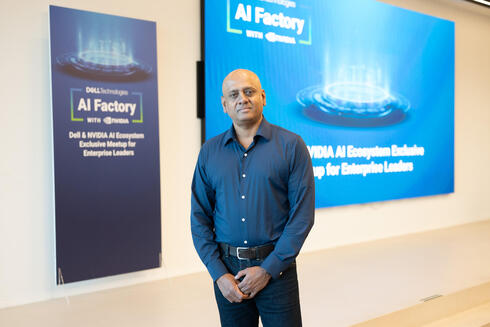
Satish Iyer, Vice President of Innovation and Ecosystems at Dell Technologies, came to Israel in search of startups. In an interview with Calcalist, he explains how to implement AI in an organization with 90,000 employees, what it takes for a startup to be ready for acquisition by a corporation, why entrepreneurs who focus solely on the cloud may be making a mistake, and why junior software developers should consider looking for work outside the high-tech sector.
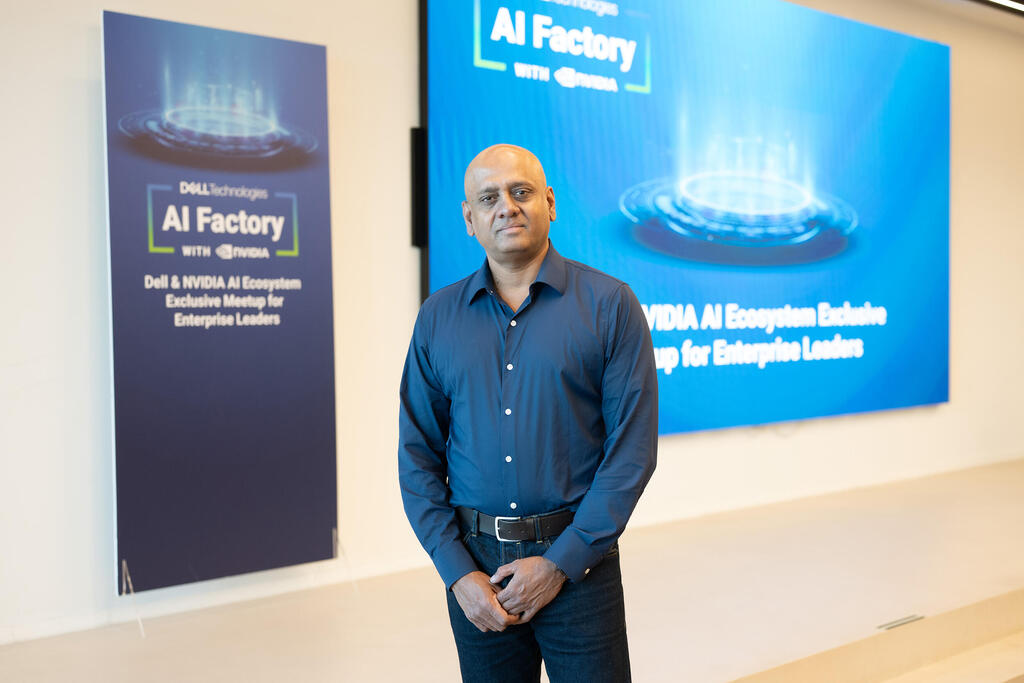
I met Satish Iyer, Vice President of Innovation and Ecosystems at Dell Technologies, during an intensive trip of meetings with 20 Israeli startups. We spoke just before a joint conference with Nvidia, where he was scheduled to discuss innovation, AI implementation, and many of the topics we would cover in our conversation.
This is the second year he has come on such a “hunting” trip, several days of meetings with startups to explore potential collaborations. A year ago, one in three of the startups he met went on to collaborate with Dell in some way. One of them, Dataloop, was acquired by the technology giant at the end of the year for $120 million. The speed of technological change has made the search for innovation more critical than ever for an organization like Dell, he explains.
As a former entrepreneur, current corporate executive, and someone responsible for ecosystem collaborations, he has some surprising advice for startups looking to collaborate, secure investment, or be acquired by a large corporation, and it is not just about technology. His first piece of advice is to focus on the problem, not the platform. Instead of starting with a product demo, it is better to begin with a deep understanding of the organization’s “pain point” and show how it can be solved. “Don’t try to sell the platform you developed. Start with a problem that bothers the corporation,” he says.
Even before the product, he suggests startups focus on people. In large organizations, processes are complex, so he recommends building trust and mapping the key stakeholders who can advance initiatives within the company. “Don’t sell from the beginning. Build relationships, a network of key people in the corporation,” he says. The complexity of corporate processes also requires patience. “You need to run a marathon. Be patient, because adopting technology in a large corporation takes time.”
You are here to meet Israeli startups, and you recently acquired Dataloop. What are you specifically looking for in Israeli startups?
“We are not looking for an ‘Israeli startup’ in the narrow local sense, but for startups operating from Israel that solve global problems. The companies here may be Israeli, but they are fundamentally global. Israel is one of the leading innovation hubs in the world, alongside San Francisco, where I come from, and Bangalore in India. Almost every Israeli startup, once it reaches a certain stage, establishes a foothold in the United States, often in San Francisco or New York. The advantage for us in Israel is that it is a small, highly networked market, where innovation can be validated quickly. We also have a strong local presence and technological leadership here.”
We see that the pace of technological change is extremely rapid. Where do you think we are heading in terms of AI and innovation, and how can organizations like Dell ensure they don’t become the next ‘Nokia’? That they remain relevant?
“Innovation at Dell comes from the fact that we are an enterprise company with deep expertise in infrastructure, edge computing, and a broad technology portfolio. AI touches almost every layer of our operations, from computing and GPUs to storage, networking, and PCs. Right now, much of the market’s investment in AI is focused on model training, but in the near future we will see more AI moving to the edge, to devices themselves, including laptops, robotics, and other intelligent systems with new capabilities. We are well positioned for this transition because this is where Dell has a structural advantage.
“We are also a 90,000-employee organization that has existed for 40 years, and we are using AI internally to improve Dell itself. Two years ago, we launched a transformation program to implement innovation across the company. Large organizations are only now moving from pilots and proof-of-concepts to routine AI deployment. I believe enterprise-level AI adoption has barely begun. We are still in the very early stages, and Dell is well positioned to help organizations increase productivity through AI.”
You say we are in the very early stages of enterprise AI adoption. Aren’t we at least in the middle of it?
“A lot of enterprise AI is transitioning from pilot programs to mainstream use. But this is still the beginning. Organizations now demand transformation with clear ROI. At Dell, we focus on four major areas and are seeing substantial productivity gains. Technology moves fast, but business processes are slower to change. Things that were impressive six months ago are now standard. Previously, everyone focused on LLMs; today there are dozens of models, and organizations are focused on implementation rather than novelty. When we speak to Dell’s 500 largest customers, almost all have implemented AI strategies aligned with business priorities. Most organizations begin with practical applications, code generation, customer service chatbots, and enterprise search. These are real productivity tools that deliver measurable results.”
This is one of the central challenges organizations face today, and there appears to be a gap between the rhetoric around AI and real-world adoption. Is productivity truly increasing?
“At Dell, we’ve seen major productivity gains where AI has been implemented effectively. There must be ROI for AI investments. For example, we have 20,000 developers, and code generation tools allow them to spend less time writing code and more time on higher-value tasks. In customer service, metrics such as response time and resolution rates have improved significantly when AI tools are used to retrieve information and resolve issues more efficiently.
“We measured these effects and saw revenue increase, returning over $1 billion to the business through modernization and AI deployment. But adoption also presents challenges, particularly prioritization, everyone wants to use AI. Transformation must be driven from the top. Our CEO, CIO, and CTO are leading a clear strategy. Another major shift is toward building with partners. In the past, companies might have built everything internally. Today, we recognize that the ecosystem is stronger. If a startup has superior technology, we will integrate it. This is difficult for large organizations accustomed to long procurement cycles, but that model is no longer viable.”
What do you look for in startups you are considering acquiring?
“First, what problem does the startup solve for us? Customer fit is essential, and the customer can be Dell itself. Can we use the technology internally, or do our customers need it? Often, a problem we solve internally is shared by banks, infrastructure companies, and others. This allows us to validate the solution and bring it to market.
“Second, corporate readiness. Large organizations have strict requirements around data privacy and security. Not all corporate data is in the cloud; much remains on-premise. AI must operate where the data resides, so startups need hybrid strategies.
“Third, patience. Enterprise adoption takes time. Sometimes AI doesn’t just accelerate processes, it transforms them entirely. That transition is complex. Many startups sell primarily to other startups, which can switch technologies easily. Large enterprises are different. They have more data, more systems, and higher switching costs. My advice is simple: identify a real problem and solve it. The experimentation phase is ending. The technology is ready. Collaboration, even between competitors, is essential.
“We met with Teva. They have real supply chain challenges, for example, how a robot can efficiently stack boxes of different sizes in a truck. This improves productivity and saves time. A small startup solved that problem. My advice is to identify the biggest pain point and apply technology to solve it.”
If someone wants to start a new startup today with the goal of being acquired, what areas will define the future?
“AI is moving into the physical world. Intelligent robotics will perform specific, targeted tasks. Quantum computing is another important area, though still early. Quantum systems will work alongside classical computing.
“Within AI, the opportunity lies in solving real organizational complexity. The traditional advantage startups had in speed and product development has narrowed, because large companies now have access to the same tools. Startups still have an advantage in agility and focus.”
So what will happen to software developers?
“The role is evolving. Code generation tools can complete up to 80% of the work, but developers are still essential. The skill set is shifting toward systems thinking, understanding architecture and integration. The role is not disappearing; it is changing.”
But graduates are struggling to find entry-level jobs.
“This is a transitional phase. Today’s graduates are AI-native. They understand the tools intuitively. Opportunities exist beyond traditional tech companies, in retail, healthcare, infrastructure, and finance. Engineers who understand industry problems will be especially valuable.”
Before leaving to continue his meetings, Iyer offered one final message:
“It’s important for startups to listen carefully to what corporations need. This is mutual learning. Startups gain insight into enterprise needs, and corporations gain exposure to innovation. That collaboration strengthens the ecosystem. This is a global trend, and in Israel it is especially powerful.”



