










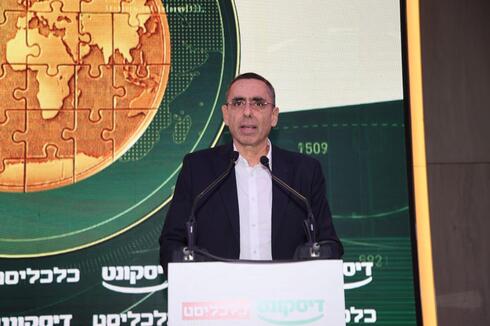
Discount CEO: "Israel must move from a mindset of a ‘startup nation’ to that of a ‘scale-up nation’"
According to Avi Levi, the innovation and technology that is currently concentrated in high-tech needs to spread throughout the economy. Levi noted that "Israel is expected to grow by 4.5% next year," and that expectations are for "three additional interest rate cuts in 2026 - to a level of 3.5%."
"We are in a time when the world is experiencing deep disruption - security, technological, political and financial - and is searching for its equilibrium anew," Avi Levi, CEO of Discount Group, , as he opened the Calcalist and Discount Global Economy Conference.
According to Levi: "Despite geopolitical tension, trade wars and high uncertainty, the global economy continues to expand. The rate of expansion is moderating and the challenges are increasing: inflation is indeed falling, but it seems that the path of interest rates is not going to change quickly or dramatically, and this requires adjustments to the ‘new normal.’"
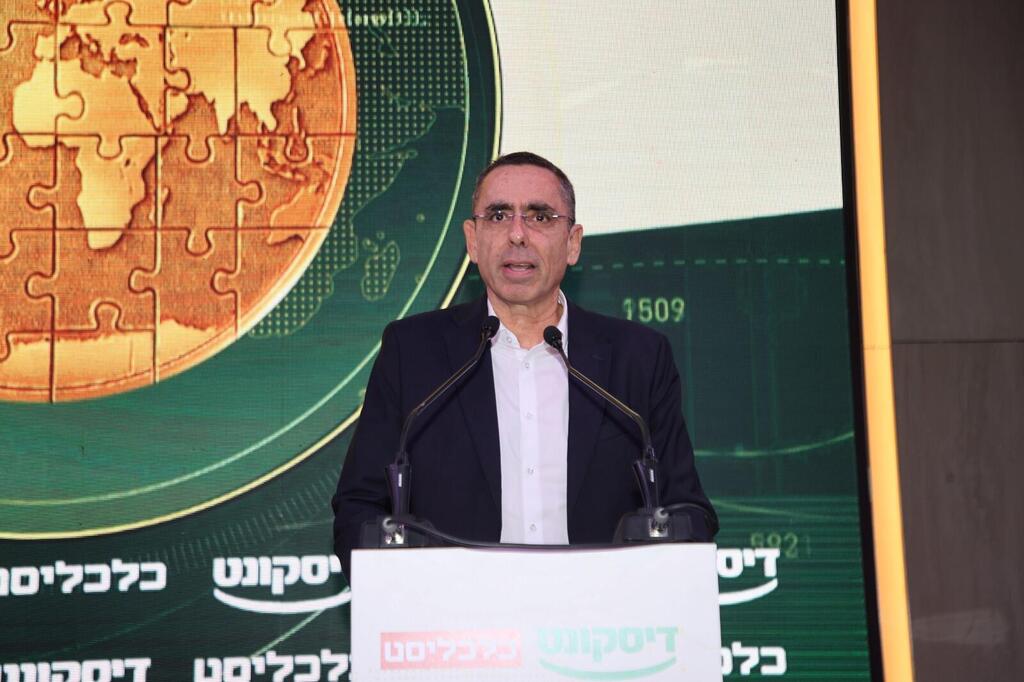
He further noted: "Since the 2008 crisis, the world has become accustomed to cheap money, continuous globalization and the perception that growth is self-evident, and many still behave as if the increase in interest rates was a temporary event, but the reality has changed. We are faced with a picture that is taking shape, of an economic world that has entered a new period, and three central axes can be identified, which are redrawing reality: the first, the era of ‘higher for longer’, interest rates will remain higher for a long period. The second axis, changing globalization, less openness, more blocs. And the last axis, a widening gap between the financial system and the real economy."
Levi further noted: "Technological innovation is one of the main trends, and within it artificial intelligence is the most significant force. According to Gartner, so far about $1.5 trillion has been invested in artificial intelligence, and the volume of investments is expected to reach $2 trillion in the coming year. However, the rate of adoption is slow, regulation is not adjusted, and the gap between vision and implementation creates concerns about elements of a bubble. The hype-cycle curve of adopting new technology reminds us that the crisis comes before maturity."
According to Levi: "The U.S., China and Europe together produce about 60% of nominal global GDP, and each of them is facing significant challenges. In the U.S., growth is moderating to 1.9% in 2025 and 2026, and fears of public debt are rising. Europe is in stagnation, with high differences between the bloc's economies, and suffers from low productivity, regulatory burden and political and demographic challenges, with average growth of only 1% this year and next year. And China relies on export-biased growth, domestic demand is weak, investments are shrinking and the real estate crisis is weighing, expected growth of about 4.3% in 2026."
According to Levi: "However, in this turbulent world, Israel is at the threshold of an opportunity. The country has had two very difficult years, socially, militarily and emotionally, and at the beginning of the war, some feared that the economy would not be able to meet the challenge. This did not happen. The Israeli economy has demonstrated extraordinary resilience: it adapted, grew stronger, reorganized and continued to function. However, in order to seize the opportunity and turn the coming decade into a decade of accelerated growth, Israel must move from a ‘startup nation’ mindset to a ‘scale-up nation’ mindset, from innovation in one sector to an engine for national growth. Thus, against global growth of about 3% in 2025 and 2026, Israel is expected to grow by 3.2% this year and 4.5% next year. Private consumption is strengthening, exports are soaring, and investments - especially in technology - are increasing. Exports of high-tech services are growing at an annual rate of about 9%. Capital raising is accelerating, mainly in the fields of cyber and AI. Trade exports are also rising rapidly, some of them defense exports."
Levi also noted: "The unemployment rate is low, only 3%. Inflation will decrease to 2.5% this year and is expected to drop to about 1.8% in the coming year. We expect three additional interest rate cuts in 2026 to a level of 3.5%. S&P has already changed the rating outlook from ‘negative’ to ‘stable’ and, in our assessment, additional rating companies will join it."
As for future scenarios, Levi foresees three possible scenarios. According to him: In the base scenario, continued security tensions alongside a gradual economic recovery. In the pessimistic scenario, increasing regional tensions and a weak global environment. And a positive scenario, a relaxation of regional tensions and the expansion of the Abraham Accords. But in all three scenarios, the right policy measures will support the acceleration of growth. Four steps are now needed for this to happen: The first is reducing overregulation. In the OECD's PMR index, which measures how regulatory or competitive the business environment in each country is, Israel is ranked 31st out of 38 in the overall 2023 index, similar to Turkey and Costa Rica, well below the OECD average. And in measuring the most significant barrier, the burden of bureaucracy, Israel ranks 35th-36th out of 38 countries.
"Regulatory certainty is needed"
He said: "Recently, regulators in Europe and the U.S. have published plans to simplify and eliminate burdensome regulations in order to encourage growth. In Israel, the trend seems to be the opposite. In order to encourage growth and attract foreign investment, barriers must be removed and regulatory certainty must be created. Another step that is required is fiscal discipline and national responsibility. The government must manage the budget responsibly, direct resources to areas that promote sustainable growth and avoid increasing the deficit without justification. A country that acts in this way sends the markets a clear message of responsible management and a desire to maintain a stable economy even in challenging times. In addition, massive investment in human capital is required, long-term growth begins with people. And a final move concerns connecting high-tech to the real economy. The power of Israeli high-tech is enormous, but its full contribution will only reach its maximum when the capabilities and innovation of the industry are available to the entire economy."
"Small, fast countries have an advantage"
Levi concluded his remarks: "The world is changing, but small, fast, creative and resilient countries like Israel have a significant competitive advantage. We at Discount Group have embraced technology as a key growth engine for the bank and are making the local banking infrastructure available to our customers alongside our significant presence in the United States, through IDB New York, the largest independent Israeli bank outside of Israel, with a presence in New York, Miami and Los Angeles. Alongside investing in business development, we are steadfastly maintaining our social commitment and investing in strengthening and supporting the community. If we are able to combine economic responsibility, business creativity and investment in people, Israel will not only succeed in the challenges, but will also be one of the economic centers of influence of the coming decade."



