









Weapons, AI and nuclear power: Trump's Middle East formula
The White House is exchanging strategic access for investment and procurement commitments, even as questions grow over the Trump family's expanding regional business interests.
The signing last week of the civil nuclear agreement between the United States and Saudi Arabia is perhaps the clearest illustration of the system of relationships Donald Trump has built in the Middle East since returning to the White House in January 2025. Countries across the region are receiving strategic assets from Washington that had long been difficult to obtain, advanced fighter jets, missile defense systems, cutting-edge AI chips, civil nuclear cooperation and even security commitments. In return, the United States is securing orders for Boeing, defense and energy companies, infrastructure investment and commitments to purchase hundreds of billions of dollars' worth of American goods and services.
Alongside the official ledger sits another. As the White House negotiates these agreements, businesses linked to the Trump family and Jared Kushner have been expanding across Saudi Arabia, Qatar and the United Arab Emirates. There is no public evidence that any specific political decision was exchanged for a private business opportunity, and there is therefore no basis to characterize the relationship as a quid pro quo. Still, the overlap between countries negotiating with Washington and those hosting Trump family business ventures has become an increasingly prominent part of the debate surrounding the administration's Middle East policy.
1 View gallery
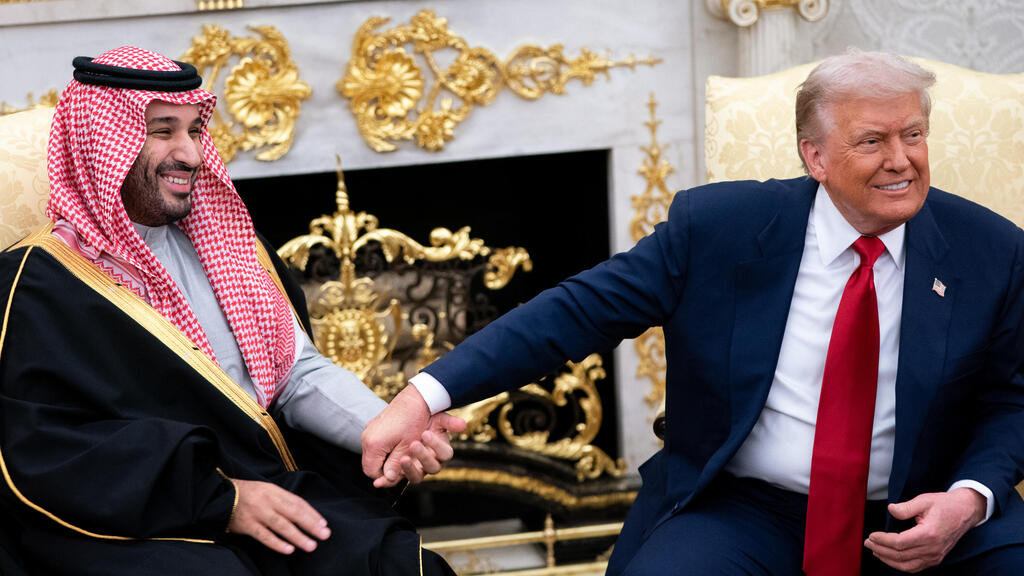
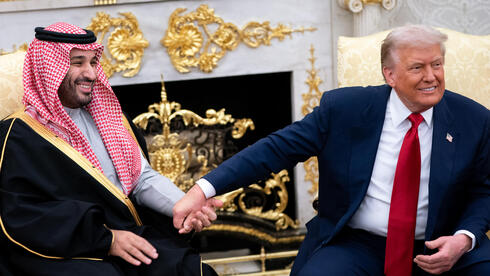
US President Donald Trump and Saudi Crown Prince Mohammed bin Salman in a meeting at the White House, November 2025
(Bloomberg)
And where is Israel in this political, security and business puzzle? No longer in the central position it once occupied. But the focus here is on the countries that have become the primary beneficiaries of Trump's regional strategy.
Saudi Arabia: Nearly $1 trillion for security, AI and nuclear cooperation
Riyadh is the centerpiece of this model. During Trump's visit to Saudi Arabia in May 2025, the White House announced a Saudi commitment to expand economic ties with the United States through investments and procurement worth $600 billion. The package included an arms deal that the White House valued at nearly $142 billion, covering air and space systems, air and missile defense, maritime security, land-force systems and communications equipment. It also included major contracts for Boeing and American technology companies.
In November, Crown Prince Mohammed bin Salman raised Saudi Arabia's investment commitment to what the White House described as "nearly a trillion dollars." At the same time, the two countries signed a strategic defense agreement. Trump approved a pathway for the sale of F-35 fighter jets and nearly 300 American tanks, while also signing a framework for cooperation on critical minerals and a memorandum of understanding on artificial intelligence. The White House emphasized that Saudi Arabia would participate in funding the defense agreement, while the expanded American presence would facilitate the activities of US defense companies in the kingdom.
Saudi Arabia also gained access to another strategic asset whose value is difficult to quantify. The US Department of Commerce approved Saudi AI company Humain to purchase the equivalent of up to 35,000 NVIDIA Blackwell GB300 chips, subject to American security restrictions and oversight.
The culmination came last week, when US Energy Secretary Chris Wright and Saudi Energy Minister Abdulaziz bin Salman signed a Section 123 agreement for civil nuclear cooperation, along with a safeguards agreement. The US Department of Energy described it as the foundation for a "multi-decade partnership worth billions of dollars" that would give American companies broad access to Saudi Arabia's civilian nuclear program. A day later, Trump added a new condition, saying the agreement would not take effect unless Saudi Arabia joined the Abraham Accords. The agreement will also be submitted to Congress for review during a 90-day session.
United Arab Emirates: AI chips in return for investment
The UAE secured another long-sought strategic objective: access to America's most advanced artificial intelligence technology.
In May 2025, the White House announced new agreements worth more than $200 billion, alongside an accelerated $1.4 trillion UAE investment framework in the United States over the next decade. Among the deals was Etihad Airways' commitment to purchase Boeing aircraft and GE Aerospace engines worth approximately $14.5 billion. Abu Dhabi also announced that its investments in the US energy sector could rise from about $70 billion today to $440 billion by 2035.
The strategic prize for the UAE was the "US-UAE Artificial Intelligence Acceleration Partnership." Under the agreement, Abu Dhabi received approval to build a computing complex with a planned capacity of five gigawatts, the largest outside the United States, with American participation and under US security and oversight mechanisms.
The Commerce Department also approved G42 to purchase the equivalent of up to 35,000 Blackwell GB300 chips. G42, based in Abu Dhabi, is one of the UAE's leading AI and cloud computing companies, backed by government investment fund Mubadala, Microsoft and Silver Lake.
Qatar: Security guarantees and an extraordinary aircraft
In Doha, the White House announced in May 2025 what it described as "economic activity exchanges" worth at least $1.2 trillion, including commercial agreements exceeding $243.5 billion. The largest was Qatar Airways' purchase of Boeing aircraft and GE engines, valued by the White House at roughly $96 billion.
But Qatar's most significant gain came later. In September, following an Israeli strike targeting Hamas leaders in Doha, Trump signed a presidential order declaring that any armed attack on Qatar's territory, sovereignty or critical infrastructure would be considered a threat to the peace and security of the United States, committing Washington to military action if necessary. Such a guarantee is unusual for a country outside NATO.
Separately from these commercial agreements, Qatar transferred a Boeing 747-8 aircraft, valued at approximately $400 million, to the US government. The aircraft was delivered to the Department of Defense rather than to Trump personally, converted for presidential use, and entered service earlier this month. The original plan to transfer the aircraft to Trump's presidential library after government use sparked legal and ethical debate in the United States.
Turkey: LNG, sanctions relief and the F-35
Turkey has followed a similar pattern, combining major commercial agreements with strategic and security objectives.
Last September, ahead of Trump's meeting with Turkish President Recep Tayyip Erdogan at the White House, Turkish Airlines announced an order for up to 75 Boeing 787 Dreamliners and plans to purchase up to 150 additional Boeing 737 MAX aircraft. If fully exercised, the order could total 225 US-built aircraft. Boeing estimated that the Dreamliner agreement alone would support more than 123,000 American jobs.
That same week, Turkish state energy company Botas signed a 20-year agreement with commodities trader Mercuria to purchase about 70 billion cubic meters of liquefied natural gas beginning in 2026, primarily from US sources. Turkish Energy Minister Alparslan Bayraktar explicitly said the agreement would help achieve the countries' shared goal of expanding bilateral trade to $100 billion. Turkey also signed a preliminary agreement with Woodside for additional LNG supplies, primarily from Louisiana.
In return, Ankara has sought security concessions. Turkey was removed from the F-35 program and subjected to US sanctions after purchasing Russia's S-400 air defense system. In early July, following a meeting with Erdogan at the NATO summit in Ankara, Trump said he intended to lift the sanctions and would consider allowing Turkey back into the F-35 program. Although such a move still faces legal and political hurdles in Congress, reopening the discussion alone represented a significant shift for Ankara.
Last September, Turkey also removed additional tariffs it had imposed on several American products as economic negotiations with Washington progressed.
Bahrain, Kuwait, Iraq and Jordan: A broader package
Bahrain joined the trend in July 2025 with agreements worth more than $17 billion. Gulf Air committed to purchasing Boeing aircraft and GE engines in a deal valued at about $7 billion. Bahraini companies also announced investments in the United States, while the two governments signed a memorandum of understanding on civil nuclear cooperation.
Kuwait's relationship has remained more security-focused. Since February 2025, Washington has approved potential arms sales totaling nearly $2.95 billion, including Patriot missile upgrades, support for Abrams tanks and engineering services.
Iraq presents a different model. Rather than committing sovereign wealth capital to the United States, Baghdad has opened a larger share of its energy sector to American companies. At a business summit in Washington this month, memorandums of understanding and non-binding agreements worth more than $60 billion were signed, including with Chevron and ConocoPhillips. Iraq's oil minister later estimated the total value of recent agreements with American companies at roughly $200 billion.
Baghdad hopes to increase oil and gas production while expanding export routes that reduce dependence on the Strait of Hormuz. For Washington, the agreements also strengthen the position of American companies in a sector where Chinese competitors have expanded rapidly.
Jordan has also become part of the broader framework. The reciprocal trade agreement signed last week preserves preferential access to the American market for Jordanian exports while requiring Amman to continue granting nearly all US products duty-free access, remove trade barriers and align more closely with American policies on export controls, investment screening and sensitive technologies.
The family business
The most sensitive intersection between diplomacy and private business can be found in Qatar. On April 30, 2025, just two weeks before Trump's visit to Doha, Qatari Diar, the investment arm of Qatar's sovereign wealth fund, partnered with DarGlobal to develop the Trump International Golf Club Doha and Trump-branded villas as part of a luxury real estate project.
In Saudi Arabia, the Trump Organization launched two Trump-branded projects in Riyadh and Jeddah earlier this year with DarGlobal, with a combined development value of approximately $10 billion.
In the UAE, the connection runs through digital assets. In May 2025, Abu Dhabi-based investment firm MGX announced that its $2 billion investment in Binance would be made using USD1, the stablecoin issued by World Liberty Financial, which is affiliated with the Trump family. According to published reports, the Trump family held a 60% stake in the project and was entitled to 75% of token-sale proceeds as well as 60% of operating income.
Kushner adds another layer. Even before Trump's second term, Affinity Partners, the investment firm he founded, secured a $2 billion commitment from Saudi Arabia's Public Investment Fund. By the end of 2024, the firm had raised another $1.5 billion from Middle Eastern investors, including the Qatar Investment Authority and Abu Dhabi-based alternative investment firm Lunate.
Since Trump's return to office, Affinity Partners has joined Saudi Arabia's PIF and Silver Lake in a roughly $55 billion bid to acquire video game publisher Electronic Arts.
The new regional balance sheet
After a year and a half, the pattern is increasingly clear. Gulf states, along with Turkey, Iraq and Jordan, are gaining access to American strategic assets ranging from advanced weapons and security guarantees to AI chips and civil nuclear cooperation.
In return, Trump can point to major orders for Boeing and US defense manufacturers, contracts for American energy and technology companies, and investment commitments worth hundreds of billions — and in some cases trillions - of dollars.
At the same time, across many of the same countries, businesses linked to the president's family and his son-in-law continue to expand. There is no public evidence that these private ventures influenced any particular US policy decision. Nevertheless, the overlap between America's diplomatic agenda and the growing commercial presence of the Trump family has become an increasingly scrutinized feature of Trump's Middle East strategy, raising questions that are likely to persist long after the deals themselves are signed.



