










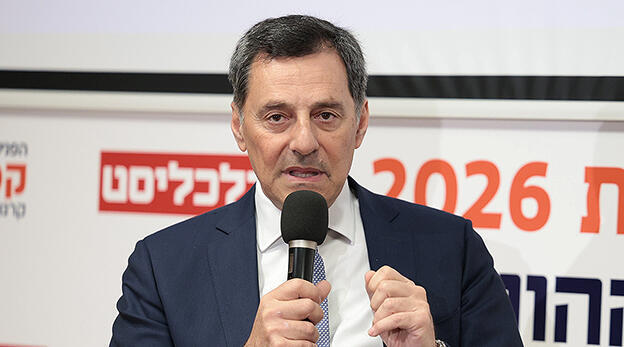
Rigas: "Energean needs more gas to compete, and to prevent a monopoly"
Speaking at the Calcalist and Kesem Mutual Funds Capital Market Conference, Energean CEO Mathios Rigas said that despite the promises it received from the state, his company did not receive new gas fields in the recent tender rounds: "If we do not have additional assets, we will not be able to compete with Chevron, the operator in Leviathan and Tamar."
Energean CEO Mathios Rigas
(Orel Cohen, Streame)


“The state should help those who remained committed during difficult times,” said Mathios Rigas, CEO of Energean, at the Capital Market Conference held by Calcalist and Kasem Mutual Funds from Phoenix Investment House, in a conversation with Calcalist’s Yarden Rozanski. According to Rigas, although the company invested about $3 billion in Israel and continued to operate its facilities under fire, the government chose to deny it access to new gas fields in the latest tender rounds, favoring new players instead.
During the war, the gas platforms were at risk. Did you ever think, ‘Why do we need this?’ Maybe it would be better to develop in other markets?
Rigas: “In 2016, when I first came to Israel, I promised Minister Yuval Steinitz that if we received the Karish field, we would ensure security of supply and that Israel would be our top priority above all else. We like to keep our promises. Over the past two years, we have dealt with very bad people like Nasrallah, who threatened to blow up the platform and kill me. I am still alive; he is no longer alive. When a site that produces 40-50% of Israel’s gas consumption is under missile threat, you have to be fully committed.
“The challenge was not hesitation about staying, that was obvious. The real challenge was convincing people from abroad: foreign workers, insurance companies, and contractors, to come and work here during a time of war. The insurance market in London sought to cancel contracts because of the high risk, and international contractors were reluctant to come, not only due to the danger, but also because of fundamental questions about the conflict. Despite this, we stayed, and I am proud of our Israeli employees who rolled up their sleeves and operated the site while foreigners were afraid to come.”
You own Karish, which is a relatively small field, and you have already sold all the gas from it. How will you compete with Leviathan and Tamar in the coming years?
Rigas: “We need more gas to compete. Without additional assets, we won’t be able to compete with Chevron, the operator of Leviathan and Tamar. The state decided to cancel an agreement with us, and in the latest allocation rounds we did not receive new areas because the government chose to bring in new players. Politicians like to talk about the big companies that will arrive, but those companies require very large assets to justify development.
“Look at Cyprus: the Aphrodite field was discovered in 2011, the government asked major companies to develop it, and now we are in 2026 and they are still relying on diesel. Energean entered Karish, and within a few years the field was already producing gas. If we don’t receive access to additional sites, competition will be harmed and prices will rise. In 2016 the price was about $6, and now it is down to $4.5 thanks to the competition we introduced against the monopoly that existed at the time. We need committed companies, not just impressive photos with global giants.”
What is your message to the government? The minister claims there will be additional tenders and that you will be able to compete.
Rigas: “The Ministry of Energy says there will be another tender and we will compete, but the reality is that other companies have received areas and have not done much with them. Israel is now a country that exports oil, and we are the only company producing oil here, 14,000 barrels a day from the Karish field, which are exported from Israel. There is still a great deal of gas and oil here that has not yet been discovered, and we are ready to invest. Israel is our core region. We are currently working with Exxon in Greece on the largest area opened there in 40 years, but our commitment to Israel is absolute. Close cooperation with the government is essential, yet the government must also know how to stand by its partners, even in difficult times.”
Watch the full interview in the video above.



