










Why David’s Sling missed: The limits of Israel’s mid-tier missile defense
Missed interceptions over Dimona and Arad reveal the challenges of adapting Israel’s mid-tier defense to long-range threats.
In the fourth week of intensifying missile exchanges with Iran, a series of failed interceptions over Dimona and Arad has drawn rare scrutiny to one of Israel’s most important, and increasingly stretched, air defense systems: David’s Sling.
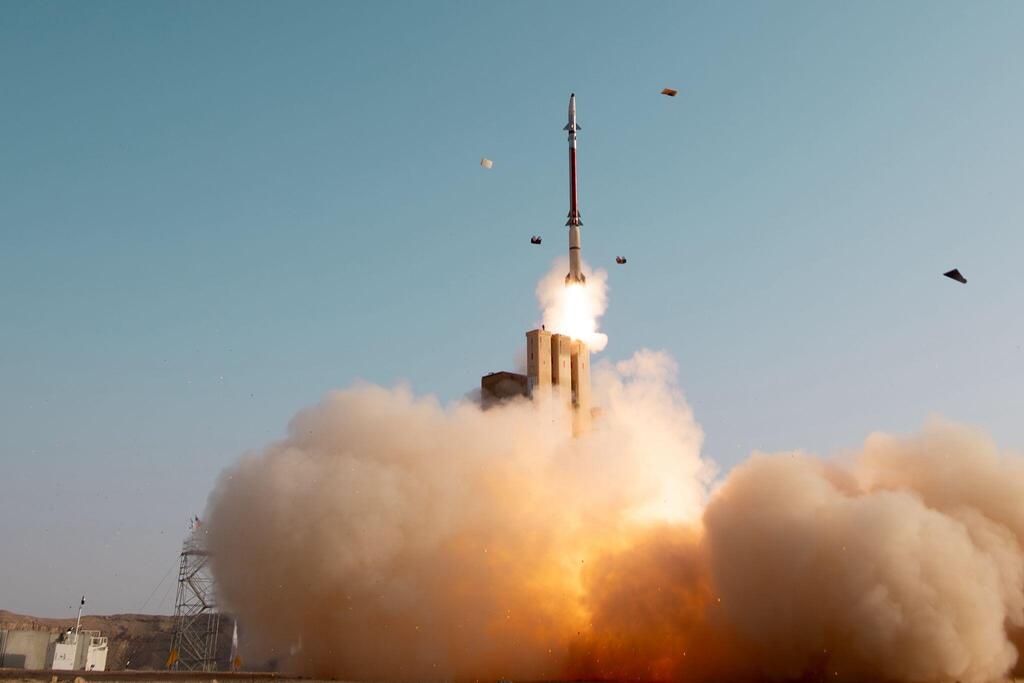
The system, developed by Rafael Advanced Defense Systems, sits at the center of Israel’s multi-layered missile defense architecture. Designed to intercept heavy rockets and cruise missiles at medium ranges, it has in recent months been pushed beyond its original role, tasked with countering ballistic threats it was not initially built to handle.
The results, as seen on Saturday night, have been uneven.
David’s Sling was conceived as the bridge between short-range defenses and high-altitude interceptors, capable of engaging targets at distances of up to roughly 300 kilometers. Historically, its primary mission was to counter threats from Hezbollah and similar actors, heavy rockets and precision-guided munitions, rather than long-range ballistic missiles launched from Iran.
But as the conflict has evolved, so too has the system’s role.
In the weeks leading up to the latest escalation, Israel’s defense establishment announced “significant” upgrades to David’s Sling, based on lessons from earlier rounds of fighting. Among the stated goals was an expansion of its operational envelope, allowing it to engage more complex threats, including certain ballistic missiles, and reduce reliance on higher-tier systems.
That shift now appears central to understanding the recent failures.
When Iranian missiles, identified by the Israeli Air Force as “Qadr” types, were launched toward Dimona and Arad, David’s Sling was deployed to intercept them. The attempts failed.
The Air Force has insisted that the outcome does not indicate a systemic flaw, noting that similar missiles have been successfully intercepted by the same system in the past. But the incident has nonetheless raised questions about the risks inherent in expanding the system’s role.
Unlike high-altitude interceptors, which aim to destroy incoming missiles outside the atmosphere, David’s Sling operates at lower altitudes. This creates both technical and operational challenges.
Ballistic missiles, particularly those carrying cluster-style warheads, can disperse submunitions at altitudes of 7 to 8 kilometers. Once that happens, interception becomes exponentially more difficult. Even when fragments are targeted, only partial mitigation is possible.
The decision to deploy David’s Sling against ballistic threats is not made in isolation. It reflects a broader operational policy shaped by the realities of a prolonged conflict.
Air defense commanders must weigh multiple factors in real time: the type of incoming threat, the availability of interceptor batteries, and, critically, stockpile management. While cost differences exist, with a David’s Sling interceptor priced at roughly half that of higher-tier alternatives, defense officials emphasize that availability, not price, is the decisive factor.
Production of interceptors has accelerated since the outbreak of war in October 2023, with manufacturing lines in Israel and the United States operating at full capacity. Yet the supply available today reflects procurement decisions made years ago.
Against that backdrop, expanding the use of mid-tier systems like David’s Sling becomes less a choice than a necessity.
Critics within the defense establishment argue that this strategy carries inherent risks.
Intercepting ballistic missiles at lower altitudes increases the likelihood that debris, shrapnel, or submunitions will reach the ground. The “firework-like” clouds seen over Israel in recent weeks, caused by the dispersal of submunitions after failed high-altitude interceptions, are a visible manifestation of that risk.
Some officials have questioned whether the attempt to stretch David’s Sling beyond its original mission is creating new vulnerabilities.
Since the start of the current conflict, Iran has launched approximately 440 ballistic missiles toward Israel, with the military reporting an interception rate of about 92%. Yet even a small percentage of failures can translate into significant damage, particularly when strikes target populated areas or critical infrastructure.
At the same time, earlier assessments that Iran’s launch capabilities had been significantly degraded have proven overly optimistic. Daily barrages continue, forcing Israel’s air defense network to operate at high tempo for extended periods.
Within this environment, systems like David’s Sling are being asked to do more, more often, and under more complex conditions.



