










From Yemen to Eilat: A journey through Saudi Arabia’s impossible balancing act
The Kingdom is opening to tourists, building futuristic cities and pursuing new alliances while confronting the Houthis, Iran and the limits of its own transformation.
“Don’t go any further,” a young man with long hair stopped us. “They’re filming for National Geographic down there. We’re recording and don’t want any background noise.”
We were looking for water in the canyons of southern Saudi Arabia, not far from the war zone along the border with Houthi-controlled Yemen. Photographer Aviad Sar-Shalom and I drove into a canyon where red-rock walls closed in around us. Monkeys screeched from the cliffs. The wadi was lush and green. We stopped near a small café and followed the sound of flowing water.
“How long?” we asked.
“An hour or two,” Khaled replied in excellent English.
He said he was born in Riyadh, but his family was Palestinian, originally from a village near Nablus. Saudi Arabia treated him well, he said. It was his home, where he enjoyed full rights and had a good job in production.
“I visited the village once, but the Israelis won’t let me in because my father was in Hamas.”
We did not tell him where we were from.
How close Saudi Arabia is to us, and yet how far away.
6 View gallery
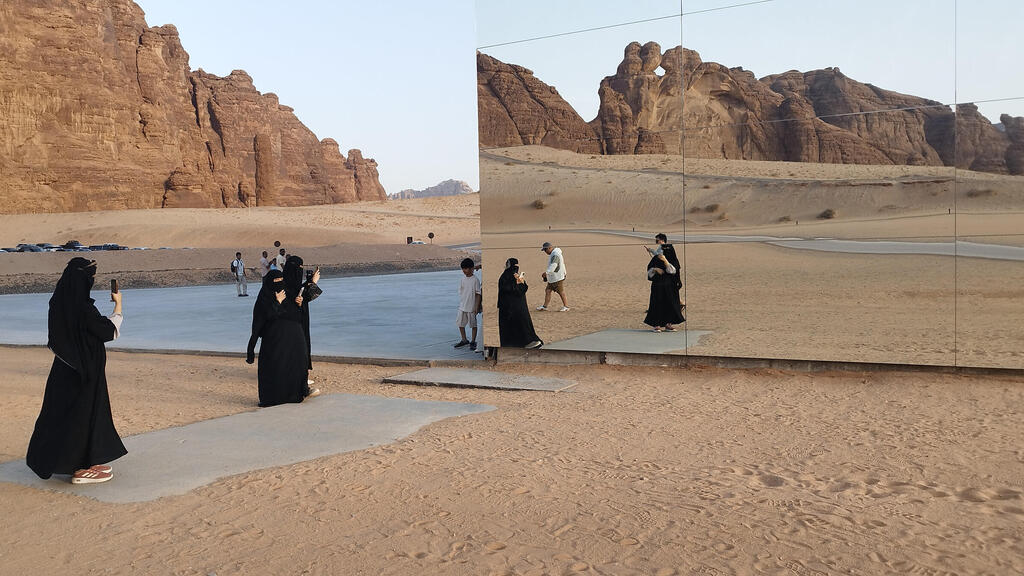
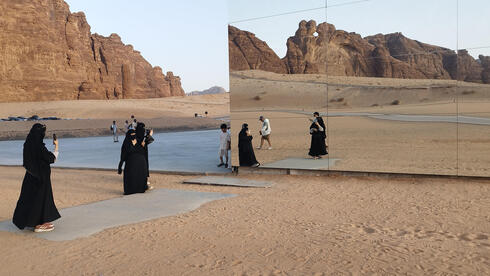
Visitors to Maraya, the innovative, mirror-clad concert hall built in the heart of the desert.
(Aviad Sar-shalom)
Earlier this summer, we traveled from the Asir region on the Yemeni border to Haql, from where Eilat is already visible. We also passed through Tabuk, whose airport had hosted the Israelis of the “Flydubai” flight this week. The journey offered a dramatic illustration of Saudi Arabia’s paradoxical nature, Israel’s potential ties with the Kingdom, and the complexities of the current Middle East.
Only at the end of the journey did we realize how little we actually knew about the country: its vast size, its power, and its influence across the Muslim world and its two billion adherents.
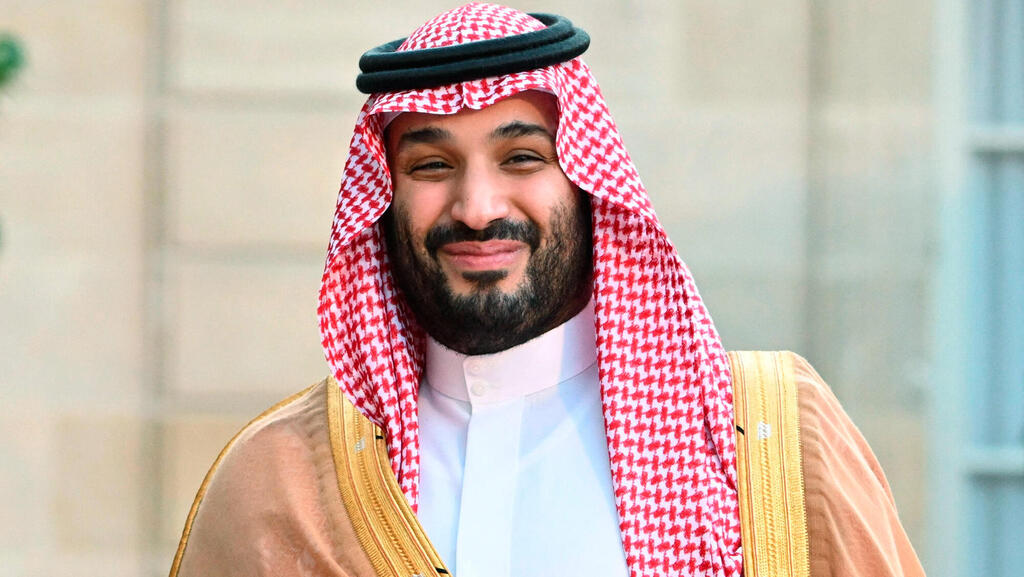
The Kingdom covers approximately 2.15 million square kilometers, roughly 100 times the size of Israel. Half of its 36 million residents are foreign nationals. Today, it serves as the testing ground for the ambitious economic and social experiment led by Crown Prince Mohammed bin Salman, known as MBS.
He is a leader with grand ambitions who must now navigate the war in Yemen, tensions with Iran, the oil market, and the prospect of normalization with Israel, a goal that constantly drifts in and out of reach.
From the villages and towns across the Kingdom, one can see the tension between the past and what Bin Salman seeks to build. Saudi Arabia is a land of balancing acts: how to connect remote communities, how to feed and provide livelihoods for a growing population, where to source the workforce, how to manage the flow of oil and gas, and how to transform the landscape and its heritage into engines of growth.
It is also a question of how to unleash civic aspirations in a controlled manner, how to keep everyone satisfied, and how far to allow change to go.
Yet the vision is colliding with reality.
In recent weeks, the Houthis have escalated the threat to Red Sea trade routes. They struck the oil pipeline that helps bypass the Iranian blockade at the Strait of Hormuz, while missiles have landed in cities and at oil facilities across the Kingdom.
Saudi Arabia, with its advanced, digital, high-tech dream, is being brought to a halt because an armed tribal force backed by Iran has decided to show the world who controls the Red Sea.
English is no longer enough. Neither is Arabic.
This is the era of the drone.
Along the routes we traveled, we encountered a remarkably well-organized country, even in its remote frontier regions. One of the symbols of “Saudi Vision 2030” is the NEOM project, which includes “The Line,” a futuristic city designed to stretch along a 170-kilometer urban strip.
The concept already exists in a different form across the Kingdom. Many of the small urban settlements we passed through are “street towns,” linear communities built along kilometers of shops with homes above them and no distinct town center.
Roads and commerce are the lifeblood of the Kingdom.
On the surface, nothing here has changed in the last 2,500 years. Yet everything has changed.
6 View gallery
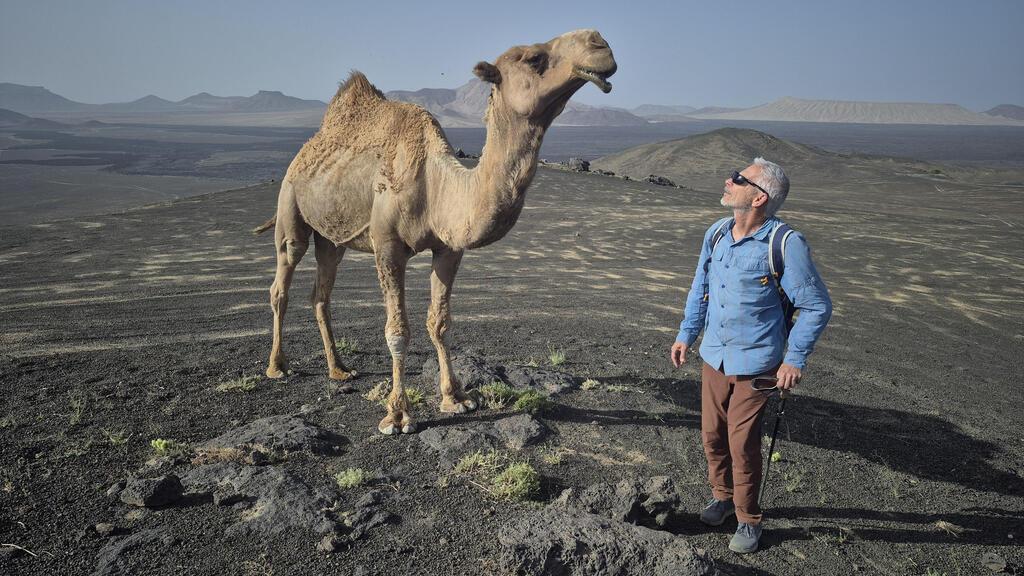
Aviad Sar-shalom and a camel at the mouth of the volcanic crater on the White Mountain (Jabal al-Bayda), east of Khaybar
(Tzur Shezaf)
The south: A kingdom within a kingdom
In Abha, the capital of the southern Asir province, it was hot even at an altitude of 2,000 meters above sea level.
These mountains had been calling to me for years. I visited Yemen in 2008, when the Houthis were threatening the Jews of the town of Houth and Yemen’s then-president, Ali Abdullah Saleh, sent helicopters to evacuate them to a hotel in Sana’a. Saleh was assassinated in 2017.
Yemen amazed me with its architecture, ruggedness, and religious zeal. Today, the Houthis control the Yemeni side of the border, occasionally launching missiles toward Israel and threatening global trade through the Bab al-Mandab Strait.
What is happening on the Saudi side of the mountains?
We got part of the answer right there in Abha.
The mobile phone serves as the bank, and renting a car was no trouble at all. Further along, we found well-paved roads, electricity and mobile reception, nothing like neighboring Yemen.
Abha has one main street. Flanking it are a lovely park and a seasonal river, channeled underground to prevent it from overflowing and flooding the area during the monsoon season. Restaurants and cafés line its path.
On weekends, families sit on the lawns. Married women wear veils, young women kneel in prayer, and the street fills with colorful vehicles arriving from surrounding towns.
There is no oil or camels in the Asir Mountains. Instead, they are watered by monsoon rains.
As we headed a few dozen kilometers south from Abha toward the Yemeni border, the tower houses lining the road grew taller. The houses here differ from those I saw in Yemen. They stand two or three stories high, are painted in earth tones, and feature small windows. Their soaring walls lack the magnificent Yemeni arches, yet each story is marked by black slate stones adorning the walls like small protective ledges.
“Those ledges,” explained Aviad, my travel companion, “are designed so that when monsoon rains wash over the mountains, they divert and drain the water away from the earthen plaster, preventing damage to the walls and the house’s foundations.”
Most tribespeople no longer live in these beautiful villages. They have left them for new homes made of concrete and plaster.
Down below, alongside the main road heading south, stalls had been set up.
“It’s an afternoon market,” one of the locals said. “It’ll be opening soon.”
There is logic to holding the market in the afternoon, as the sun begins to dip and the world fills with soothing shadows.
Traders gathered around a small truck carrying goats. A broker managed the transactions and hastened the deals, championing the livestock while trying to secure the best price.
The professionalism of Arab brokers, and their ability to keep the world moving and progressing rather than getting stuck with the goats, is sometimes underestimated.
We left the market and turned onto a side road where two stone towers stood overlooking a broad valley nestled between high mountains. Terraces crisscrossed the valley, where mountain communities cultivated barley, vegetables and khat.
A vehicle pulled up beside us. The driver eyed us suspiciously and asked where we were going.
I told him the tower had caught our eye. He asked if we had permits. I asked if he would allow us to take photographs.
“Where are you from?”
“Britain,” I replied.
“Impossible. You’re Arab,” he declared. “No Brit speaks Arabic the way you do.”
I laughed. I know Englishmen who speak Arabic better than I do.
“Are you Muslim? Then recite the Shahada!”
“There is no god but Allah, and Muhammad is the Messenger of Allah,” I answered.
“You are an Arab!” he concluded, and let us take photographs.
The blanket of Islam is spread across the land, and not just in Saudi Arabia. Almost everywhere Islam is found, if you speak Arabic, the person you are talking to may assume you are a brother, meaning a Muslim. And if you know the Shahada, that can serve as proof.
This was one of the few times during the trip that someone treated us with suspicion.
The Yemen border: “To hell with the Houthis”
In Wadi Lajab, where we met Khaled, we did not disclose where we were from. Since Saudi Arabia is not a liberal democracy, conversations with strangers are conducted with due caution. One must draw conclusions from what is visible and what remains unsaid.
The country emulates an American approach: as long as you do not break the law and conduct yourself according to local regulations, you enjoy a range of rights and services. If you do break the law, the penalties can be severe.
A decade ago, when Bin Salman took over the country’s administration from his father, a group emerged seeking a quiet regime change. Its members were arrested and tried, and some were executed.
If there is one lesson to be learned from the House of Saud, it is the combination of caring for the population, through healthcare, infrastructure, government services, education and employment, while suppressing criticism or any desire for change that does not originate from the top.
The royal family calls the shots. Everyone else, from technocrats to contractors, works for the King.
We left the wadi to the film crew.
The growing stream of visitors is the result of yet another initiative by the Crown Prince, whose influence is visible everywhere. Unlike in the past, women now drive, and many wear Western clothing in public.
I have no idea how tourists were received in the country a decade ago, but today they can obtain visas on arrival. The entry process is handled by a machine using a credit card and can be completed within minutes. A significant portion of the visa fee, about $140, goes toward health insurance covering visitors during their stay in the Kingdom.
The transformation in Saudi Arabia was palpable as we descended a steep concrete road toward an ancient village where new houses stood interspersed among traditional towers.
Below, an Ethiopian worker was tending to a coffee grove. It was here, and on the other side of the Red Sea in the Ethiopian highlands, that coffee began its journey to the rest of the world.
The coffee in Saudi Arabia is exceptional, whether at a gas station or a café. Poured from traditional pots into small cups, it has a distinctive, slightly acidic flavor.
We wandered through the grove for a while. As we emerged, a white pickup truck rolled toward us. Inside sat a young man who, we later learned, was named Abdullah.
“Where are you headed?” he asked.
“Just exploring,” I replied.
“Then come home with me. There’s plenty of room, and if you like, you can hike in the mountains and stay at my place.”
It was late afternoon, and our eyelids were growing heavy.
We joined Abdullah and stopped at a gas station with an adjoining supermarket. A liter of gasoline cost one and a half riyals there, cheaper than water.
He filled bags with fruit and vegetables: bananas from Ecuador, apples from Russia, and cherries from some other cool climate. None of the abundant produce on the shelves was grown in Saudi Arabia.
We stopped by a house. Abdullah opened an iron gate, and we entered the courtyard.
“I have the most beautiful view one could ask for,” he boasted. “This is the home I share with my third wife.”
His third wife. The others had homes of their own.
He peeled and sliced the imported apples and piled bananas and other treats onto a tray, while we stretched out for a nap on mattresses in the cool house.
Before leaving, he said to me quietly, “If you’re staying, leave the door open. But if you decide to move on, slam the door shut behind you.”
Once he had left, I said to Aviad, “Let’s keep going.”
Despite the warm welcome, I wasn’t sure how comfortable he was with us staying. We continued on our way, looking for a hotel in a town at high altitude, with clouds blanketing the land below.
Beyond them lay the border with Yemen, while to the west the sun was setting toward Jizan, on the shores of the Red Sea.
The slopes were filled with coffee plantations enclosed by high fences, and the locals refused to let us photograph them or enter the grounds.
The coffee vendor said he was from Sana’a and claimed the war in the neighboring country was not being felt.
“The border is open and everything is running,” he said.
And the Houthis?
“To hell with the Houthis,” he replied angrily. “No one likes them. They’ll fall eventually.”
Since then, however, the Houthis have only grown stronger, and news agencies have reported that Bin Salman was forced to ask U.S. President Donald Trump for assistance in the war against them.
When we asked what grew in the orchards nestled among the coffee trees, he looked at me with a smile and said quietly: “Khat.”
The mountains near Yemen are a kingdom within a kingdom. The tribesmen living in the area wear colorful galabiyas, drape black keffiyehs over their heads, and carry a jambiya, a short, curved dagger.
This is the place where the Arabian Peninsula shifts from the Kingdom of the House of Saud to a region shaped by independent Yemeni tribes.
“Is growing khat forbidden here?” I asked.
“It’s banned in Saudi Arabia, but there’s plenty of it in Yemen,” he replied.
6 View gallery
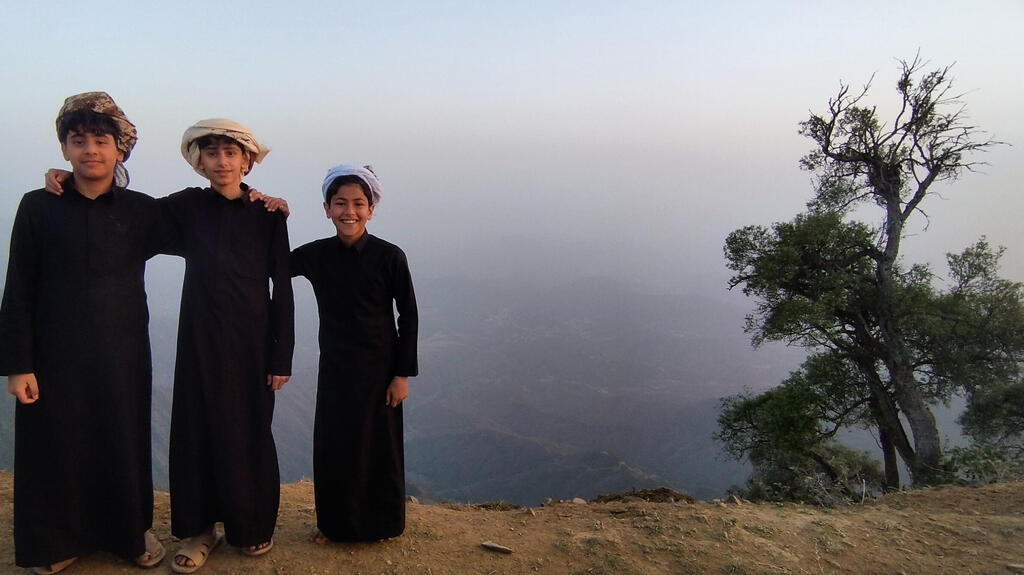
Three youths in the mountains of the Asir region, on the border with Yemen.
(Aviad Sar-shalom)
Medina and Khaybar: The Jewish shadow still lingers
Route 15 heads north from the mountains, following the path of an ancient caravan route that once crossed the peninsula from Yemen, wound through oases and ended at our Mediterranean coast.
For centuries, Arab tribes traveled along it, while others used it to flee the Romans and escape deep into the desert. It was in this way, seeking a measure of peace, that Jews also arrived in the region after the destruction of Jerusalem, fleeing their homes for the desert.
We drove for many kilometers along the modern, paved road until we reached Medina, Islam’s second-holiest city.
We parked about a kilometer from the Great Mosque and walked through neglected, treeless streets toward a magnificent boulevard. The walk from the poorer neighborhoods to the regal avenue highlighted the inequality: not everyone here has money, and in this country, not everyone is equal.
After a short walk, we reached the gates of the Prophet’s Mosque.
The oasis of Yathrib, renamed Medina, Arabic for “The City,” served as Muhammad’s power base. He is buried here, in the mosque whose vast, gleaming courtyard we entered.
The mosque has numerous gates. Beyond them lies a beautiful marble courtyard shaded by giant umbrellas. To the east, the entrance to the Prophet’s tomb was visible, though non-Muslims were politely turned away.
The throngs of visitors here, arriving from all corners of the Islamic world, usually come after completing the Hajj pilgrimage to Mecca. They appear radiant and smiling, moving among convoys of floor-cleaning machines operated by Pakistanis, Indian Muslims and Bangladeshis.
Eighteen million pilgrims arrive in the Kingdom annually, heading to Mecca and Medina, the beating heart of Islam.
From the Prophet’s tomb, we drove another 175 kilometers north along a desert highway, searching for traces of the place where our kin, the Jews of Khaybar, had once lived.
The town we reached via the highway interchange stretched along the road, much like most towns in Saudi Arabia. We drove through it looking for the old city, but when we arrived at what appeared to be an ancient settlement, we found the site closed.
Two police officers informed us that renovations were underway and photography was prohibited.
It was a fitting metaphor, for Saudi Arabia is deeply engaged in renovating its past and history, maintaining the present and planning for the future.
Date palm groves stretched out on both sides of the road.
This was Khaybar, a Jewish kingdom and Jewish stronghold on the Arabian Peninsula. Eight fortified cities once stood here. Muhammad and his men conquered the area, and their victory was so decisive that when the founder of Islam later arrived in Mecca, the Quraysh tribe, which ruled the city, converted to Islam and accepted him as the Messenger of God.
This is also the place invoked to this day by those who call for the destruction of the Jews: “Khaybar, Khaybar, O Jews! Muhammad’s army will return!”
With this thought in mind, we climbed the ridge and looked out over the oasis and its ancient, abandoned settlements.
After Muhammad and his successors converted or expelled the Jewish population, only Yemenite Jews remained on the peninsula for centuries, until their last communities in the region were also destroyed by the Houthis over the past decade.
The memory of the Jews still hovers over Khaybar, like smoke or a shadow.
6 View gallery
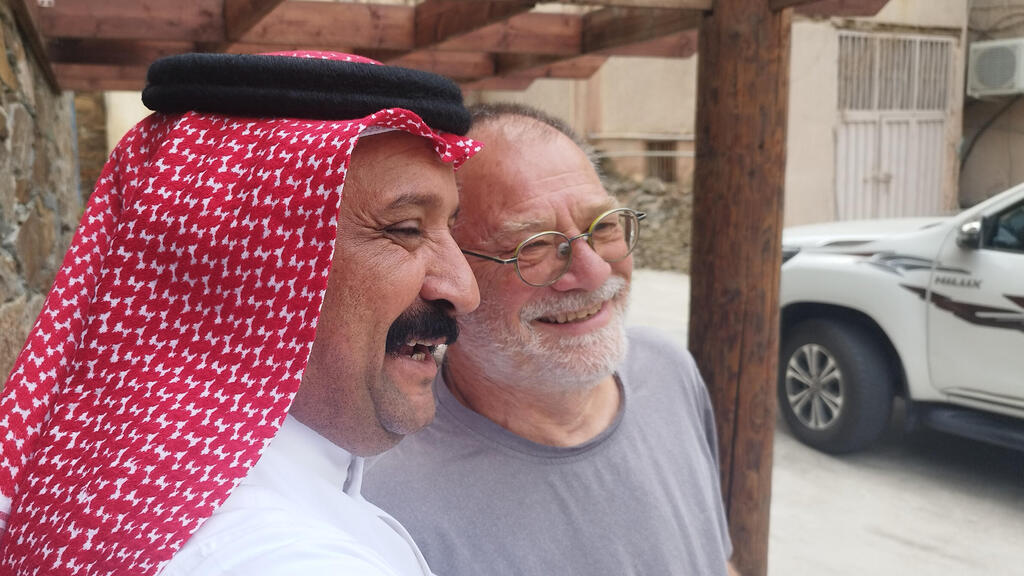
The author and a local resident during the journey from the Yemen border to the city of Medina.
(Aviad Sar-shalom)
Al-Ula: A concert for the truly wealthy
From the ruins of Khaybar, we drove east, deep into a desert that transformed into a volcanic plateau dotted with volcanic craters.
On these roads, the Kingdom feels vast and empty.
At night, we found a large pool of water beneath the road. We descended to its edge and spread out our mattresses under a star-filled sky. We rose before the intense heat set in and went down to swim in the waters beneath the basalt columns.
But to truly grasp the roots of the Saudi transformation, one must continue the journey to Maraya Hall.
It is a place of innovation, ambition and precision, a site that reflects the natural world while seamlessly blending into it.
The Saudis call the area Al-Ula, meaning “The First,” referring to it as the first city of Arabia.
Here, too, residents were displaced from the city’s ancient heart, and the area was transformed into a reserve featuring hotels, shops and restaurants built southwest of the Nabataean tombs and the other remnants of the oasis that had sustained the community for generations.
As elsewhere, we witnessed ancient history being displaced and then reconstructed to suit a specific narrative.
The Saudis have transformed Mada’in Saleh, the nearby archaeological site, into a centerpiece of the Arab past. The visit is well organized and streamlined: tickets must be booked in advance, and the number of visitors is limited. The guides speak English and Arabic and possess impressive knowledge.
More recent history is also preserved here.
Railway stations left behind by the Ottoman Turks, who built the Hejaz Railway line 120 years ago, have been transformed into mini-museums commemorating the historic route from Damascus to Mecca. The section running through the Land of Israel was known as the Valley Railway.
Currently, Saudi Arabia and Turkey are advancing plans to revive the line and create a direct overland route to Europe, thereby reducing reliance on the Straits of Hormuz and Bab al-Mandab, both vulnerable to threats from Iran and its Houthi proxies.
The only open question is whether the train will once again reach Haifa. For the time being, the Turks are not particularly keen on the idea.
Al-Ula is surrounded by red sandstone mountains, towering rock pillars, magnificent arches, sandy valleys and spectacular canyons.
In one of these, Ashar Valley, lies an extraordinary project: Maraya, the “House of Mirrors.”
It is a concert hall rising from a sea of sand, featuring exterior walls that reflect the surrounding mountains and towering cliffs.
This is a place worth traveling to Saudi Arabia for in its own right, and it perfectly embodies the Crown Prince’s ambitious and intriguing Saudi Vision 2030: spectacular, mesmerizing and unique, while simultaneously blending into the landscape and standing apart from it.
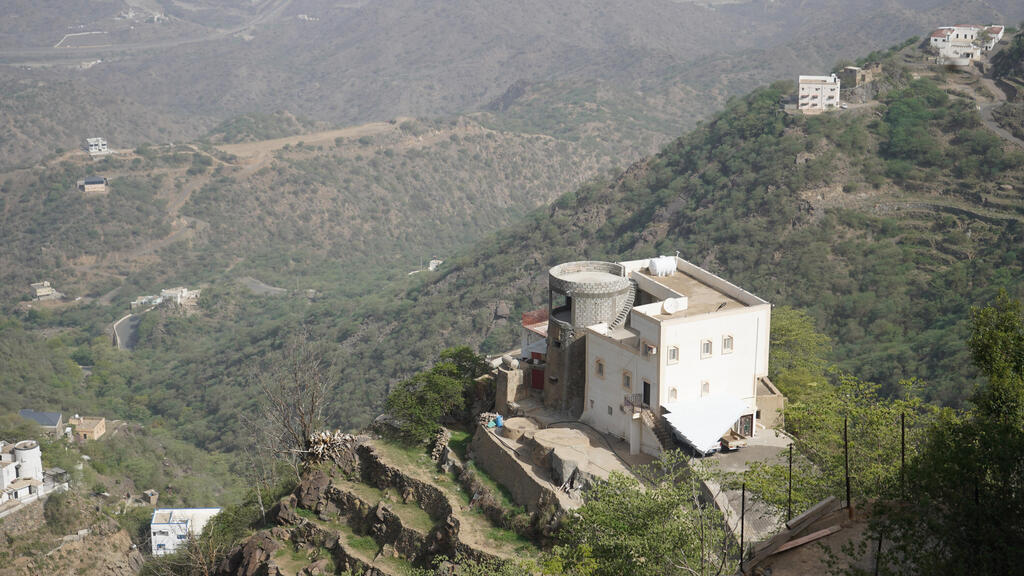
The north: Distant yet close
From Al-Ula, the ancient caravan route climbs northward into a land of red mountains, sandy wadis and oases interspersed with seasonal stream beds.
The highway continues to Tabuk, the major city of the north. It was there that a Flydubai flight landed the previous day, after what appeared to be a hijacking attempt was thwarted by the quick thinking of passengers.
The handling of the emergency also illustrates the potential for cooperation between Jerusalem and Riyadh.
Today, the entire region is overshadowed by the NEOM project, intended to realize Bin Salman’s vision. The Crown Prince aims to link this massive undertaking to Africa and perhaps, someday, to us as well.
In the meantime, some of these ambitious plans have been scaled back, and the conflict with Iran has added another layer of uncertainty.
While the Kingdom seeks to attract tourists and new investment, it still relies heavily on oil revenues.
Ultimately, Bin Salman’s approach appears practical, dynamic and utterly dispassionate. He holds all the cards, and the vast wealth is not earmarked for squandering but for prudent management, reserved for the time when the Kingdom truly needs it.
The royal family seeks to break free from present troubles and plan for the future, yet the present refuses to stop hounding it.
The shores of the Gulf of Eilat, which filled the view from the windows as we drove north, were becoming a familiar sight by then.
It was in these mountains that Lawrence of Arabia lay in wait for Ottoman trains and, leading his Bedouin army, captured Aqaba.
Sands blanket the history.
The border town of Haql spread out before us. It is not large, boasting a few seafood restaurants, a beach where swimming is permitted and two police cruisers.
There is a border.
The next day, we took a taxi to Aqaba and from there to the crossing into Eilat.
Three countries in less than two hours.
So far away, yet so close.



