










Opinion
The only country iterating DefenseTech under fire - Israel celebrates 78 years of independence
"Traditional militaries learn between wars. Israel is learning between iterations of the same war. Systems here do not just reach product-market fit. They reach battle-fit," writes Alex Shmulovich, a Partner at Viola Ventures.
As Israel celebrates its 78th Independence Day, its defense is not defined by static strength, but by continuous adaptation.
In April 2024, Iran launched one of the largest aerial attacks in modern history against Israel. Hundreds of drones, cruise missiles, and ballistic missiles in a single coordinated salvo. The lesson was clear: mass, cheap, and distributed systems can overwhelm even the most advanced defenses.
Two years later, that lesson is no longer theoretical. It has already been iterated on. Iran shifted from single-night saturation attacks to sustained, multi-week campaigns. Over a thousand ballistic missiles. Continuous drone pressure. Mobile launchers buried and recoverable. The pace of engagement shifted from shock-and-awe to continuous, adaptive warfare.
Israel adapted accordingly. Interception systems improved against drone swarms after facing over a thousand UAVs. Air defense doctrine evolved from pursuing perfect interception to real-time threat prioritization across layered systems. Offensive capabilities shifted toward preemption, targeting launchers and supply chains before strikes materialize.
This is what compressing the defense innovation cycle looks like. Traditional militaries learn between wars. Israel is learning between iterations of the same war. Systems here do not just reach product-market fit. They reach battle-fit.
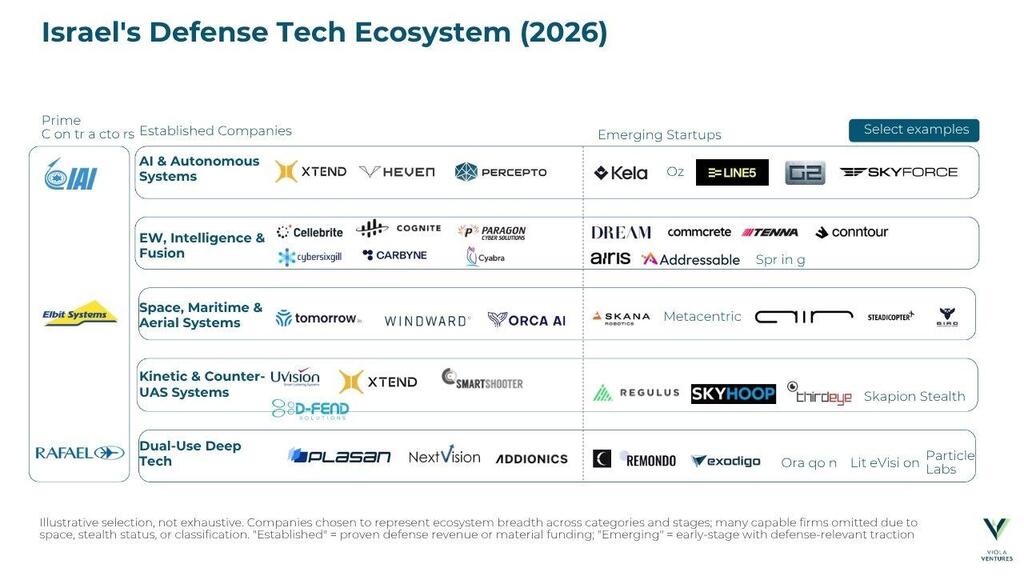
That compression sits on top of an ecosystem that has been building in layers for decades. At the foundation are the primes: Rafael, IAI, Elbit. They built Iron Dome, Arrow, Trophy, the F-35 helmet-mounted display. They remain the engineering bedrock and have produced thousands of systems engineers. On top of them, a middle generation of companies like UVision and NextVision grew into established global defense exporters, proving that Israeli companies outside the primes can win international procurement. What is new is the third layer: a wave of defense tech startups whose founders are beginning to converge in ways we have not seen before. They combine cloud and AI-native engineering, deep operational experience from military service, and world-class systems engineering inherited from the layers beneath them.
Many spent the years between military service and founding in VC, consulting, high-growth startups, and finance, bringing that speed and product discipline to a sector built on decade-long cycles.

Tenna Systems shows how these layers converge. Founders with deep operational experience and ELINT engineering from the primes built a hardware-free spectrum intelligence platform that maps the electromagnetic battlefield in real time - no sensors, no antennas. Within 18 months they had US Army and US Air Force contracts. They are now layering cloud and AI-native leadership on top of that operational core. Operational depth first, then cloud-native scale - that is the pattern this ecosystem is producing.
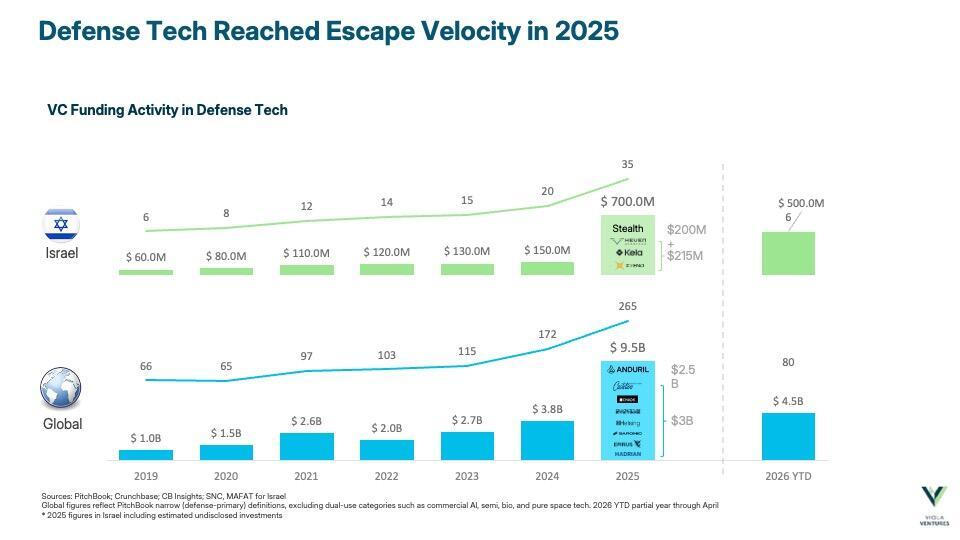
Kela tells a similar story. Alon Dror, Talpiot, MAFAT and Stanford graduate, partnered with Hamutal Meridor who managed Palantir Israel and was a partner at Vintage Investment Partners, raised $100 million in their first year and deployed his product within seven months. Line5, founded by Redis co-creator Yiftach Shoolman, raised the largest defense seed round globally in 2025.
The domains where these companies are building reflect what the current wars exposed. Saturation attacks created demand for cheaper countermeasures and autonomous threat prioritization. The collapse of the line between frontlines and depth - from Hezbollah drone penetrations to operations launched from inside Iran itself - created demand for systems that operate without GPS, without stable communications, and without centralized control. The shift from episodic warfare to continuous campaigns created demand for persistent operations and contested logistics.
Israeli startups are already building in those gaps. In maritime autonomy, Skana Robotics and a few other companies in stealth are building unmanned surface and underwater vehicles. In energy resilience and supply chain security, new companies are emerging around infrastructure that must operate under sustained attack. And at least one Israeli company is developing a kinetic weapons platform so quietly that it does not appear on any public list, yet it has already raised significant capital and produced results that have drawn serious attention from Western militaries.
But the innovation is not only on the battlefield. Israel’s “war between wars” - the continuous campaign against terror networks, financing, and hostile intelligence - has produced its own technology layer. Cellebrite, now a public company generating close to $500M in annual revenue, became the global standard for digital forensics in fighting crime and terrorism. Paragon and Carbyne were both acquired in the past year at valuations between $625 million and $900 million. The next chapter is already forming. Addressable is leveraging blockchain intelligence to counter terror financing, recently hired an executive who spent 15 years helping turn Cellebrite from a single hardware product into a global platform. That kind of talent movement - from proven scaled companies into early-stage defense tech - is exactly the convergence this ecosystem needs.
These companies are part of a rapidly growing ecosystem of over 300 startups, accounting for close to 4% of Israel’s total tech funding in the last 12 months.
Ahead of Israel’s 78th Independence Day, Viola Ventures published its Israel DefenseTech Leaders list - over 70 founders, executives, government officials, and ecosystem leaders shaping the category. Many more deserve to be recognized. Some cannot be named. Others are still building quietly, and their time will come.
The feedback loop between battlefield and product, between operational need and deployed capability, is measured in months here. Not years. Not decades. This is not just about building better systems. It is about building a different kind of resilience, one that is tested, refined, and proven in real time.
Alex Shmulovich is a Partner at Viola Ventures.



