









"Today, drones seem like a given. In October 2023, they were almost nowhere"
After witnessing the drone shortage on the front lines and losing his brother Eitan in Lebanon, Udi Oster is building the technology he believes could change future battles.
On October 8, 2023, while IDF soldiers were fighting Hamas terrorists who remained in Israeli territory on kibbutzim and on roads around the Gaza Strip, Udi Oster, now CEO of drone company Aitan (formerly eyesAtop), met a reservist he had never encountered before. “He arrived at the intersection where I was waiting in a shabby uniform, just a few hours after being drafted, and I was there with a bag containing two private drones I had at home that I was supposed to give him. I don’t even remember who connected us, but it was the day after the massacre, and any drone that could reach the battlefield had to get there.”
This meeting, brief, anonymous and on the side of the road, became Oster’s (38) entry point into the drone industry. “Suddenly everyone realized that if a fighter has a surveillance drone, he can see a kilometer ahead and understand where the terrorists are. Even if he has a drone that he buys from a technology store like Bug or KSP, it changes the battle. And suddenly you ask yourself: How can he not have one?” he recalled in an interview with Calcalist.
And how could that really be?
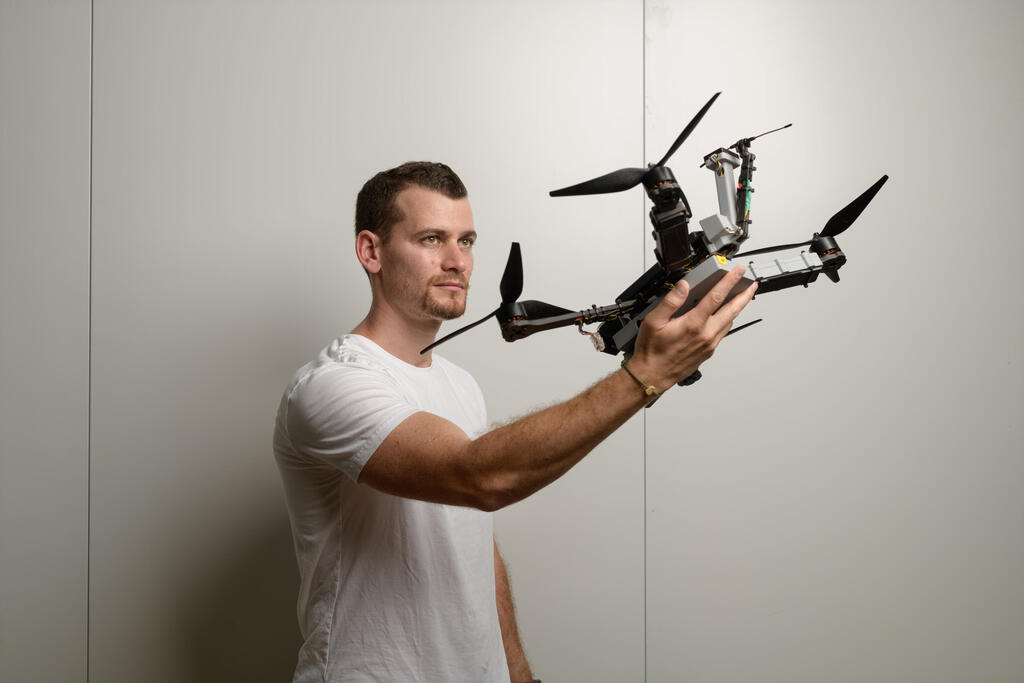
“It’s unclear. Today, drones seem like a given, but in October 2023 they were almost nowhere to be found. One of the things that shocked me the most, the biggest shock, was realizing how many simple things were missing from units in the field. This is not futuristic technology, but a product you can buy in a store. You see how a simple civilian drone provides any unit with a significant operational capability, and then you ask yourself how this wasn’t already part of the system.”
Transferring his two private drones to a reservist who took them to the front lines was only Oster’s first move in the field. Immediately after the war broke out, Alon Dror, now CEO of security startup Kela, approached him and asked for help bringing drones into Israel that wealthy Jews in the United States wanted to donate. “Alon was brought in by the IDF to organize the donations that were flowing chaotically from the United States, and he set up a task force that operated in the Sarona complex in Tel Aviv. Flights were being stopped, it wasn’t clear which military units needed drones most urgently, and donors also didn’t know where to direct their efforts,” Oster says.
The solution the Israelis found was improvised but effective: Volunteers in the United States gathered equipment worth millions of dollars in Florida, Washington and New Jersey, but since it could not be shipped through regular channels, liaisons sent to airports across the U.S. asked travelers heading to Israel who agreed to help to take black Pelican cases containing drones intended for combat units onto their flights.
“We would photograph their passports, record who was taking what, and send the details to Ben-Gurion Airport. Then we would wait for these people in Israel and collect the equipment from them. That’s how the first shipments arrived,” he says. “All the military units wanted drones, and each one tried to obtain drones with thermal imaging capabilities by any means possible.”
IDF commandos didn’t have drones? After all, they are used in almost every episode of “Fauda.”
“Soldiers in the field did not receive drones, at least not in numbers appropriate for a war, because the IDF’s perception over the years was that there would be no large-scale maneuvering and that there was no reason to direct significant budgets toward this area. The money was allocated to defense and strategic objectives.”
How many drones do you estimate arrived in Israel during the two months that this commando unit was operating?
“Between 3,000 and 4,000. That sounds like a lot, but it’s actually not, because drones are a type of ammunition. They are not disposable, but they are consumable and are lost frequently.”
Who decided which units would receive drones, what type they would get and when?
“Some donors wanted to send drones to specific units, but most of the equipment was distributed among different units according to instructions from the IDF’s Planning Directorate.”
"The company's slogan is 'making sure that the IDF will always have the advantage'"
Almost three years after those crushing days, drones have become one of the most common and sought-after means of warfare in the IDF arsenal. But Oster's story reveals how wide the gap was between the IDF's capabilities on October 6 and the new reality that emerged a day later.
Today, Oster leads a startup that develops a unified operating system for drones of various types. The company is currently raising $15 million, including from a former OpenAI executive, and its advisors include Shaul Mofaz, former IDF Chief of Staff and Defense Minister. A few weeks ago, the company, together with Kela, one of the hottest Israeli startups in the defense-tech field, won a major IDF drone tender.
The deliberate disruption in the company's name hints to investors and customers that its technology makes use of AI, but it also carries a personal and painful meaning: the company was renamed in memory of Oster's brother, Eitan, who was a team commander in the Egoz unit and was killed in battle in Lebanon in October 2024. Today, Oster is convinced that if his brother and the team he led on the day he fell had drones, the battle in which Or Mantzur, Itai Giat, and Nezer Itkin also fell could have ended differently.
What could and should have been different?
"I can't say what the battle in which they fell would have looked like if they had more resources, but I know that today there are technologies that can change such battles. In that specific battle, IDF fighters were at a disadvantage in terms of resources. The area where they operated was covered in heavy fog, preventing aircraft and helicopters from assisting them, while armored vehicles such as APCs and tanks could not accompany them because of the terrain. That is why our slogan at the company is: 'to ensure that IDF soldiers never end up in a fair fight, but always have the advantage.'"
Today, Oster knows the field well, but before the war he operated in a completely different world. Shortly before completing his military service in Unit 8200, he met Daniel Almog, a new immigrant from the United States, and in 2014, at the age of 26, the two founded a startup called Tapingo. The company developed an online food ordering and management platform similar to Wolt, and in 2018 it was sold for $150 million to American delivery giant GrubHub.
"Almost immediately after the sale, the coronavirus broke out and the business flourished, and we even started thinking about how we had sold it so 'cheaply,'" Oster laughs. But after the initial excitement around fast food delivery faded, he found himself bored working for a large American company.
"It was very comfortable, but after a year I realized that the organization didn't appreciate how passionate I was about Israel. They told me, 'Where are you running? Calm down,'" he says. After proposing an efficiency plan that was rejected, he realized he wanted to pursue a new path.
After leaving GrubHub with Almog, they founded Zetz, a company focused on international logistics and supply chain management, but the venture was short-lived. Shortly after the company was founded, Hamas launched its surprise attack, and almost all of the company's employees were drafted into reserve duty.
One of the company's veteran employees, who had worked with Oster since the Tapingo days, was Or Levy, who was kidnapped to Gaza from the Nova music festival, while his wife, Einav, was murdered (more on that later).
"Our system allows two drone operators to work together"
The following year was chaotic, but after the fighting on some fronts began to calm down, Oster realized that the extensive knowledge he had gained in the drone field could become the foundation for the next stage of his career.
He and Almog met with representatives from about 15 Israeli companies involved in different areas of the drone industry and eventually arrived at eyesAtop, "a small company from Tirat Carmel with seven employees, founded by Yinon Atzmon, Idan Yitzhak, Ben Barkay, and Einav Harazi, but also with a working product that had already been sold to the IDF."
4 View gallery
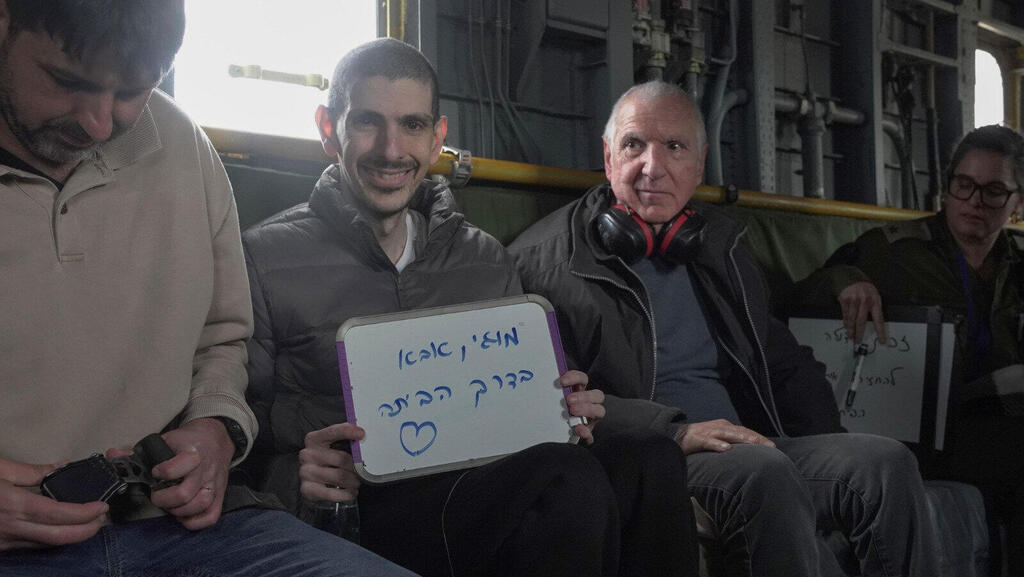
Or Levy on the day of his release from Hamas captivity in February 2025
(IDF Spokesman Office)
"I remembered hearing from fighters that they wanted drones with the 'Ronen' system. We didn't yet know what that meant, but then we discovered that it had been developed at eyesAtop back in 2017."
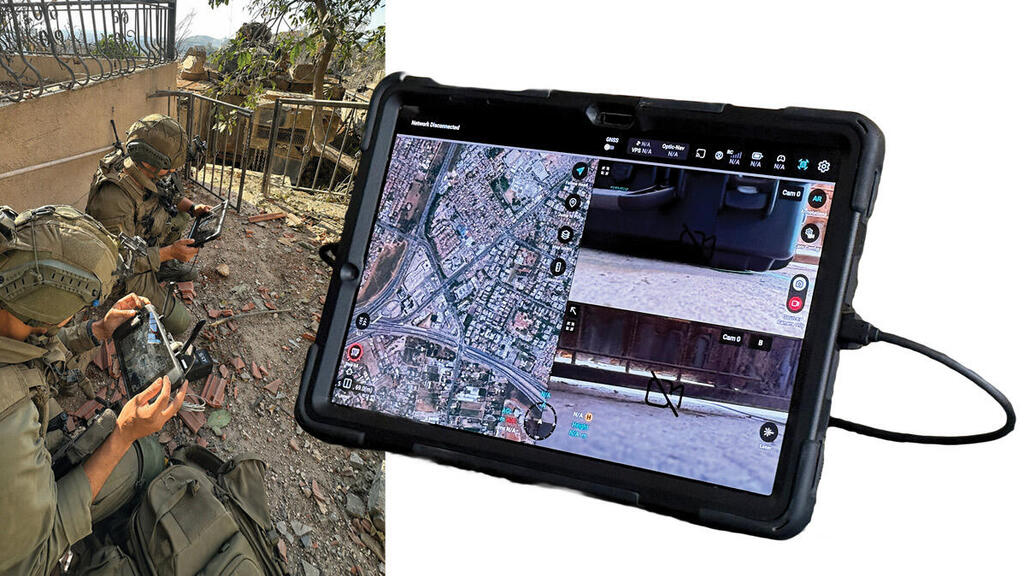
Ronen, they discovered, is a unique operating system that allows users to control different types of civilian and military drones through a single platform.
In March 2024, the two invested $1 million in the company. They took it over in September 2025 and since then it has grown rapidly, with Oster and Almog serving as co-CEOs. Today, the company employs 50 people at its offices in Ramat Gan, generates tens of millions of dollars in annual sales.
How does your system help soldiers in the field?
"We realized that in the future there will not be a single drone, but many different types of drones from many companies. The question is how you give a soldier one system that knows how to operate all of them.
"What we are trying to do is bring capabilities that exist today in Zik (an intelligence-gathering and attack drone manufactured by Elbit) down to the company level.
"I'll give you an example: if a reconnaissance unit identifies a terrorist and wants to neutralize him, until now it required coordination directly with the Air Force. Our system can direct a suicide drone toward that terrorist, even from a reconnaissance drone.
"In addition, it allows soldiers to track targets, for example, a terrorist moving from house to house, while simultaneously watching a recording showing what that terrorist did beforehand.
"Our system also allows two drone operators to work together. When two people are looking at the same battlefield cell at the same time, one operating a drone carrying grenades and the other operating a drone directing it, it is difficult for them to explain to each other what they are seeing.
"Our system is like clicking the screen-sharing button on Zoom. Everyone sees what they need to see together."
There are companies much larger than you investing heavily in this market, including Anduril, Ondas, and Xtend, which is preparing to go public on Wall Street at a valuation of $1.5 billion. How do you compete?
"That's true, but since October 7 there has been a major blue ocean in drone technologies, and not enough has been done until now.
"Today, the IDF's most significant mission drone is manufactured in the United States, and now we are replacing it.
"The major challenge is that the body purchasing the equipment is not necessarily the body using it in the field. After October 7, the IDF became much more aware that procurement bodies need to understand operational needs and stay close to the soldiers who will actually use the systems, and that gives us an advantage.
"One of the challenges in this field is that you cannot purchase drones as part of a multiyear plan and store them like mortar shells, because in two weeks there will be a better drone.
"Beyond that, there is the issue of reservists. You train them today on a certain drone, but by the time they use it, years may have passed and the drones could be completely different. Our system ensures that their knowledge is preserved because the operating system remains unchanged."
How big can you grow?
"Today, there are three companies that receive most of the IDF's procurement, Elbit, Rafael, and Israel Aerospace Industries, but there is a huge market in Israel for additional players that can capture a significant portion of defense budgets.
"If the IDF needs 200 mission drones at a cost of $200,000 per drone, that's already a potential market of $20-30 million. In addition, the army needs drones for border defense, which is another market worth millions.
"And beyond that, you have to remember one thing: drones crash."
"At Eli (a religious pre-military preparatory academy), I was almost the only one who grew up in a pluralistic environment"
Oster grew up in Maccabim-Reut in a religious Zionist family and today lives in Ra'anana with his wife and four children. As a child, together with his twin brother, he was sent to study at the prestigious Lev Institute boarding school in Jerusalem, where his older brother and sister had also studied. The institution was very different from what was customary in religious society because of the diversity of its students: religious, secular, Muslim, and Christian.
Contrary to his parents' expectations, he was not an outstanding student. "Actually, my twin brother was the one who was accepted to the boarding school because he is the genius who later went on to the Talpiot program and now works in the Prime Minister's Office. They didn't accept me, but my father told them we were a package deal and that if they didn't accept me, my brother wouldn't come either. That's how we ended up studying there," he laughs.
What did you focus on?
"I started out as an art major, but my father quickly told me that if I was having fun and everything came easily to me, it probably meant I wasn't studying enough, and that I needed to switch to physics and computers. I graduated with a score of 36 in my physics matriculation exam and dreamed of being drafted into a combat unit. To get closer to that goal, I went to the Eli religious pre-military preparatory academy."
Eli was already considered a controversial institution at the time, with some of its rabbis making racist statements and encouraging students to adopt a messianic and militant worldview. Oster, by contrast, came from a family with more pluralistic views.
It's hard not to wonder what you were thinking when you decided to study there.
"I was an oddball there because, to them, I was almost secular. My parents are very intellectual, and it was always clear to me that there was an option to rely on rabbis to tell you what was right, but there was also another option: to consult professionals, while understanding that the responsibility and decisions were ultimately yours.
"This was reflected in simple questions, such as whether to eat legumes on Passover, and in much more complex questions, such as where was God during the Holocaust. For Eli, it was a fascinating experience to have me there because I was almost the only one who had grown up in a pluralistic environment and could explain how the other side thinks.
"But in the end, I didn't stay there long because I was recruited into Unit 8200, where I specialized in identifying security vulnerabilities."
After returning to the unit following an officer course, and right as the Second Lebanon War broke out in 2006, he realized that even his perception of Israel's military strength was quite different from the reality revealed on the ground.
"I remember that we received Hezbollah communications equipment captured in Lebanon in order to examine and hack it. One day, we discovered a huge folder containing MP3 files with countless recordings of IDF communications, including encrypted communications. It made me realize that they had been preparing for war for years and that they were much more sophisticated than we had assumed," he recalled.
Tragically and ironically, it was precisely the organization whose capabilities Oster learned to appreciate during his military service that would years later be connected to his brother's death.
"It was the eve of Rosh Hashanah in 2024, and I was making meatballs for the holiday dinner that was supposed to take place at our home in Ra'anana. My father, who almost never calls anyone unless he accidentally sits on his phone, called me. Because my hands were covered with meatball mixture, I answered with my elbow, and he told me, 'I don't have an easy way to say this - Eitan was killed. Come home quickly.'
"Unlike the rest of my family, until that moment I was still in a healthy state of denial," he says.
"Or knows we're waiting for him. There's an office here reserved for him."
As mentioned, this was not the first tragedy Oster faced during the war. A few days after October 7, while working as part of the drone import task force, he learned that Or Levy, with whom he had worked for years, was missing after attending the Nova music festival, while Levy's wife, Einav, had been murdered there.
He immediately formed another task force with the company's employees who had not been drafted into the reserves, dedicated to gathering every piece of information that could help determine what had happened to him.
"Or was not just an employee; he was a central figure in the company, a significant engineer, and someone who was well known in the United States, where he was involved in our business activity," Oster says.
"There were technical people in the company who tried to check everything possible, to figure out when he last logged in, where his phone was, how to access his Google account, and go through information that came from the internet. People traveled south, searched for information, watched videos, and tried to connect the dots.
"You understand that you are in the middle of an event that you have no real way of controlling, so you look for every small thing you can do. We realized that until the IDF began systematically tracking every person to determine who had been kidnapped and who had been killed, it would take time, so we had to act ourselves.
"After a week, we went to Einav's funeral. Two weeks later, we received confirmation that Or had been kidnapped to Gaza, and later we were informed that he was alive."
Did you meet him immediately after he was released in February 2025 with Eli Sharabi and Ohad Ben Ami?
"Of course. The meeting was almost surreal. You are used to talking about someone for so long as someone who is somewhere else, and suddenly he is standing right in front of you."
Do you continue to see each other?
"Yes, we are on good terms. He comes by occasionally, but he is not working today. Right now, he is focused on his rehabilitation and spends most of his time with his son.
"He knows that we are always waiting for him. We have an office here reserved for him."



