










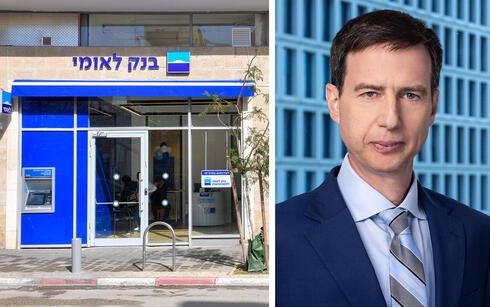
Bank Leumi posts record NIS 3 billion quarterly profit as rivals lose momentum
The bank's third-quarter earnings rose 10.6% year over year and 5.4% from the previous quarter. But declining net interest income and a narrower financing margin point to pressure on its core business.
Bank Leumi increased its profitability in the third quarter of 2026, bucking the trend among several other Israeli banks that have reported lower profits compared with the previous quarter. The lender, led by CEO Hanan Friedman, posted net income of NIS 2.99 billion ($979 million), up 10.6% from NIS 2.7 billion ($881 million) in the same quarter last year. It was the highest quarterly profit reported by an Israeli bank so far this earnings season.
The results represented a return on equity (ROE) of 16.9%, compared with 16.3% a year earlier. Profit was also up 5.4% from the NIS 2.83 billion ($925 million) recorded in the second quarter. This contrasts with the results reported by Bank Hapoalim, First International Bank and Bank Yahav, all of which recorded lower profits than in the preceding quarter.

The reported results were affected by the special tax levy imposed on banks and by income recognized following an adjustment to the bank's estimated deferred tax liability. Leumi's press release said that excluding the special tax alone, third-quarter net income would have reached NIS 3.3 billion ($1.1 billion), with ROE of 18.5%, rather than the reported 16.9%.
A separate calculation that also excludes the income from the deferred-tax adjustment puts third-quarter net profit at NIS 2.94 billion ($961 million), compared with NIS 2.9 billion ($948 million) in the corresponding quarter last year, an increase of approximately 1.6%. On that basis, return on equity fell to 16.6% from 17.5%. The different figures reflect different adjustment assumptions and should not be treated as interchangeable. Taken together, they show how the tax-related effects influenced the headline results, while underlying profitability remains under pressure.
Net interest income, traditionally a key source of earnings for banks, declined following interest rate cuts by the Bank of Israel over the past year. Leumi reported net interest income of NIS 4.27 billion ($1.4 billion) in the third quarter, down 4.5% from NIS 4.47 billion ($1.46 billion) a year earlier. Compared with the second quarter, when the figure reached NIS 4.57 billion ($1.49 billion), the decline was NIS 300 million ($98 million).
The pressure was also reflected in the bank's financing margin, which fell to 2.06% from 2.42% in the same quarter last year. The margin measures net interest income relative to interest-bearing assets. Its decline indicates that the expansion of the bank's credit portfolio has not fully offset the pressure on income from interest.
With interest income weakening, Leumi has increasingly relied on other revenue streams. Non-interest income rose 10.3% to NIS 1.64 billion ($536 million) in the third quarter, compared with NIS 1.49 billion ($487 million) a year earlier. Commission income increased by 17.3% to NIS 1.15 billion ($376 million), driven in part by an expansion in business activity and greater customer activity in securities. Despite the increase in non-interest income, total revenue edged down to NIS 5.92 billion ($1.94 billion) from NIS 5.96 billion ($1.95 billion) in the corresponding quarter.
One of the bank's main growth drivers has been its expanding credit portfolio. At the end of September, net credit to the public totaled NIS 586.1 billion ($191.3 billion), up 18.3% from NIS 495.4 billion ($161.7 billion) a year earlier. Since the beginning of 2026, the portfolio has grown by 12.7%, exceeding the bank's annual target of 8% to 10%.
The bank's latest figures show that corporate lending has been the main driver of this expansion. Corporate credit reached NIS 199.2 billion ($65 billion) at the end of September, up 25.4% from NIS 158.9 billion ($51.9 billion) a year earlier. Leumi said corporate credit had grown by 20.5% since the beginning of the year, primarily in the national infrastructure sector.
Credit to the middle market totaled NIS 75.4 billion ($24.6 billion), up 12% from NIS 67.3 billion ($22 billion) a year earlier. Lending to small businesses reached NIS 30.1 billion ($9.8 billion), an increase of 8.1% from NIS 27.9 billion ($9.1 billion). The bank said its commercial portfolio had grown by 9.1% since the start of the year.
Mortgage lending totaled NIS 167.2 billion ($54.6 billion), up 8.5% from NIS 154.1 billion ($50.3 billion) a year earlier. Leumi said its mortgage portfolio had expanded by 6.7% since the beginning of the year. Credit to retail customers reached NIS 32.9 billion ($10.7 billion), up 5.6% from NIS 31.1 billion ($10.2 billion) a year earlier.
The expansion of lending has also brought higher provisions for credit losses. Leumi recorded credit loss expenses of NIS 184 million ($60 million) in the third quarter, compared with NIS 32 million ($10 million) in the same period last year. For the first nine months of 2026, the figure reached NIS 642 million ($210 million), more than double the amount recorded in the corresponding period of 2025.
The bank attributed the increase primarily to higher collective provisions, reflecting the growth of its credit portfolio. It said the third quarter marked the 11th consecutive quarter in which all provisions were collective, while specific provisions generated income. The non-performing loan ratio stood at 0.43%, according to the press release.
Another factor supporting Leumi's profitability has been its ability to contain operating costs. Operating and other expenses totaled NIS 1.54 billion ($503 million) in the third quarter, down from NIS 1.61 billion ($526 million) in the same period last year. The bank's efficiency ratio improved to 26% from 27%. Leumi attributed the improvement, among other factors, to its investments in technology and artificial intelligence. Personnel expenses, including salaries and related costs, fell 1.7% to NIS 843 million ($275 million).
For the first nine months of 2026, Leumi recorded net income of NIS 8.16 billion ($2.67 billion), up 5.8% from NIS 7.71 billion ($2.52 billion) in the same period last year. The bank maintained its full-year profit target of NIS 9 billion to NIS 11 billion ($2.94 billion to $3.59 billion), alongside a projected return on equity of 13.75% to 15.25%. These targets had previously been revised following an increase in the special tax levy imposed on banks. Leumi estimated that the levy cost it approximately NIS 831 million ($272 million) in the first nine months of the year.
The bank is also returning a substantial portion of its earnings to shareholders. Its board of directors approved a distribution of approximately NIS 1.5 billion ($490 million), equivalent to 50% of third-quarter net income. Of that amount, approximately NIS 1.2 billion ($392 million) will be paid as a cash dividend, while the remainder, approximately NIS 299 million ($98 million), will be used for a share buyback program.
Leumi's deposits from the public totaled NIS 739 billion ($241 billion) at the end of September, up 15.3% from NIS 641.1 billion ($209.3 billion) a year earlier. Shareholders' equity increased 6.6% over the same period to NIS 71.4 billion ($23.3 billion), from NIS 67 billion ($21.9 billion).
The bank's Common Equity Tier 1 capital ratio stood at 11.38%, down from 12.33% a year earlier, while its total capital ratio declined to 14.15% from 14.87%. Its liquidity coverage ratio stood at 120%.
Over the past 12 months, Leumi shares have gained 12.6%, outperforming the banking sector index, which rose 7.4% over the same period. The bank's market capitalization stands at approximately NIS 107 billion ($35 billion).