











$25 billion in employee equity draws Leumi into Israel’s high-tech options business
The bank is joining forces with Aspire to challenge IBI Capital, Phoenix ESOP and Altshare in a market that has expanded alongside Israeli high-tech. Its banking relationships could help attract customers, but building the expertise and technology required to compete will take time.
$25 billion: that is how much Israeli high-tech employees realized from shares and options granted by their employers in 2025, before tax. Now, Bank Leumi wants a role in managing the money generated by those plans.
On Sunday, Leumi and newly established investment house Aspire announced that they are setting up a joint trust company. Leumi will own 51% of the venture, with Aspire holding the remaining 49%. The company will manage shares and options allocated to employees on behalf of employers, as well as provide trust services in mergers and acquisitions (M&A). Among other things, it will hold funds in trust between the signing of a deal and its closing.
The company will be led by attorney and CPA Vanessa Monowicz, who previously held senior positions at accounting firms and the Israel Tax Authority.
Expected to begin operating by the end of the year, the venture is entering a market dominated by three established players: IBI Capital, Phoenix ESOP and Altshare. Leumi and Aspire will not displace them overnight. Over the years, these firms have built specialized technology systems, teams with expertise in taxation and operations, and relationships with companies and financial institutions in Israel and abroad.
Still, the new venture has clear ambitions. “We are coming to be a significant player,” Hanna Hollander, Aspire’s CEO and founder, told Calcalist. Hollander knows the business from her time as CEO of Excellence, which owned ESOP. She says the new company will draw on a combination of “knowledge, connections and technology.”
2 View gallery

IBI Capital CEO Tal Dori, and Aspire CEO and founder Hanna Hollander. Competition in the sector is heating up.
(Photo: Inbal Marmari)
A bank without an existing operation, but with customers
The venture’s potential advantage lies in its unusual ownership structure, which combines an investment house with a bank. Leumi does not bring an established employee-options administration business to the partnership, but it does have an extensive customer base that could help the new company win employers already working with competitors. Companies that hold accounts at Leumi, borrow from it or use its other financial services could be natural targets.
For Leumi, managing those companies’ employee share and option plans would add another layer to its relationships with business customers. The move is intended to broaden the financial services it offers them, rather than create a major profit engine in its own right.
The numbers nevertheless help explain the appeal of the market. IBI, whose share of the market was estimated at around 40% at the beginning of 2026, is the only one of the three main players to report revenue from employee-options services separately. Its revenue from the activity reached NIS 74 million in 2025, up from NIS 55 million in 2024 and NIS 42 million in 2023, a 76% increase over two years.
At the end of 2025, IBI managed plans covering approximately 165,000 employees, including about 40,000 overseas. More than 250 new companies joined in the first half of 2026.
High-tech is the main driver of this market, and the $25 billion realized by Israeli employees in 2025 illustrates its scale. Growth in the trust business therefore depends heavily on the health of the sector, including the formation of new companies, fundraising, initial public offerings and exits. IBI has also warned in its financial reports that a slowdown in high-tech activity could directly reduce demand for its services.
The market, however, extends beyond technology. Large and international companies in other industries also offer employee share and option plans, and Leumi and Aspire intend to target businesses more broadly. High-tech may provide much of the sector’s momentum, but it does not define its limits.
2 View gallery
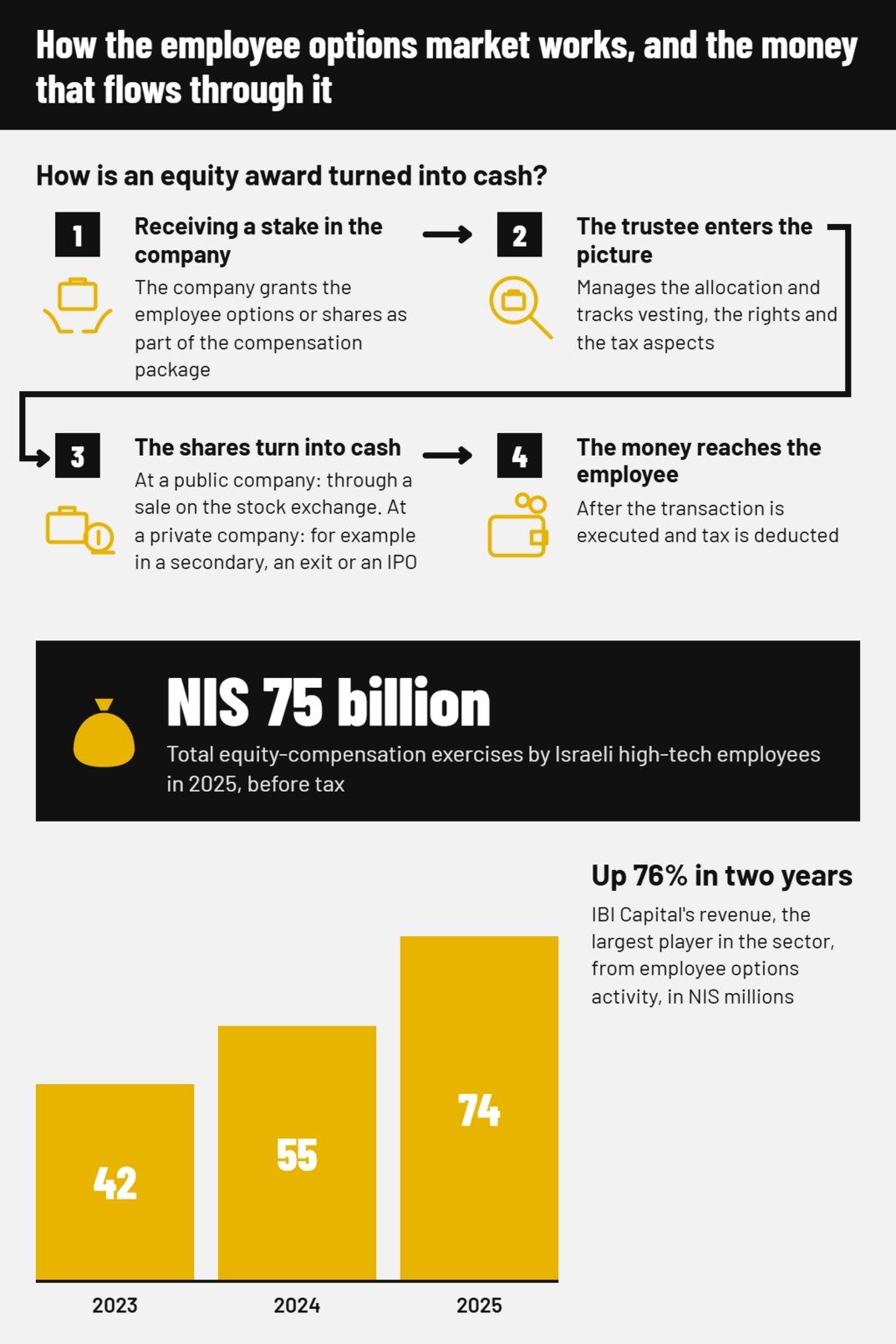
Infographic: How the employee options market works, and the money that flows through it.
(CTech)
The business behind employee options
The work of a trustee begins long before an employee can turn equity into cash. When a company grants shares or options, the trustee administers the plan, tracks vesting and handles the associated tax requirements. Options give employees the right to buy shares in the future at a predetermined price.
At a publicly traded company, employees may eventually exercise their options and sell the resulting shares on the stock exchange. Employees at private companies generally have to wait for an event that allows them to realize their holdings, such as a sale of the company, an IPO or a secondary transaction in which an investor buys shares from existing shareholders, including employees.
For trustees, these events can be particularly lucrative. At a private company, the provider typically receives an annual fee for administering the employee plan. When an exit or secondary transaction takes place, however, large sums can move through the system, creating additional revenue opportunities from securities sales, transaction handling, foreign-currency conversions and other financial services.
The business therefore extends well beyond the administration of options. Phoenix noted in its 2025 annual report that ESOP is entitled to additional payments beyond its trustee fee, adding that “most of its clients’ accounts are managed at the stock exchange member.” Phoenix also offers services including valuations and trust arrangements for M&A deals. IBI, meanwhile, provides valuations, CFO services, financing and M&A advisory alongside its options-management business.
M&A is particularly closely connected to employee-equity administration. When a high-tech company is sold, the transaction involves more than its principal shareholders. Employees may also hold shares and options, sometimes across several countries and subject to different tax regimes. A provider that has managed a company’s employee plans for years can therefore play a significant role when the business is sold.
The Leumi-Aspire venture plans to offer trust services for such transactions, including holding funds until the parties have met the agreed closing conditions.
But the same specialization that makes the market attractive also presents a challenge for a new entrant. A large customer base can open doors, but it cannot replace expertise. Competition depends on professional knowledge, service quality and technology, including the ability to manage complex transactions efficiently. Some industry participants also expect recruiting experienced professionals to be difficult, given that many already work for established providers.
The employer chooses the trustee
Even as competition intensifies, its benefits may not necessarily reach employees in the form of lower fees. Employers generally choose the trustee, and they may prioritize reliable systems, responsive service and the ability to manage thousands of employees and complex transactions over a relatively small price difference.
Employees, by contrast, usually have little say in the choice of provider. They may encounter the fees directly only when they exercise their options or sell their shares.
Providers may charge for selling shares, transferring the proceeds to an employee’s account and, in some cases, handling dividends. Another issue is the time between a share sale and the transfer of the proceeds to the employee, which can take several business days. Whether the money earns interest during that period, and who receives it, is another question.
These sums may be small relative to the value of an employee’s holdings, but across hundreds of thousands of employees, the questions of cost and transparency are far from trivial.
Oversight of the sector is also fragmented. The Israel Tax Authority supervises trustees operating under Section 102 of the Income Tax Ordinance and their compliance with the relevant tax rules. However, no single financial regulator currently oversees all the commercial aspects of the business, including fees, money transfers and interest.
Leumi’s entry could inject fresh competition into a market that has grown alongside Israeli high-tech. But a bigger field of providers does not automatically mean lower costs or greater transparency for employees. Much will depend on whether the new venture can challenge the incumbents on service and technology, and whether employers begin to demand more than the administration of their equity plans.



