










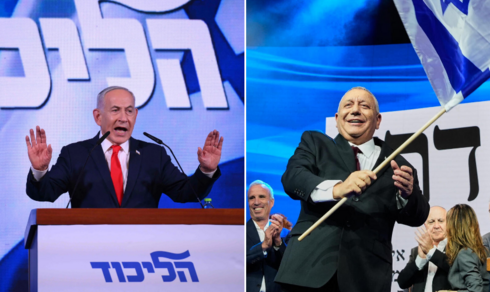
Netanyahu’s lead in Israel’s vote count leaves both camps short of power
The prime minister’s bloc has moved ahead of Gadi Eisenkot’s opposition camp in the partial count, but neither has the 61 seats needed to govern. With hundreds of thousands of ballots still awaiting verification and some cities yet to report results, the final balance of power remains uncertain.
Israel’s election is turning into a contest not only over which bloc can win the most seats, but over whether either side can assemble a government from a fragmented parliament.
Benjamin Netanyahu’s bloc held 55 projected seats in the latest count on Wednesday morning, six short of a majority in the 120-member Knesset. The bloc led by former military chief Gadi Eisenkot stood at 49 seats. Neither side had secured a clear path to power, despite the changing balance between the two camps as votes continued to be counted.
The latest shift came as the predominantly Arab Joint List gained a seat at the expense of National Security Minister Itamar Ben-Gvir’s far-right Otzma Yehudit party. The change brought the two Arab parties’ combined projected total to 16 seats and reduced Netanyahu’s bloc from 56 to 55. Eisenkot’s bloc remained at 49.
1 View gallery
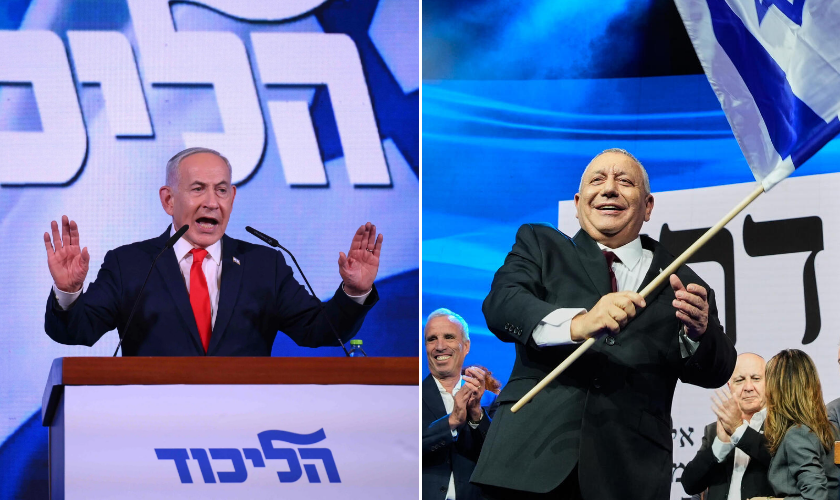
Gadi Eisenkot (right) and Benjamin Netanyahu.
(Photos: Jewel SAMAD / AFP, AP Photo/Baz Ratner)
With 51.5% of votes counted and results received from 57.2% of polling stations, Likud remained the largest party, with 27 projected seats. Eisenkot’s Yashar followed with 21, while the Joint List was projected to win 12 and former Prime Minister Naftali Bennett’s Beyachad party 11.
The figures differ from the television exit polls released after voting ended at 10 p.m. Tuesday, which initially indicated a narrow advantage for Eisenkot’s bloc. The partial official count has since put Netanyahu’s allies ahead, though it remains too early to determine whether that position will hold.
The immediate political question is what either side can do with the seats it wins. Netanyahu’s bloc remains short of a majority, while Eisenkot’s camp has an even larger gap to bridge. The results so far establish the relative strength of the parties, but not which combination of them can secure enough parliamentary support to govern.
The smaller parties hold the balance
The emerging Knesset would be divided among a wide range of parties, making coalition negotiations central to the outcome.
Beyond Likud and Yashar, the Democrats and United Torah Judaism were each projected to win nine seats. Avigdor Lieberman’s Yisrael Beytenu stood at eight, Shas at seven, and both Otzma Yehudit and the Religious Zionism-Zehut alliance at six. Ra’am, the other Arab party, was projected to win four seats.
The Joint List and Ra’am together account for 16 projected seats in the current count. Their position could be important in efforts to form a government opposed to Netanyahu, but the figures alone do not establish whether either party would support a particular coalition.
The changing tally has also complicated the political narratives offered by the two main camps. Eisenkot declared on election night that voters had chosen change, while Netanyahu pointed to Likud’s position as the largest party and called for unity among Zionist political forces. Neither claim resolves the question of who can secure a majority.
The missing votes could change the picture
More than half the votes had been counted by Wednesday morning, but the results were far from geographically complete. As of the 7:55 a.m. update, not a single polling station had reported a count in several cities, including Kfar Saba, Ra’anana, Rahat, Sakhnin and Kafr Qasim.
The absence of results from those cities means the national figures do not yet provide a complete picture of voting patterns across the country. Additional ballots could change individual parties’ seat totals and the balance between the blocs.
Early municipal results showed United Torah Judaism leading in Jerusalem, while Yashar was ahead in Tel Aviv and Haifa. Likud led in Tiberias, Ashdod, Rishon LeZion and Kiryat Shmona. Those figures are also provisional.
A second source of uncertainty is the large number of double-envelope ballots, which require additional verification before being included in the national tally. Election officials have prepared for an estimated 600,000 to 650,000 such ballots, including votes cast by soldiers, reservists, diplomats, hospital patients and displaced Israelis.
The estimated volume is equivalent to roughly 15 Knesset seats’ worth of votes, although seats are not allocated separately to this category. Historically, double-envelope ballots have tended to favor Zionist parties across the political spectrum and have sometimes changed the final distribution of seats. Their effect on this election remains unclear.



