










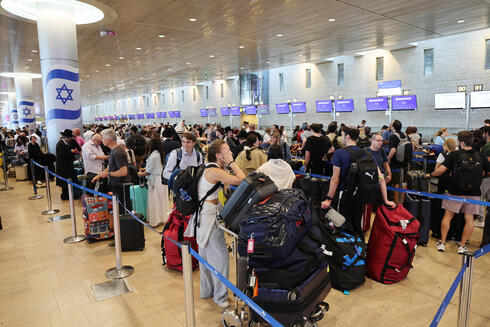
Flights resume at Ben Gurion, but airlines warn bags may be left behind
After a two-and-a-half-hour halt caused by severe baggage congestion, operations are gradually returning. But with hundreds of flights delayed and the sorting system overloaded, some passengers are being asked to fly without their luggage.
The disruption at Ben Gurion Airport has moved into a new phase: Check-in counters have resumed operating after a two-and-a-half-hour shutdown, but airlines are warning some passengers that their luggage may not be loaded onto their flights as the airport struggles to clear an unprecedented backlog in its baggage system. The Finance Ministry estimates the disruption has already cost the Israeli economy NIS 25-30 million ($8.4-10.1 million).
The check-in counters resumed operations at around 3 p.m. after an “emergency event” was declared at 12:30 p.m. amid severe congestion on the baggage conveyors and in the loading and unloading of luggage from aircraft.
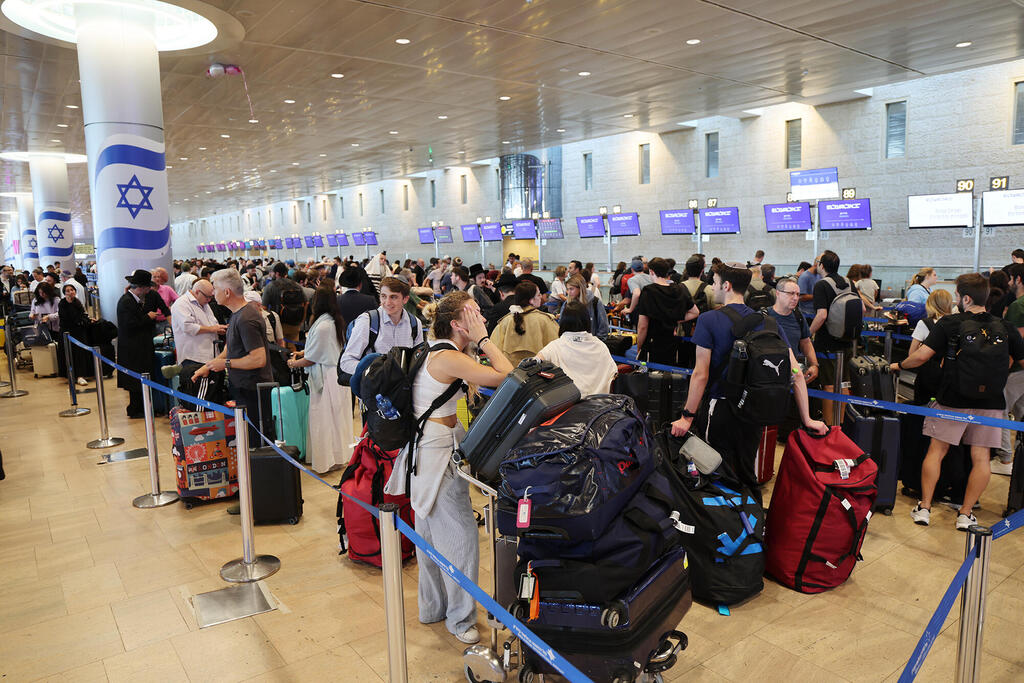
The Israel Airports Authority attributed the crisis to what it described as an illegal work disruption led by the workers’ union. The Histadrut, which represents the employees, disputed that account, saying the congestion was the result of capacity problems that workers had warned about in advance. The sides subsequently reached an understanding that allowed airport operations to resume gradually.
But the end of the shutdown did not mean a return to normal operations. Hundreds of flights have already been delayed, and the disruption is expected to continue throughout the day as the airport attempts to rebuild its schedule.
The most immediate problem for passengers is their luggage.
Calcalist has learned that some airlines have begun warning passengers at check-in counters that, because of the disruption and the airport's already tight schedule, their luggage may not be loaded onto the aircraft. Airlines will try to send bags that remain behind on subsequent flights or arrange for them to be delivered to passengers at their destinations, but travelers are being asked to decide whether they are willing to board without their luggage.
For passengers traveling with medication, baby food or other essential equipment packed in checked bags, the decision is considerably more difficult.
The airlines' decision is not simply an attempt to make their operations easier. The baggage backlog has become so severe that airlines cannot reliably determine which bags have been loaded and which remain in the sorting system. At the same time, they have little room to delay flights further because virtually the entire schedule is already running late.
Airlines are effectively weighing two risks. Delaying a flight to wait for additional luggage could cause it to miss its departure window and further disrupt the schedule. At the same time, pilots and cabin crews who have already been delayed for hours could approach or exceed their legally permitted working hours, potentially forcing an entire flight to be canceled.
El Al faces a particularly difficult calculation. The airline is operating roughly half of today's flights at Ben Gurion Airport, and long-haul aircraft have tightly connected schedules. A plane flying to New York, for example, needs to leave Israel on time to return to the country on schedule the following day.
As a result, El Al has begun informing passengers at check-in that there is a possibility their luggage will not be loaded. Passengers are also being offered the option of canceling their flights for a full refund.
There is another problem: Even if baggage employees return to normal operations, the backlog itself may be too large to clear quickly. An unusually heavy load has accumulated in the sorting system, meaning that the physical capacity of the baggage infrastructure has become a bottleneck independent of the labor dispute.
The consequences are already visible across the airport's flight schedule.
An Air France flight that was approaching Ben Gurion was diverted back to France and has not yet been rescheduled. Another Air France flight scheduled to land in Israel at 4:30 p.m. was canceled.
A Wizz Air flight from London was diverted to Larnaca and has not yet been rescheduled. Lufthansa canceled flights from Frankfurt and Munich after passengers had already arrived at the airport.
A Flydubai flight, which was also carrying Israelis traveling through Dubai on connecting flights, was postponed without a new departure time. Hundreds of Israeli passengers are now stranded at the Dubai airport, despite having had no intention of staying in the emirate. They were told that they would receive an update later on whether they would need to find accommodation for the night.
The disruptions at Ben Gurion are particularly difficult because the airport was already operating under severe pressure before today's incident.
In the morning, an Arkia flight from Bratislava landed 17½ hours late. A TUS flight from Paphos arrived 10½ hours late, while a Bluebird flight from Heraklion experienced a similar delay.
Today's disruption has therefore been layered on top of an already strained system. Hundreds of flights that have been delayed or canceled must now be fitted into a revised schedule, creating a cascading effect.



