










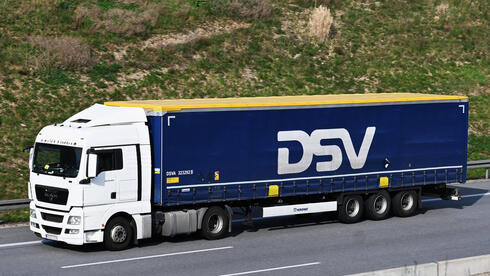
One warehouse mistake allegedly turned $2.1M of drugs into a total loss
Harel is suing DSV after it says medicines worth €1.76 million were exposed to temperatures outside their permitted range for nearly 175 hours and ultimately had to be destroyed
The insurance company Harel filed a lawsuit for 6.4 million shekels with the district court against the international shipping company DSV and against the company's insurance company, alleging damage caused to a shipment of high-value medications destined for Israel.
According to the statement of claim, a worker on the vessel made an error when he stored medications for treating arthritis and psoriasis for about seven days in an area with a temperature significantly higher than required, instead of in a refrigerator, and as a result the entire shipment was disqualified for use. The lawsuit was filed after Harel compensated its insured party, the Israeli company Neopharm, for the full amount of the damage, and it is now seeking to recover the money from the parties it claims are responsible for the damage.
According to the statement of claim, the Israeli company Neopharm ordered from the drug manufacturer UCB Pharma in Belgium a shipment that included nine pallets: three pallets of the drug Cimzia, comprising 1,276 units, and six pallets of the drug Bimzelx, comprising 2,673 units. The total weight of the cargo was 1,049 kg, and its value stood at approximately 1.76 million euros.
These are medications that require continuous maintenance of a cold chain at a temperature of 2-8 degrees Celsius, the temperature standard in refrigerators. According to the lawsuit, DSV committed to handling the cargo's transport and storage at a controlled temperature, from its collection until its delivery in Israel. But the cargo, which was collected on January 22, 2026 in good condition and at the required temperature, did not arrive at its destination that way. After it arrived at DSV's warehouse in Antwerp, it was placed, according to Harel's claim, in an area where the temperature was 15-25 degrees Celsius, instead of in the refrigeration area designated for medications requiring a much lower temperature.
The error was not discovered for about seven days. According to the statement of claim, only after seven days, on the afternoon of January 29, was the deviation detected and the cargo moved to the correct refrigeration area. In total, the shipment remained outside the required temperature range for approximately 174 hours and 40 minutes. The manufacturer UCB conducted a quality check and determined that the cumulative exposure time to temperatures outside the cold chain exceeded the permitted limit for both medications.
For Cimzia, the permitted exposure time was 408 hours, compared to 488 hours and 24 minutes measured in practice. In the case of Bimzelx, the gap was more significant: 72 permitted hours compared to 874 hours and 55 minutes in practice. Following the check, the manufacturer determined that both medications were unfit for use, and therefore the entire shipment was classified, according to the lawsuit, as a total loss and sent for destruction.
One of Harel's central claims rests on an internal document of DSV's own. According to the statement of claim, a Corrective and Preventive Action (CAPA) nonconformance report prepared by the company determined that this was a serious incident, and that the root cause of the failure was that a warehouse worker placed the shipment in an area at a temperature of 15-25 degrees. It is further alleged that the report determined that the worker did not act in accordance with standard procedures.
In addition, Harel claims that DSV did not meet the reporting obligation set out in the quality agreement. According to the statement of claim, the agreement required the company to report incidents of this kind within 48 hours. In practice, according to Harel, the incident occurred on January 22, was detected on January 29, and the report reached the insured party only after February 2, and through third parties.
Following this, Harel alleges negligence, breach of contractual obligations, and breach of the quality agreement, and further claims that DSV was subject to a heightened duty of care due to its declared expertise in the field of logistics and pharmaceutical transport. Harel further argues that since the damage occurred before the cargo was loaded onto the ship, the liability limitations of international maritime transport conventions should not apply in this case.
After Harel paid Neopharm 6.38 million shekels for the damage it sustained, after deducting the insured party's deductible, it is now asking the court to order DSV and the group's insurance company to pay it the full amount, plus interest, linkage differentials, and legal costs.
In response, DSV stated: "We do not comment on relationships with customers."



