








"In the AI era, cyber needs to be thought of in terms of tasks rather than products or tools"
Senior cyber industry executives predict that swarms of autonomous AI agents will gradually replace traditional security tools, detecting threats and running penetration tests with almost no human intervention.
Artificial intelligence is rapidly transforming the cybersecurity industry. Its next stage may involve a shift away from defense systems built around separate security tools and toward swarms of autonomous agents capable of detecting threats, investigating them and responding with minimal human intervention. That was the central message of a panel on the future of cybersecurity in the AI era at the New Era Capital conference in Boston.
One of the key takeaways was that this transformation is about more than simply accelerating existing processes. It requires rethinking how security teams are organized, how companies decide whether to build or buy technology, and how responsibilities are divided between humans and machines.
“We need to stop thinking about building tools or solutions and start thinking about building swarms of agents that need to perform a lot of tasks,” said Guy Flechter, founder and CEO of startup Sola Security. He argued that attackers are also moving beyond familiar tools and increasingly using multiple agents to perform separate tasks, learn from one another and operate independently. “The future is fewer tools and more tasks and constant learning,” he said.
1 View gallery
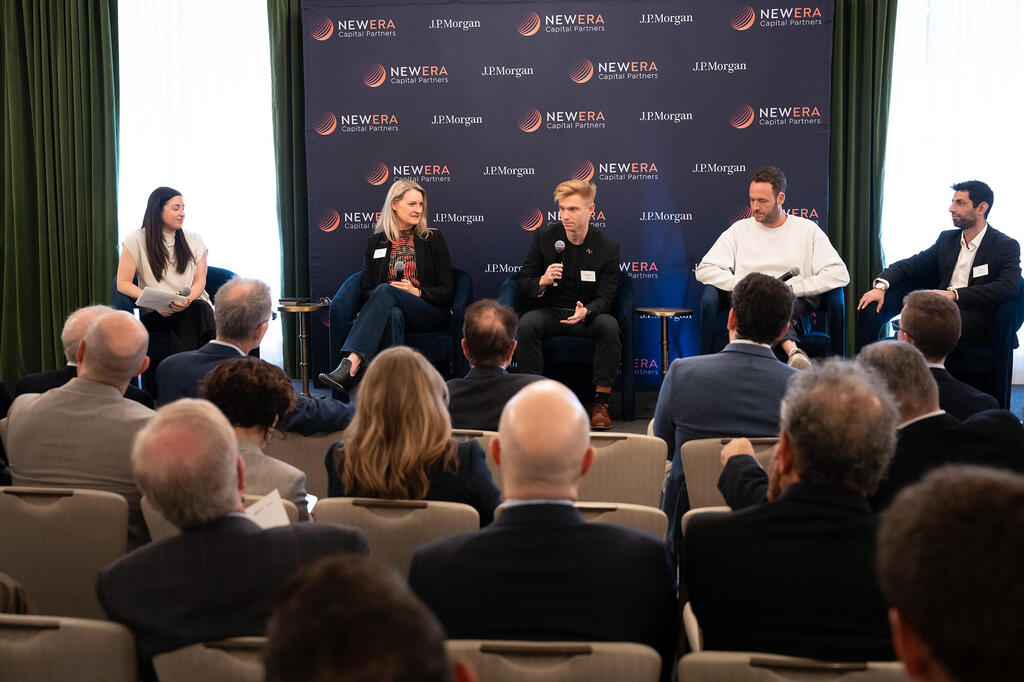
From right: Omer Shirazi, Guy Flechter, Damien Lewke, Katie Jenkins and moderator Stephanie Cherrin
(Photo: Pierce Harman)
Flechter, a serial entrepreneur whose previous startup, Cider, was acquired by Palo Alto Networks for $300 million, also described how dramatically the pace of building a company has changed. “To build a company in the AI era is something completely different compared to the company I had before. It gives a different perspective on what needs to be achieved, and the pace is tremendous. Almost every few weeks things change, and on a monthly basis we need to examine whether we are still going in the right direction.”
Alongside the transformation in cybersecurity itself, the AI revolution is creating new opportunities for companies in the sector. Organizational budgets are growing, while security teams are under increasing pressure to respond more quickly to technological change.
The shift is also changing how organizations decide whether to develop security solutions internally or buy them from outside vendors. Katie Jenkins, CISO of insurance giant Liberty Mutual, explained that in the past, organizations often opted to build their own solutions when no suitable product was available on the market. But the accelerating pace of technological change is shortening the period in which that decision makes economic sense.
“If in the past I thought that if I could build something within a year or two, it was worth doing it myself, today it's perhaps three to six months that can cause me to make a different decision,” she said.
Related articles:
- Former IDF spokesman warns: The next war for public awareness will increasingly play out on AI-powered platforms
- Former U.S. National Security Advisor: "An average hacker can inflict severe damage, and we are not prepared"
- "Today it's not enough to block an agent, you need to explain to it why you did so"
Panel moderator Stephanie Cherrin of banking giant JPMorgan Chase surprised the participants by revealing that the bank's AI budget exceeds $20 billion this year, part of which is naturally directed toward addressing the cybersecurity risks created by the technological transformation. She asked Jenkins how her company planned to allocate more of its budget to cybersecurity in the AI era.
“You need to think that today the budget is also for securing the transformation to artificial intelligence,” Jenkins replied. “First of all, identity management, regulation on AI, and I am not looking for more budget for solutions that are operated by people.”
One area in which AI is already demonstrating significant value is threat hunting, the process of searching for malicious activity that existing security systems have failed to detect. Damien Lewke, founder and CTO of Nebulock, described a case in which a machine learning-based system detected unusual activity involving the ScreenConnect remote access tool. Although the incident was initially classified as medium severity, an AI agent investigated further and identified an attacker attempting to install components and erase traces of their activity on an enterprise customer's systems.
According to Lewke, the organization had endpoint security systems and advanced managed security services in place, but the additional investigation by the agent may have prevented the incident from going undetected.
In another case, agents identified an employee attempting to extract trade secrets through a virtual environment amid a company reorganization. The individual actions appeared normal in isolation, but connecting them revealed suspicious behavior.
These developments, Lewke argued, will change the role of cybersecurity professionals. “Today we are talking about a person who is inside the process and supervises the agent. In the next six to 12 months, we think we will see a transition to a situation in which the person is above the process. He becomes an architect,” he said.
The field of penetration testing, or pentesting, is also expected to undergo a transformation.
Omer Shirazi, CEO of Faze Security, said the traditional model, which relies on human experts, limits the ability to provide continuous security coverage across all of an organization's assets. “When we thought about the idea for the company, we thought about what would happen in another three years. We thought that CISOs would need agents and would be responsible for their actions. Today, the world of penetration testing is really moving toward full, permanent coverage rather than a service. We are seeing a transition from services to a model of constant coverage. The organization wants to know that every asset is scanned and protected. The goal is autonomous and transparent agents that can perform tests without ongoing human involvement, while allowing every action they take to be examined retroactively.”
For startups, the panel's message was that having the right technology is not enough. Lewke said that before raising capital for Nebulock, he interviewed 90 potential customers in 90 days to ensure the company was addressing a genuine market need. “You need to identify a problem that is a high priority, listen to customers and not push an idea on them in the hope that they will approve it,” he said.
Flechter offered a final piece of advice for young entrepreneurs. “Sometimes when you come to a potential customer, it seems your solution is not among the organization's top priorities. But you need to emphasize and convince them that it is, because the CISO has a lot of problems on the table that require attention.”