











Only 47 airlines operate at Ben Gurion Airport – delays jumped 24%
In the past week, 1,847 flights took off from Ben Gurion Airport, and only 9.8% of them departed on time.
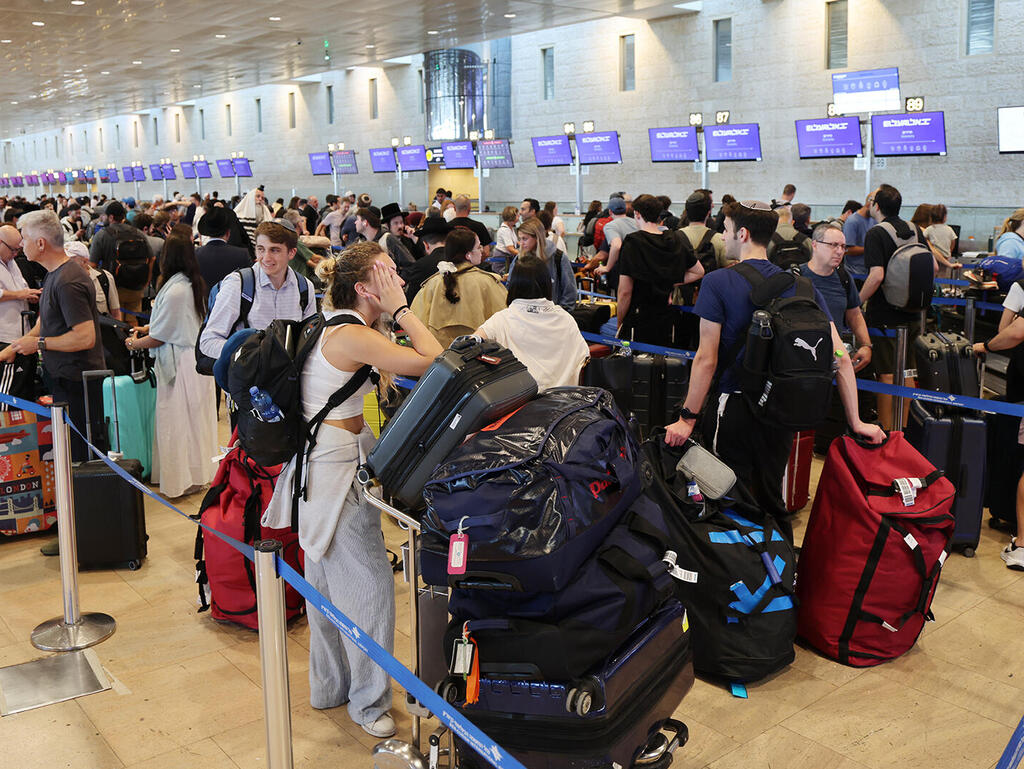
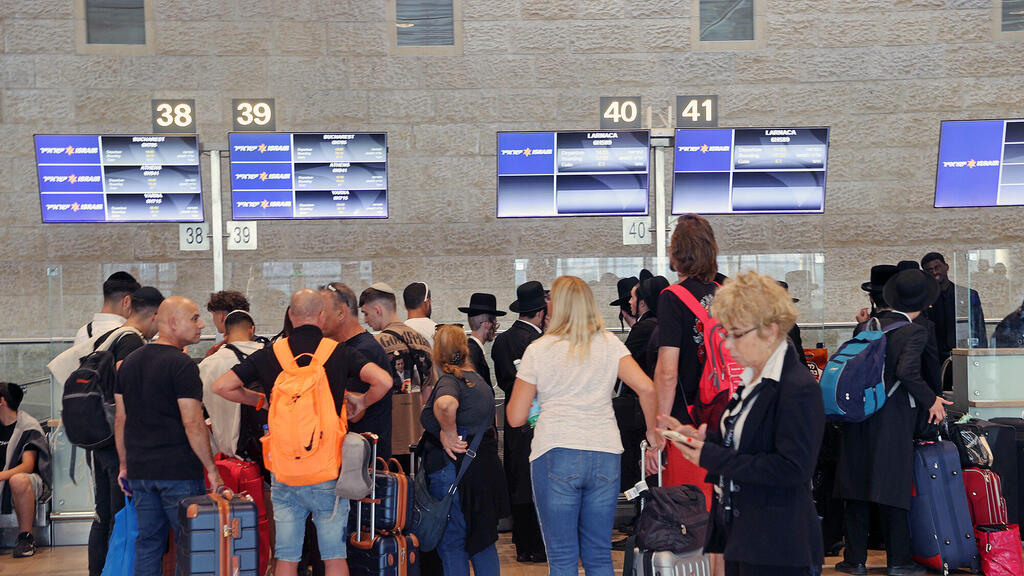
Ben Gurion Airport recorded an especially busy week, with 31% more takeoffs than the weekly average over the past three months and 24% more delays than the weekly average for this period, according to data from the airport's load index. The congestion was also evident on the ground, with hundreds of flights departing with significant delays and long lines recorded at check-in counters, at security screening, and at baggage carousels, where passengers reported this past Friday waiting up to two and a half hours to collect their luggage.
In the past week, 1,847 flights took off from Ben Gurion Airport, and only 9.8% of them departed on time or with a delay of up to 15 minutes. The average delay for takeoffs from Terminal 3 stood at 69 minutes, and from Terminal 1 at 66 minutes, even though domestic flights also depart from there.
The record for delays was set by Red Wings, which operated only 17 flights, but whose average delay stood at 207 minutes. After it is Blue Bird Airways, ranked fourth by volume of activity at Ben Gurion but second on the list of most-delayed airlines, with 189 takeoffs and an average delay of 128 minutes. In third place is TUS, with 69 takeoffs and an average delay of 114 minutes.
The airlines with the lowest average delays are those operating flights east of Israel, though even they cannot boast excess punctuality. In first place is Flydubai, with 70 takeoffs and an average delay of 22 minutes; after it, Azerbaijan Airlines, with 21 takeoffs and an average delay of 28 minutes; and in third place, Emirates, with 82 takeoffs and an average delay of 29 minutes.
The gap between short-haul and long-haul destinations is especially pronounced recently at Ben Gurion. All flights are affected by the congestion at the airport and by the presence of the American refueling aircraft, which cause extensive disruptions to slots — takeoff and landing windows — but flights departing north from Israel, to Greece, Cyprus and nearby Europe, are also affected by congestion in European airspace, which often leads to restrictions being imposed on flights arriving from Israel.
According to the Israel Airports Authority, this creates a situation in which flights scheduled to take off or land throughout the day are funneled into narrow time windows, increasing the load on ground operations. This is what happened, for example, this past Friday at Ben Gurion, when 90 flights piled up within three hours. In the past week, the most exceptional average delays at Ben Gurion were recorded on flights to Heraklion, Mykonos and Barcelona, with averages of 104, 103 and 101 minutes respectively.
The congestion in Greece is not unusual and happens every summer. This year in particular, with only 47 airlines operating at Ben Gurion, compared to about 100 airlines in a typical summer, the expectation was for more routine activity. The reason Ben Gurion is struggling to cope with the congestion is mainly a shortage of infrastructure, a shortage of car parking — even the check-in counters are operating with very little maneuvering room — and at security screening, long lines are being recorded due to a shortage of stations and also a shortage of manpower. According to the Israel Airports Authority, the manpower difficulty stems partly from the fact that it's not always possible to estimate in advance the number of workers required, due to flight delays created by the refuelers.
As every summer, Israeli airlines dominate most flights departing Ben Gurion, but the delay gaps between them are significant. This past week El Al, which operated 598 flights and holds the highest flight count at Ben Gurion, recorded an average delay of only 42 minutes — a reasonable figure relative to its volume of activity. Israir also managed to maintain an average of 59 minutes of delay, despite operating 282 flights. Arkia is last among the Israeli airlines, with an average of 100 minutes of delay across 284 takeoffs.
Is improvement expected? Not this summer. The Israel Airports Authority is expanding Terminal 3, planning a tender for parking management, and promising that by 2030 Ben Gurion will be a larger, more advanced airport, also richer in aircraft parking stands. But these promises, which fall under the Ministry of Transportation, were made around the same table that also promised a supplementary airport for Ben Gurion — a plan that has been advanced for decades and has yet to materialize.
Despite the chaos at Ben Gurion, the Ministry of Transportation is unfazed and claims this is a routine summer. Transportation Minister Miri Regev, who herself has flown 15 times during the current term, takes pride in the fact that despite the security situation, Ben Gurion continues to operate at full capacity. But it should be remembered that this month only 47 airlines are operating at Ben Gurion, not about 100 as in routine times. If all the foreign airlines that used to fly to Ben Gurion had indeed returned this summer, including the American airlines, the situation at the airport could have spiraled out of control.
In response to the congestion this past week, the Ministry of Transportation and Minister Miri Regev's office stated that this is routine summer congestion, and that the very fact that sweeping flight cancellations were avoided due to the presence of the American refuelers is already good news for the Israeli passenger who just wants to go on summer vacation.
"The summer months are always a busy period at Ben Gurion, and this year we are dealing with a special security situation alongside especially significant congestion in the airspace of Greece in particular and Europe in general. Despite the security situation in our region, we have worked continuously to enable the continuation of air activity and to prevent flight cancellations and harm to passengers, and we kept the skies open. Among other things, we worked to move the military refuelers to IDF bases, in order to enable as many flights as possible to depart and return, even during this complex and busy period, so that not a single flight ticket would be canceled due to a restriction stemming from the security situation vis-à-vis Iran.
"To the extent that airlines canceled flights, this was done based on the considerations and decisions of the airlines themselves. Ben Gurion Airport currently operates at exceptional volumes of about 100,000 passengers and about 600 aircraft movements per day. Unfortunately, traffic congestion and restrictions in European airspace also affect us. We continue to work to enable as many Israelis as possible to fly, return home, and keep the skies open, even during this challenging period," the statement read.



