









“This is more of a merger than an acquisition,” CyberArk founder Alon Cohen explains the Palo Alto deal
Cohen describes the integration as a delicate union of two cybersecurity giants, highlighting the challenges of combining forces. In an interview with Calcalist, the CyberArk co-founder predicts the end of work, slams judicial reform, and weighs registering his next company abroad.
CyberArk, says Alon Cohen, was founded out of love. Not as the cliché of “high-tech love,” nor as a worn-out image of a passion for creation, but out of real, human love - of the heart.
“I was a soldier in Mamram (Hebrew abbreviation for Center of Computing and Information Systems) and I was in love with a female soldier,” he recalls. “I wrote her a long letter, chapter by chapter, which was a kind of serialized story about our imaginary trip to Asia. Then one of the soldiers in the training unit hacked into the army’s main computer, looked up what I was doing, and found this very personal letter. He thought it would be funny to print it out in 30 copies and distribute it to all the soldiers in the unit. It was terrible.”
What was worse, the shame or the security breach?
“In this case, it was my love letter, but it made me realize that if they could get to it, you can’t trust the system that’s supposed to protect the most sensitive information in the country. And if this happens at the IDF’s computer center, then something is rotten in the world of information security. After seven years of service, I was discharged as a specialist technologist. I went on a trip to the East, and while trekking in Nepal, an idea struck me: let’s open a network vault, regardless of the organization’s general security level.”
What does that mean?
“That you get a safe place from the manufacturer, just like a safe in the physical world, like one where you keep a gun, except this safe is for information. I was 29 years old, the year was 1997, and I settled in the basement of my house in Modi’in. For two years, I developed this safe by myself. I raised money, and then I called my best friend from high school, Udi Mokady. I told him, ‘Leave being a lawyer, I have great technology, a great product, and I’ve raised $1.5 million.’ He joined, CyberArk was founded in 1999, and the rest is history.”
Where did it evolve from there?
“We realized that with a safe, you can do a lot more. A safe for legal documents, a safe for the board of directors, and so on. And the good news is that if you have the organization’s passwords, you can not only be the gateway that prevents unauthorized entry, but also control where people are allowed to go within the organization and where they’re not. From there, the whole issue of identity management evolved.”
The female soldier you were in love with should get a percentage of the sale.
“Don’t tell her, she shouldn’t get any ideas.”
Why sell? That’s a question for Udi.
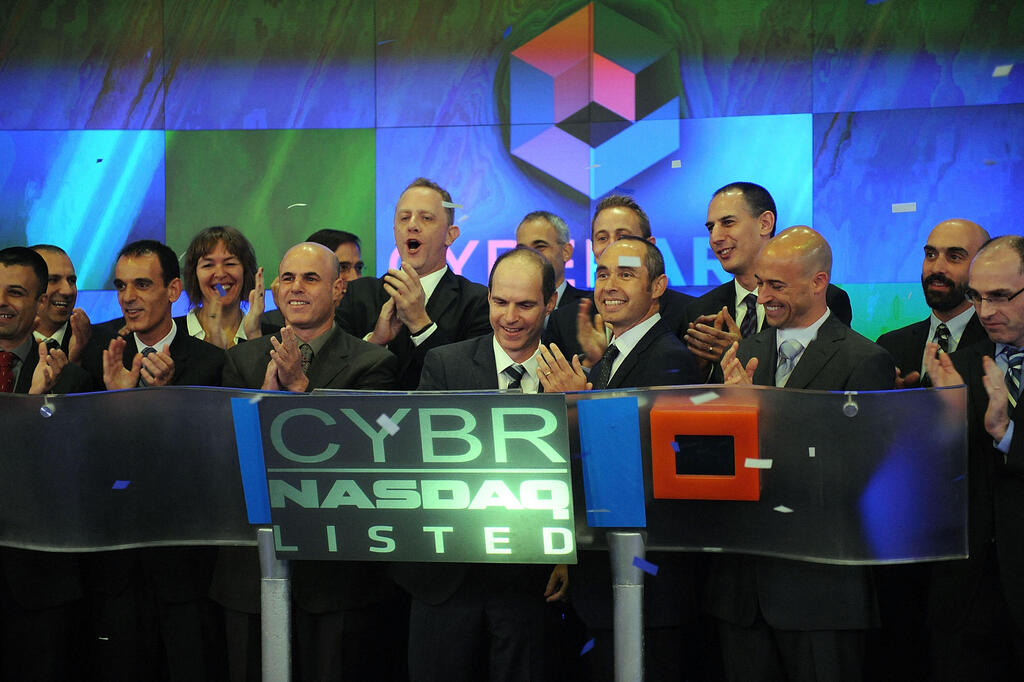
Cohen (57) served as CEO of CyberArk for six years and chairman for 15 years. Mokady took over from him as CEO and later as executive chairman. CyberArk is no longer an experimental startup but a major global player, employing about 3,800 people and traded on Nasdaq since 2014, with a valuation approaching $20 billion. Just a week ago, it made headlines when it was announced that it would be acquired and merged into Palo Alto Networks, the cybersecurity giant founded by Nir Zuk, in a deal worth about $25 billion.
This is the second-largest deal in Israeli high-tech history, behind only the $32 billion sale of Wiz to Google, which has yet to be completed, and the largest acquisitions in Palo Alto’s history. But in the days after the announcement, excitement cooled somewhat: Palo Alto’s stock fell sharply, while CyberArk’s stock rose only moderately, by about 8%. The market reaction suggests that investors in both companies are not fully enthusiastic about the merger, which is expected to close in the second half of 2026.
Let’s start with the phenomenal amount, historic in terms of the sale value of an Israeli company.
“Money is not the motivator. I already made an exit with a company I sold to IBM in 2008” (FilesX, sold for about $80 million).
So let’s get to the point. Shlomo Kramer, co-founder of Check Point, Imperva, and Cato, has been sharply critical of Palo Alto. He says it wants to be a giant supermarket for all types of cybersecurity, but according to him, that’s never worked, not even for giants like Microsoft. In his words: ‘I believe the Palo Alto Networks-CyberArk acquisition is the end of a successful run from PANW.’
“I can understand what Kramer is saying, but time will tell. This is a decision by CyberArk management.”
This isn’t just mean-spirited criticism, he has a case. He says the acquisition will turn Palo Alto into IBM, the old computing giant that became too spread out and stopped growing.
“Don’t try to catch me opposing the deal.”
So let’s talk about what Kramer is saying.
“He’s basically saying no cybersecurity company has ever succeeded in being multi-segment. IBM tried, buying companies in many areas, and failed repeatedly. He’s saying that now Palo Alto, which has its own strength in cloud security, is trying to be strong in identity security, CyberArk’s area, and will fail at both.”
And is there a fear of the IBM syndrome?
“You can’t always learn from the past and apply it to the future. Only a few companies have tried and failed. It’s possible Palo Alto, together with CyberArk, will dominate both classic cybersecurity and identity management, and succeed here. Kramer says that definitely won’t happen. I don’t know, I give credit to smart people who say, ‘Let’s join forces.’”
Why is Palo Alto willing to pay so much?
“Because AI changes the picture. In the world of AI, it’s not just people deciding which doors are open to them, but millions of AI agents acting on behalf of people, and you have to monitor what these agents are allowed to do.”
What does this mean?
“Artificial intelligence will create a huge number of identities that will ‘speak’ on your behalf. It could start with an instruction like, ‘Go buy me a bike,’ or asking an AI agent to book a hotel. This will create a flood of new identities that must be protected. And of course, it could be an AI agent you tell, ‘Delete all my files older than two months’, and you need to make sure it doesn’t accidentally delete everything. Mechanisms must be built to monitor what AI agents are allowed to do and what they’re not. AI is exponentially increasing the number of identities, so Palo Alto saw this as a huge opportunity in the AI world.”
And the price? CyberArk sells $1 billion a year and is being acquired for $25 billion.
“This is a high multiple, based on strong belief in its potential given the AI revolution. And if CyberArk’s market cap is $20 billion, then there has to be an upside in the sale. So there was no choice but to offer around 25% above market value. Ninety percent of the deal is in shares, so CyberArk is taking a risk that Palo Alto’s stock could drop before the deal is approved. A cash deal could have been closed for $23 billion.”
Udi Mokady himself said less than six months ago that CyberArk could reach a value of $100 billion. So why sell?
"This is a question that should be addressed to Udi and the company's management. I can say that waiting for something that might happen in the future involves risk. Maybe he's wrong? Maybe things will suddenly go differently? He thinks that with Palo Alto it will be easier to grow at a rapid pace. They like to use the term ‘power multiplier,’ and when you join another large entity, it's a power multiplier."
To what extent does the Wiz deal affect pricing in the industry?
"There is no doubt that the Wiz deal set a precedent and increased the appetite of companies. By the way, Wiz, which sells less than CyberArk, was sold for $32 billion, at a higher multiple."
Why?
"Because the value is determined by additional parameters. Google doesn't necessarily think that Wiz will sell more. It thinks that thanks to Wiz and the solution it developed, Google itself will sell a lot more cloud services. That's why the value multiple is much higher."
And what are the chances that CyberArk will be able to justify the value it was given?
"One of the dangers of a merger is the loss of senior executives, who might say, ‘We liked the startup mentality, even if there were already about 4,000 employees, and suddenly we are part of a huge company.’ A lot of employees leave, and that is a very big danger. Look at what happened to Waze, which was an excellent company, after the merger with Google. A merger is very, very risky, and whether the deal will justify itself depends on how the managers of both companies handle the integration."
Palo Alto, whose pre-deal value was around $130 billion, is swallowing a company about 20% of its size.
"This is more of a merger than an acquisition. When Google buys you, it's an acquisition because you're a small cog. Here, we're talking about two companies of similar size. In a merger, you have to connect the two parts wisely, and I hope that happens. As a metaphor, it's like a snake swallowing a creature almost half its size, you have to know how to do it. It's really not trivial.
"Any merger like this is scary and needs to be managed correctly. I really believe in Udi Mokady, he's balanced and talented, but time will tell because the dangers are great. We've seen mergers in history, and they don't always succeed."
Cohen currently has no executive role in CyberArk, only a minor holding of less than 1% of its shares.
"I sold most of my holdings as a founder in 2012–2013, on the eve of the IPO," he says. "But during the coronavirus pandemic, I bought back a good amount on the stock exchange, and I made sure to regularly buy shares of CyberArk to maintain a financial and emotional connection to the company I founded. Today, my holdings are minor, and it’s clear that if I had not sold shares over the years, and had kept 12%, I would have received $3 billion in the deal today. So you could say selling shares was a bad deal for me, but I’m happy in part because the early sale allowed me to invest in other ventures.
"I’ll never be able to spend everything I have anyway. Money is a headache, it’s work, it has to be managed, and in the end I’ll pass it on to the children. I’m not a person who needs more money."
How long did the negotiations leading up to the acquisition last?
"They were very short. In public companies, you don’t have much time to deliberate. As soon as talks begin and managers get involved, it leaks, and the stock is affected. Decisions have to be made quickly."
Did you hesitate?
"They didn’t ask me. Fortunately, I wasn’t involved in this decision."
Because if they had asked, you’re not sure you would have said yes?
"I can’t say. I really love the ‘child’ we created, and of course the instinct is to want it to grow independently. But sometimes, in certain business circumstances and for the benefit of the shareholders and the company, there’s no choice but to merge with another company."
It’s clear the shareholders are happy with the exit. The question is what the CEO and founder think is best for the company.
"What the shareholders want is not decisive. When a CEO doesn’t want a deal, it doesn’t happen. It is rare for acquisition offers to bypass the CEO. Usually, the CEO leads the move because he thinks it’s right."
So are you sadder or happier?
"Both. There’s a part of you that’s very happy, because such a valuation is a significant milestone. But another part believes strongly in the company’s independent potential."
Between the lines, it sounds like you didn’t 100% want it.
"You’re pressuring me to say it. The only thing I can say is that time will tell whether the deal is right."
To what extent will the founders and investors benefit from the exit?
"The founders, senior executives, and all the original investors sold most of their holdings over the years. The main beneficiaries now are American institutional investors who bought shares recently."
So the Israeli tax authority won’t share much in the joy?
"In this deal, the State of Israel won’t see much in taxes. But over the years, from share sales and payroll taxes, it has earned billions, and that will continue. Because CyberArk is Israeli-owned in terms of technology, Israel will keep getting taxes and royalties from product sales, even under U.S. ownership.
"Udi and I debated this at the Indian restaurant Indira in Tel Aviv and decided to register it as Israeli, out of Zionist thinking. I’m proud that Israel has benefited and will continue to benefit. I just hope the taxes go to good causes, not to things like financing yeshiva students."
"Shwed should have retired a long time ago"
According to Cohen, he decided to retire from active management at CyberArk "when at some point I felt that I could no longer tell its story. For 15 years you’ve been telling the same vision, and I couldn’t anymore."
You got tired?
"You feel tired, and fatigue is dangerous. That’s why I would never buy shares in a company whose CEO has been in office for 30 years, or even 15 years. There’s no chance. A new CEO needs to be appointed, someone with a fresh finger on the pulse.
"Bibi has been the CEO of the State of Israel for almost 20 years, and that doesn’t work, not in commercial companies, and certainly not in running a country. A new spirit and vision are needed."
Gil Shwed managed Check Point for 30 years and built a company preserved by conservatism, with low leverage, strong cash flow, and consistent profitability.
"Check Point is a masterpiece. Gil Shwed has built a beautiful company. He chose to focus, to be the greatest expert in what Check Point specializes in, and not to go wild. The world of firewalls and VPNs is still the heart of the company, and it is very difficult to reinvent a company. I assume that is what Shlomo Kramer means when he says Palo Alto is trying to disguise itself and be both, because it will be difficult for it.
"On the other hand, it’s a shame for me to see that Check Point has dropped to a value of $20 billion and that CyberArk has surpassed it. Who would have believed that would happen? When I founded CyberArk, Check Point was a beacon for me, a dream company. I never dreamed we would surpass it. But I only have good things to say, it is an amazing company with magnificent technology."
CyberArk is also a very old company, more than 25 years old, and its value is similar to that of Check Point. It’s not that it grew much faster.
"Check Point initially signed an agreement with the computer company Sun, which sold its firewalls. Within a year of its founding, it had already sold $10 million. It was a miracle, and they came out just as the Internet was exploding. It took a company like CyberArk years to educate the market that there was even a need for our product and to achieve such sales."
Did conservatism prevent Check Point from taking off?
"In gambling, there’s luck, and sometimes when you’re not conservative, you crash. Shwed did an excellent job, but he should have replaced himself as CEO long ago. That’s my only criticism of him, because he’s brilliant and ran the company excellently. You need to bring in new spirit to management; otherwise, you freeze in place."
And is Nir Zuk, who founded Palo Alto, an adventurer, the opposite of Shwed?
"Nir is smart. He’s not a CEO; he’s a chief technology officer for the company, and you can push to do a lot of things from below. If he had been CEO of Palo Alto all these years, it wouldn’t have gotten where it has."
"For years I’ve been dreaming that Dad would come back"
Alon, divorced and a father of three, is in a relationship with Yael Lev Avidor, owner of the DeVine wine subscription brand. He is the son of Shalom, a police officer who immigrated from Morocco, and Marlen, a Tunisian-born housewife, the third child in a family of four who grew up in the Baka neighborhood in south Jerusalem when it was still a deprived area. "The neighborhood I grew up in created in me the drive to succeed," he says. "When my mother took us out to eat pizza, my dream was that I could buy myself more than one slice. We only knew that we had expensive things like cheese or tuna in the house twice a week.
"We lived in a 2.5-room apartment, three brothers in a room and a little sister in half a room. At the age of 10, I was orphaned from my father, who was killed in a car accident at work due to negligence, and I found myself having to take care of the house."
How does a 10-year-old boy cope with the loss of a father?
"I remember coming home and seeing a lot of people. The best thing is to grab hold of something you love to do so much. But at that time, I was physically outside the house, not understanding what happened. And it stays with you, for several years you don’t believe it and just deny it. You’re sure your father will appear and you’ll see him. You don’t understand how it can be that suddenly it’s over, just like that. If there are five stages of dealing with grief, for years I was stuck in the denial stage. I dreamed that he came back, and I’d wake up to the heartache of not having a father.
"From the age of 10, I was forced to be completely independent. I learned to fix water leaks, to fight to protect myself in the neighborhood. I lived with risk from a young age, and this built my personality, with the ability to take risks and fight, even when you have to fight your own board. Until the age of 18, I was a soccer player, a goalkeeper for Hapoel Jerusalem, but luckily I was also good at math and physics, and I was accepted into Mamram."
How did your mother cope?
"My mother had to raise four children alone, boys who were wild, and she did an amazing job with what she had. Today she is 83 years old, lives in Ma’ale Adumim near my sister, and if there is one thing that makes me happy it’s to see her happy and proud of this sale. When it became public last week, she immediately said, ‘Dad can’t see this.’"
About five years ago, Cohen moved his base from Boston back to Israel, and today he splits his time between his homes in Givatayim, Zichron Yaakov, and Boston, where he spends a third of his time. About three months ago, he had a car accident while on a motorcycle trip in the northeastern United States.
"It took me a few minutes to remember who I was, what I was doing in Boston, even to remember that I had children," he recalls. "I realized that in order not to hit a pedestrian, I swerved hard onto the sidewalk and flew off. I shattered my collarbone and a few more ribs."
What is it about motorcycles?
"I’m crazy about motorcycles. I have five, and I love each one almost like my own child. I’ve had a motorcycle since I was 16, it was the first significant thing I bought in my life, and I’ve traveled around the world on them. I like to take risks, and a motorcycle is a risk, maybe also a love of thrills. But mentally, it’s hard now, I can’t get on a motorcycle. I want to continue doing the thing that made me happiest, but there’s a trauma that keeps me from getting on.
"I always thought I was in control of my destiny, that’s my worldview, but that’s not really true in life, and even less so on the road on a motorcycle. At the end of the journey, as in business, you discover that you have little control over your destiny, because you also depend on the market and your partners."

Being an entrepreneur is hard work, and you really don’t depend only on yourself, but in your case it paid off.
"I don’t suggest anyone envy my life or that of another high-tech entrepreneur. It’s a terrible life. If you want to be happy, God forbid you become an entrepreneur. Entrepreneurship is a crazy emotional roller coaster, for years. Do you know what difficulties we went through at CyberArk? We founded it in 1999, and in 2000 the dot-com bubble burst. In September 2001, we were running on fumes, and just before the money for salaries ran out, we signed a memorandum of understanding with SoftBank Europe to invest in the company. We were supposed to close the deal on September 11, and in the morning the Twin Towers fell. SoftBank Europe shut down, and the deal collapsed.
"In 2002, buses exploded in Israel, and I had to take care of employees and reassure customers. In 2006, during the Second Lebanon War, missiles were falling, and customers again needed reassurance. In 2008, the subprime bubble burst, and the first thing we did was cut our salaries.
"You lose your hair, your joy of life. I have no doubt that I got divorced because of it. The family pays a price when you are absent 90% of the time and your mind is focused on building the company. An emotional roller coaster is not a recipe for happiness or for successfully managing a family. Many entrepreneurs who have made an exit get divorced, it’s part of life. That’s why I say to those who want to be happy, ‘Don’t start a company.’ I wanted fulfillment, satisfaction, creation, and contributing to the world, but there are better ways to take care of your happiness."
What do you recommend to those seeking happiness?
"Be an outstanding high-tech employee. Sometimes we envied our employees. Udi and I used to joke that we wanted to be Yair Sade (VP of Product Management). He's a top gun, one of the best engineers at CyberArk, and we kept courting him, wanting him to succeed. He earned an excellent salary and was happy. He didn’t have to worry about situations where we might not have money for salaries at any moment. We envied him constantly."
"In a decade, people won’t be working"
Despite his theory about the collapse of entrepreneurs' happiness, Cohen is not a one-company entrepreneur. In 2004, a few years after founding CyberArk, he founded the storage company FilesX, which was sold to IBM in 2008 for about $80 million. A few years before the coronavirus pandemic, he founded Muvix, an entertainment company that closed during COVID-19 ("It's good for an entrepreneur to have failures on his résumé"). In 2015, he founded Intezer, which develops technology for autonomously performing security operations; and in 2016, the fintech company nsKnox, which focuses on securing money transfers.
Do you plan to start more companies?
"As an AI enthusiast, that’s where my next project will be. I have a vision to start a big AI company, hardcore, not just something peripheral to AI. It will be in the ‘safety’ areas of AI. Everyone is rightly concerned about the dangers, and I have some ideas in that space. I’m currently looking for talented people to join the startup. I’m no longer at the age to personally lead a company, so I need to build a team to take the lead."
You claim that AI will completely change the world of work.
"It will bring about a dramatic change. In about a decade, people will hardly work at all, and they’ll need to find new ways to create interest and passion in their lives. Governments will have to provide basic funding because most people will not have jobs. I hope I’m wrong, but I believe that within ten years, the labor market will be unrecognizable. People will work very little and will need to learn how to spend their time and find alternative sources of personal satisfaction and meaning."
Sounds like a utopia.
"But it’s a dystopia. Work creates challenges, interest, satisfaction, and a sense of achievement. All of these could be lost, and humans will struggle to find them elsewhere."
So how do you raise your children to be productive, when they don’t have to work today?
"Without drive, passion, and challenge, life is boring. My children don’t even know how much money I haveת nobody does. My daughter works, as she should. My middle son is a paramedic in the National Service, and my youngest is about to join the army. Even someone who wins the lottery can end up unhappy if they lose all challenges in life."
Cohen won’t remain silent as long as Bibi falsely toots his own horn
During the struggle against the judicial reform, Cohen publicly expressed his opposition to the government. In July 2023, he criticized it for damaging the high-tech sector and threatened not to register new companies he founded in Israel. In September, he posted a direct message against Prime Minister Benjamin Netanyahu, claiming Netanyahu was taking undue credit for Israel’s cyber achievements.
"What exactly did you do, touting your role in turning Israel into a cyber superpower?! If you really want to make Israel an AI or cyber superpower, retire from politics or go home," Cohen wrote.
Last week, after CyberArk’s historic exit, the post went viral again. "It really bothers me that Bibi takes credit for everything that succeeds," Cohen says now. "I wrote that post because it made me jump when he said, ‘I turned Israel into a cyber superpower; I will turn it into an AI superpower.’”
You also responded to Minister Dudi Amsalem’s “Rolex Speech,” which claimed Kaplan protesters were an elite.
"I’m proud of my parents’ origins, and I won’t allow my name to be used to stir up ethnic hatred or create divisions in society. I grew up in a distressed neighborhood, part of Begin’s neighborhood rehabilitation program, which I admired. My father was a policeman who was killed when I was 10, so talk about Rolexes doesn’t work on me. It’s all manipulation meant to create conflict between different groups in Israel.
“To be a high-tech powerhouse, we must be a democracy with freedom of thought, quality education, and political stability. We don’t want to be Russia, China, or Turkey. Any attempt to turn us into a dictatorship makes me fear for my home. My family returned a decade ago; I came back from Boston about five years ago. I have senior employees asking for relocation, and we cannot afford to lose people like that voluntarily. My life is centered here in Israel by choice. I love this country and will defend it."
Where will the AI company you’re considering be registered?
"I’m undecided. It would be easier to start a company in Israel if I knew that tax revenues wouldn’t be directed toward the Religious Zionist sector and the Haredim, who are keeping Bibi in office. There’s also the professional consideration of building a global company. But everything I do will be centered in Israel, it’s my home. I don’t know where the country is heading, but I know one thing: I’m not going to live in a dictatorship."



