










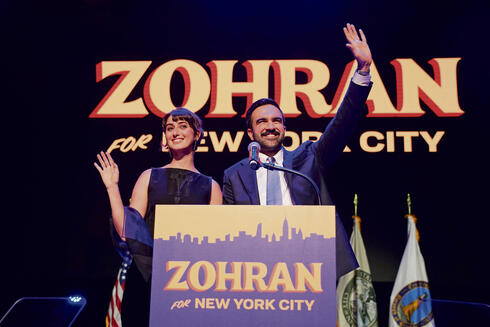
Israeli tech unfazed by Zohran Mamdani’s New York mayoral win
Despite his anti-Israel stance, startup founders and investors say his power to affect them is “minimal, if any.”
He is anti-Israeli, anti-Zionist, has been accused by critics of antisemitism, and criticized the Israeli government just a day and a half after the Hamas terrorist attack on October 7. Yet despite this, Israel’s high-tech community is not alarmed by Zohran Mamdani’s victory in the New York mayoral election, believing his ability to affect Israeli startups or entrepreneurs operating in the city will be limited.
“Ultimately, he’s the mayor,” said the founder of an Israeli startup planning to open its first office in New York in the coming weeks. “Most of his life will revolve around property taxes, garbage collection, and construction projects. He was elected on a platform of major urban reforms, and his focus will be there. If he’s busy with New York’s internal affairs, the impact on us will be minimal, if any.”
New York remains one of the most popular destinations for Israeli startups expanding into the U.S. Its East Coast location offers a convenient balance between flight times from Israel and time-zone overlap with Silicon Valley. As a result, a large community of Israeli entrepreneurs and startups has taken root in the city.
While many in the Israeli tech ecosystem acknowledge that Mamdani could, by virtue of his position, make life more complicated for Israeli firms, few expect a meaningful impact.
“Israeli high-tech is everywhere in New York. If there are obstacles, they’re just bumps in the road,” said Yorai Fainmesser, co-founder of venture capital fund Disruptive AI. “It doesn’t stop the industry. Relationships with investors from New York, and we have several in our fund, won’t be damaged because of this. No one is saying, ‘The mayor spoke against Israel, so we won’t invest.’ Israeli tech hasn’t lost its appeal. Institutional investors look at risk, war, markets, geopolitics, but I don’t think anyone will mark Israel as a risk because of the mayor.”
Yuval Kaminka, founder and CEO of Simply, shares that view.
“Politics changes constantly, especially in recent years,” he said. “What makes Israeli high-tech unique, creativity, problem-solving, unconventional thinking, and bridge-building, allows us to thrive even amid upheavals, wars, and political shifts.”
Guy Franklin, founder of Israeli Mapped in NY, emphasized the scale and resilience of the Israeli presence in the city.
“New York is home to the largest Israeli high-tech ecosystem outside Israel, with around 450 Israeli startups operating here,” Franklin said. “Companies see New York as a major destination, and I don’t think that’s changing anytime soon. For now, we’re in a waiting mode, Mamdani won’t take office for another two months, and even then, we’ll have to see what happens. But I don’t expect any significant impact on companies already here.”
According to Franklin, companies weigh three main factors when deciding whether to operate in New York.
The first is sales and customers.
“Will his victory affect the ability to sell to customers? No. Companies will continue to sell to large corporations, and those corporations will continue to want Israeli technology,” he said.
The second is recruitment.
“If Mamdani remains openly hostile toward Israel, it could create a slightly negative atmosphere. Some employees might hesitate to work for Israeli companies,” Franklin said. “But hundreds of résumés come in for every open position, so the overall impact will be marginal.”
The third factor is the business environment.
“We received significant support from the current mayor. That will probably stop,” Franklin admitted. “But Mamdani may also want to prove he represents everyone. After all, New York has the largest Jewish community outside Israel, more than a million people, and many of them voted for him.”
If anyone is likely to respond to Mamdani’s election, it may be Israelis themselves.
“I wouldn’t move to New York right now if I were a startup,” Fainmesser said. “Maybe to Silicon Valley, Florida, Boston, even Washington, D.C. There’s no shortage of options on the East Coast.”
But not everyone agrees. The startup founder planning a New York office said Mamdani’s win hadn’t changed his plans.
“If he actively intervenes, say, by targeting institutions that work with Israel, he could have some influence. But that’s unlikely. He’s the mayor; he was elected to run the city, not the war in Gaza,” the founder said.
Still, he acknowledged a psychological impact.
“He could amplify an existing trend. There’s already an anti-Israel atmosphere in some places, and this could add to it. That kind of sentiment might subtly affect the mood, for example, in how some funds or banks behave. It’s not that there will be overt discrimination, but there could be a less comfortable psychological environment.”
Fainmesser echoed that concern from a broader view.
“What worries me is the ripple effect,” he said. “That other cities might follow. Copycats. That’s the contagion effect, and that’s what I’m afraid of.”



