










Mind the Tech London 2025
“Women must demand a seat at the table, and then make the table longer so that others can join”
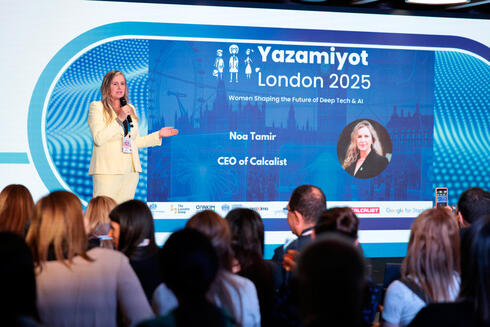
Michal Freeman-Shor, Head of Primary Markets - Israel, at the London Stock Exchange, was speaking at a panel held during the Mind the Tech London conference. Noa Tamir, CEO of Calcalist: "We are not Sparta, we are the opposite. We believe in building bridges and opportunities and driving growth through business, technology, and collaboration."
“Women must demand a seat at the table, and then make the table longer so that others can join,” said Michal Freeman-Shor, Head of Primary Markets - Israel, at the London Stock Exchange, at the “Women Leading” panel held as part of the Mind The Tech London 2025 conference by Calcalist and Bank Leumi.
Freeman-Shor emphasized the importance of female presence in the fields of deep technology and artificial intelligence. “We live in extraordinary times. Artificial intelligence and technology are transforming industries, rewriting business models, and raising profound questions about ethics, trust, and responsibility,” she said. “At the same time, women are still underrepresented in these fields, especially as founders and investors.”
She added: “When I think about deep tech and AI, I don’t just see algorithms and patterns. I see the opportunity to solve humanity’s toughest problems and build technologies that reflect the future. Without women at the table, we risk building systems that reflect yesterday’s prejudices instead of tomorrow’s.”
Freeman-Shor emphasized the unique value that women entrepreneurs and investors bring: “As founders and investors, you bring something new – resilience forged by challenge, creativity sharpened by disdain, and a determination not just to build successful companies, but to build meaningful companies.”
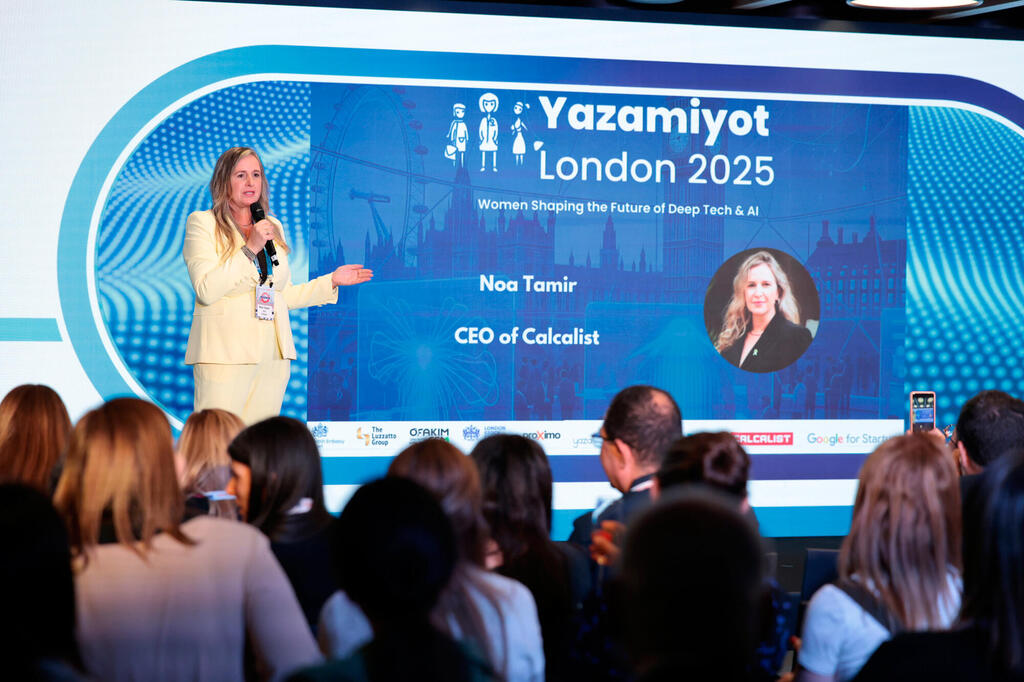
Noa Tamir, CEO of Calcalist, emphasized the importance of the event in complex times. “This is my favorite event for women entrepreneurs. It’s exciting to see so many extraordinary women as part of our conference in London. Israel is going through difficult times right now, but we are not Sparta, we are the opposite. We believe in building bridges and opportunities and driving growth through business, technology, and collaboration.”

Debbie Shapiro, Israel Director at the UK Department for Business & Trade, outlined the strength of economic ties. “The economic relationship between the UK and Israel continues to be strong. Total trade in goods and services is £6 billion, reflecting not only the strength of our trade relations, but also the growing appetite for collaboration in sectors such as technology, life sciences, cyber, and financial services.”
Shapiro added: “The UK is open to doing business with Israeli companies, and London is the perfect accelerator for Israeli start-ups, offering access to global markets, deep investment networks, and a vibrant technology ecosystem that welcomes diverse talent and ideas.”
Freeman-Shor called for a redefinition of success: “Let’s redefine success in deep tech and AI not just in terms of valuations and exits, but in the impact we create, the barriers we break, and the people we inspire. The future of AI and deep tech is being written here and now, and this room is where the notebooks are.”
5 View gallery

Marla Shapiro, Managing Partner at HERmesa, spoke with Elinor Honigstein of Startup Grind.
(Photo: Orel Cohen)
The London Stock Exchange, she said, “is opening doors. When institutions of this caliber stand behind inclusion, it sends a strong message, that the future of finance and innovation must be diverse.”
Tamir concluded: “Each of these is proof that leadership can build a future of entrepreneurship and hope.”
As part of an entrepreneurship event at the conference, Marla Shapiro, Managing Partner at HERmesa, spoke with Elinor Honigstein of Startup Grind. “The reason I invest in women entrepreneurs is to get rich,” said Shapiro.
A Wall Street graduate who moved into the world of tech entrepreneurship, Shapiro founded HERmesa in early 2020 as a fund specializing in women-led companies. “I started with a logo and an idea of ‘women like me want to write checks.’ We evolved and grew, and to date have invested in 35 women-led technology companies.”
The framework that HERmesa developed for selecting investments is called “The Vehicle & The Journey.” “The vehicle is the problem, the solution, the approach. If the vehicle is not roadworthy, you don’t even bother to go on a journey. We look at whether it’s a burning problem, whether the solution really solves the problem, how to reach customers sustainably, and most importantly, whether the team is exceptional.”
Only 25% of companies make it past the vehicle stage, she said, and only 10% survive the “journey”, examining market size, competition, business model, and finances. “We look for exceptional levels of something truly special in all of these factors.”
Shapiro identified two common characteristics of the successful female founders in the fund’s portfolio: “First, resilience, which means self-belief. The founder truly believes in what she’s doing. Many of our founders are immigrants, women who are willing to leave their country and start over.”
The second is fast execution: “Time is money. Women generally raise less money than men, they have less time to prove their thesis. The best founders not only execute with incredible speed, but when something goes wrong, they pivot.”
She gave as an example a Chinese founder who arrived in the UK with two suitcases and no English, and built a technology designed to help mothers. “She was technically amazing, but with zero sales knowledge,” Shapiro said. “When we invested in her, we connected her with a mentor who taught her how to sell. Today she tells me, ‘I have two salespeople because then they compete and that’s how you get the best.’”
According to Shapiro, research shows that diverse teams perform better. “A study released this year shows that 70% of unicorn founders in the US are underdogs, immigrants, women, and Black. But only 10% of them were backed by the top 10 early-stage venture capital funds.”
“The people who invest in HERmesa are here to make money. The reason I invest in women is to get rich,” Shapiro added.
When asked what opportunities exist for women entrepreneurs, Shapiro replied: “Women can do exactly what men do. So obviously artificial intelligence, obviously robotics, obviously defense.”
Finally, Shapiro provided advice she took from a colleague. During a panel with women, one of the founders said, “Oh, it’s going to be so hard to raise money,” and Shapiro’s colleague replied, “Well, if you don’t believe in it, why are you even doing it?” “My advice is to just have self-belief. That’s the only way you’ll succeed,” Shapiro concluded.
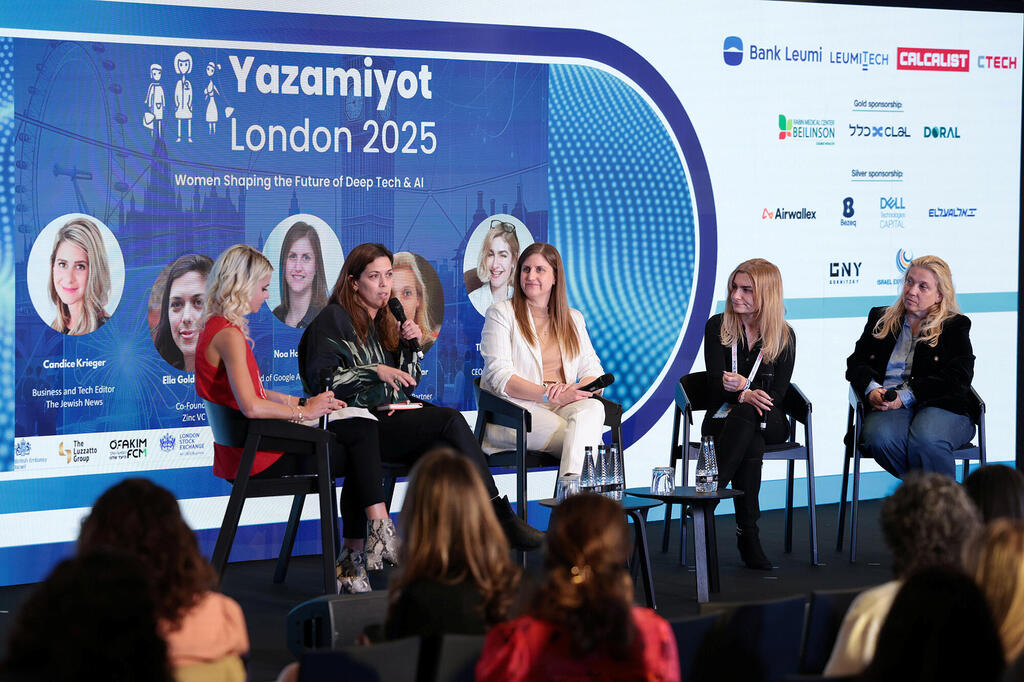
“Pretend you’re your male partner”, that’s the golden advice of Thuria Wenbar, CEO and co-founder of Evaro, to women entrepreneurs taking their first steps in raising their startup’s first round of funding. Wenbar spoke during the session “Women Shaping the Future of Deep Tech & AI.”
The panel, moderated by Candice Krieger, business and technology editor for Jewish News, brought together leading female entrepreneurs and investors working at the forefront of Israeli and global high-tech to examine the unique challenges alongside the enormous opportunities for women in high-tech. In addition to Wenbar, the panel also included Ornit Shinar, co-founder of “Yazamiyot” and partner at the RAIN Foundation; Ella Goldner Levy, Co-Founder of Zinc VC; and Noa Havazelet, Head of Google Accelerator, EMEA. Each shared their personal and professional journeys and their perspective on the technology ecosystem.
Krieger opened the conversation by presenting data on women’s involvement in the high-tech industry: In the previous year, entrepreneurial teams consisting only of women received a total of 2.3% of global venture capital funding. In Israel, the figure was double the global average, but still very low. Between 2021 and 2024, only 4.3% of global venture capital funding flowed to startups with female CEOs. This is despite repeated studies showing that companies with women and diverse management teams generate higher returns and better team performance.
Ella Goldner Levy, an engineer by profession and co-founder of Zinc, noted that while half of Zinc’s portfolio of companies includes a female founder, many of them have struggled to raise seed capital, which led her to start Alma Angels.
Ornit Shinar, referring to the ongoing funding gap, said: “It’s still a problem and the numbers speak for themselves.” She pointed to systemic problems such as limited access to early-stage capital, with many women not even knowing angels or wealthy friends who could help. Another significant factor she highlighted is the lack of women investing or managing funds, although she noted that her fund is moving toward more managing partners. Shinar also stressed the importance of role models: “You need to see more women succeed to believe that you can too.” Still, she expressed optimism that future generations will not need such panels at all.
Thuria Wenbar, who started out as a software engineer and became an emergency room physician, provided a personal look at the challenges of entrepreneurship through unconventional paths. She initially funded her startup, Evaro, with her own money earned working night shifts in hospitals, and only later was she exposed to the world of venture capital. Her fundraising experience revealed a glaring gender bias. She said that when she reached out to investors via LinkedIn, her conversion rate was much lower than when she “pretended to be my male partner.” Additionally, while she received polite responses, messages to her “male partner” immediately resulted in calls and meeting invitations.
She also revealed that venture capital funds “automatically write off something like 33%–50% of whatever you put out in your pitch, because they’re used to men exaggerating and overpromising.” Her advice? “Play dirty. Pretend you’re your male partner” and “Don’t show your real numbers.”
The discussion moved on to how women are reshaping AI and deep tech. Noa Havazelet, who leads the Google Accelerator for EMEA, expressed optimism, seeing AI as “a way to level the playing field.” She said AI requires everyone to “relearn it,” which creates new opportunities.
Havazelet also noted that AI could reduce the need for deep technological expertise, allowing more women, even those without a strong STEM background, to lead tech companies. She emphasized her passion for the fusion of academia, research, and AI, predicting that this would create “the next big unicorns.” For her, this is a huge opportunity to create an entrepreneurial mindset in many women in academia.
Ella Goldner Levy agreed about the potential of academic spin-outs, noting that 10% of their investments are direct spin-outs from academia, and many more were born from researchers who left academia but retained intellectual property and knowledge. However, she expressed doubts about the impact of AI on raising capital, warning that the increased use of AI to write and read presentations could actually make it harder for women because it could push investors back to “warm introductions” (introductions through personal connections, mutual recommendations, or existing networks), where human connection and trust are even more critical, and less through proactive outreach to people they don’t know beforehand.
Havazelet acknowledged this concern, but emphasized the opportunity to “shape the AI landscape… to be less biased and more representative,” as well as to develop ethical AI.
In a conversation about continued recruitment and expansion of activity, Shinar explained that in more advanced stages, “gender becomes completely irrelevant, if the company is larger than the cap. And the numbers are strong.”
Goldner Levy added that women need to be bolder in their financial ambitions: “This is not the romantic novel of helping startups succeed. That’s nice, but if you’re just here for the romance, read a book. This is a business of making money, right?.”
She noted that she has invested over $150 million, and of that, only a small portion went to women, “not because I didn’t want to, not because they weren’t good, but because they just didn’t show up.” Her advice: “You have to show up.”
As for the cash burn rate and responsible expansion, Havazelet said she sees a similar burn rate between men and women entrepreneurs. She emphasized the importance of community: “Surround yourself with a good community, with people who understand what you’re trying to do.”
Goldner Levy referred to a change in the market: While investors initially became more conservative, the advent of Gen AI “loosened the belt,” leading to aggressive metrics and a focus on explosive growth, which makes it difficult for others to raise.
Wenbar said that her company chose a different path: It achieved profitability before turning to investors. This gave it a position of strength, which led to many financing offers. Shinar reinforced this, pointing to a “gap in pre-seed” that is growing, where investors are demanding more commercial proof and validation, forcing entrepreneurs to be “very focused, capital efficient… and prioritize the next inflection point.”
Wenbar added that the company she founded waited five years before taking its first investment. Havazelet summed up this point by emphasizing the importance of asking for enough money in the first round: “Make sure you ask for the right thing that will give you enough breathing room to get to the data you need to show.”
Toward the end, each of the speakers offered one last piece of advice. Ella Goldner Levy urged entrepreneurs: “Be brave. Be braver than you think you can be.” She shared her strategy for preparing three different presentations with fundraising requests of $500,000, $2.5 million, and $5 million, tailoring each presentation to the size of the check the investor is writing. She also recommended being assertive: “If you don’t push, they won’t want to put their money on you.”
Winner of the Entrepreneurship Competition – Startup URIna
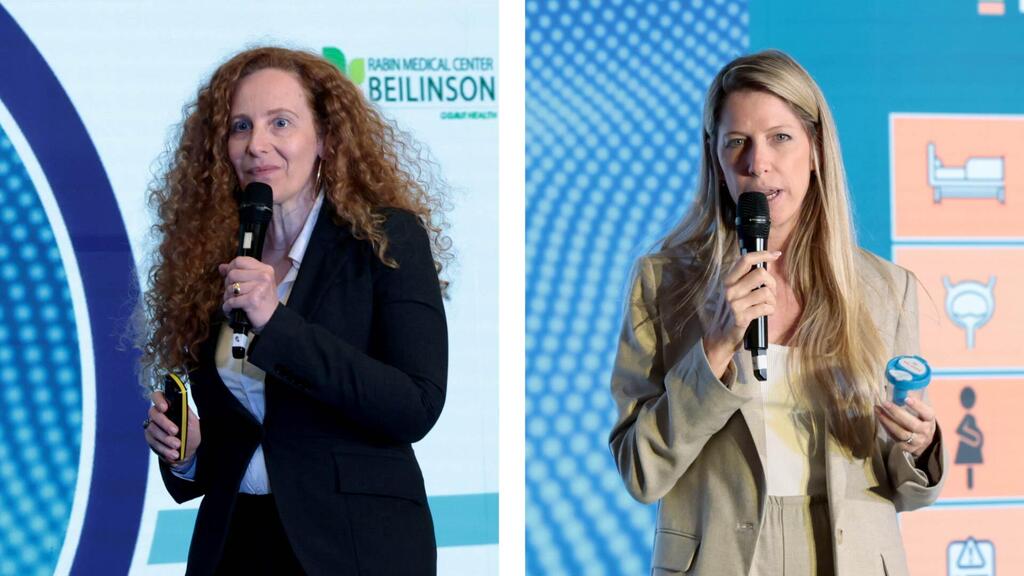
“Winning the ‘Entrepreneurship 2025’ competition is an important step on our way to redefining the entire field of urine testing,” said Keren Riber Abrahami and Dina Gat, co-founders of the startup URIna, in their winning presentation at the entrepreneurship competition.
At the beginning of her pitch, Abrahami shared the personal story that led to the founding of the company: When her daughter Liani was 14 years old, she was concerned about a urinary tract infection. The doctor refused to give antibiotics without culture results, which led to three days of pain. According to her, this is a widespread phenomenon, many women are forced to wait for long days to receive answers, which can lead to medical complications, hospitalizations, unnecessary treatments, and even premature births. In many cases, the test must also be repeated, so the wait is extended to six days. In the US alone, the economic consequences of poor diagnostic processes are estimated at approximately $7 billion per year.
URIna’s solution is simple: a disposable product in the form of a cloth, on which the woman sits while urinating. Sensors built into the cloth perform an immediate analysis of the urine, and the results are sent directly to the user’s phone and the treating doctor without the need for a laboratory. The technology is based on advanced electrochemical principles, similar to those used in security tests to detect explosives, and allows for the rapid and accurate identification of bacteria that cause infection.
The entrepreneurs noted that the timing for the venture is ideal: the market is growing, and key trends in the healthcare sector, telemedicine and point-of-care testing, are gaining momentum. In addition, the transition to quantitative urine testing gives URIna a significant competitive advantage. The company brings clear value to all stakeholders: for women, fast and accurate diagnosis; for clinics, new revenue streams; and for insurance companies, significant cost savings.
The company is already recording achievements: memoranda of understanding with Meir Medical Center and Sheba Hospital, winning a competition at Tel Aviv University that led to an initial investment, and clear plans for expansion into the American market, including receiving FDA approvals and marketing kits to clinics and insurance companies in the US. Behind the company stands an all-female team: three entrepreneurs who together hold nine academic degrees in a variety of fields, law, economics, and diagnostic engineering, and are supported by a diverse and senior advisory board.
The vision of Abrahami and Gat goes beyond diagnosing urinary tract infections: they seek to redefine the entire field of urine testing, so that women and girls like Liani will receive a real, fast, and accurate response. Winning the competition, they said, was another important step in this journey and proof of the power of Israeli innovation on the world stage.



