











"AI does not replace people, nor does it surpass human ability"
Dror Litvak, CEO of ManpowerGroup Israel, said at the Calcalist and Mizrahi Tefahot Growth Conference that although there are layoffs in high-tech, "many companies in Israel continue to recruit."
"AI does not replace people, nor does it surpass human ability," said Dror Litvak, CEO of ManpowerGroup Israel, during a panel held at the Calcalist and Mizrahi Tefahot Growth Conference. The panel also featured Nirit Cohen, an expert and researcher on the future of work; Dor Gabizon, Head of Wolt Benefits; Sivan Baron, Director of Human Resources at Akamai Israel; and Nirit Peled-Muntz, Chief People Officer at HiBob. The discussion was moderated by Almog Azar of Calcalist.
The high-tech industry is suffering from both the strengthening of the shekel and the rise of AI. What are new employees looking for?
Baron: "In human resources, we know that people are living with uncertainty, so they are looking for stability. I see employees who want access to technological tools and expect their organizations to provide them with the tools they need to remain relevant. This is a change we have seen over the past few months."
1 View gallery
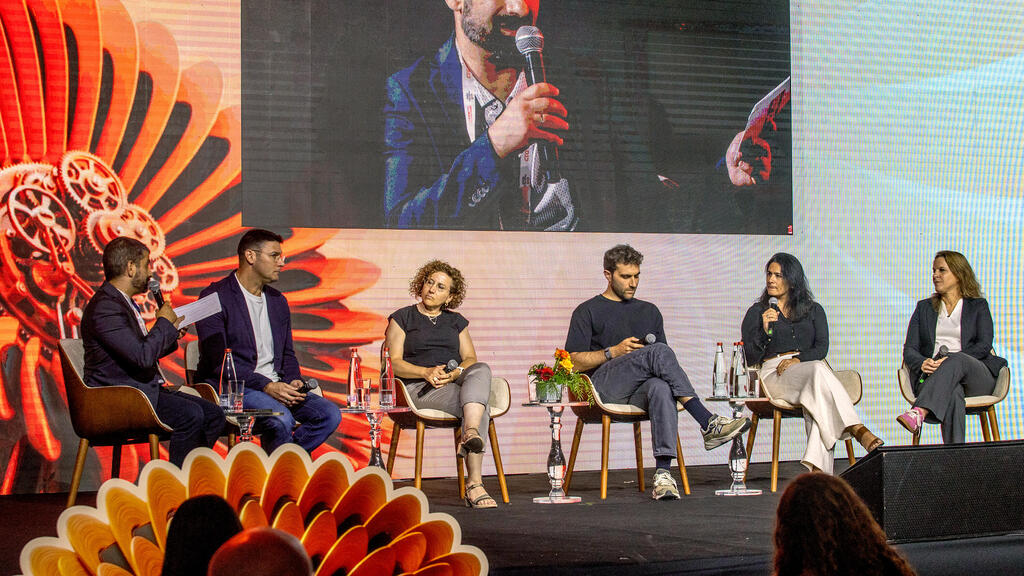
Growth Conference panel (from right): Nirit Peled-Muntz, Sivan Baron, Dor Gavizon, Nirit Cohen, Dror Litvak, Almog Azar
(Ido Erez)
Are there companies receiving more applications?
Baron: "In the current environment, there are more job applications. I can say that we have hired many new employees, and we are happy to welcome young people who want to experiment and acquire new skills."
Is there anything that can be done to reduce uncertainty?
Peled-Muntz: "I speak from the perspective of an HR tech company, and I think there is a great deal of variation between organizations. We are an organization that takes employees by the hand. We recruited 1,400 employees before the AI era, and many of them now want new tools. We try to provide them with tools and training, while thinking about what work will look like after AI. In human resources, there are many discussions about where the responsibility lies, with the organization or with the employee. Some organizations believe employees should learn on their own."
When employees begin learning AI, do they remain in the same roles?
Peled-Muntz: "For the most part, employees stay in their positions. Over the past five years, we've gone through wars, a pandemic, and constant disruption. As a result, people move between departments anyway."
How will AI affect the world of work? You argue that it is not the central issue.
Cohen: "The coronavirus reminded us that life is short, and we are witnessing a profound transformation in work. Technology has created new opportunities, and we are seeing a decline in traditional salaried employment alongside increased spending on services. In other words, people are working differently. About half of the U.S. labor market, for example, relies on additional or independent work. Today's workers can choose, they don't have to define themselves by a single role. The new tools allow a company to become a billion-dollar business with very few employees, and they also allow an individual to become a billion-dollar employee without belonging to a single company."
You argue that AI is primarily a high-tech issue. Why?
Litvak: "Our latest survey found that Israel's employment outlook remains very strong, with a net employment outlook of 26%. We tend to focus on high-tech and layoffs, but many companies across Israel continue to hire. Israel is experiencing a severe talent shortage: 86% of employers say they cannot find the people they need. This is true, for example, in manufacturing, where Israel is bringing in foreign workers because there simply are not enough workers."
According to him, the shortage is also evident in certain technological fields. "There is a shortage of hardware engineers and embedded software developers. This is particularly true in the defense sector. We see new contracts awarded to Elbit Systems and Israel Aerospace Industries almost every day as Europe continues to rearm."
What's missing? More workers?
Litvak: "Skills. The shortage stems from technological progress. Some 68% of employers are looking for people with the right skills and tools, people who know how to create and work with AI software and systems. AI does not replace people, nor does it surpass human ability."
What are employees looking for today?
Gabizon: "Flexibility, freedom of choice, and the confidence that they will be taken care of, that everything is covered. There are different personas within every company, each with different needs. One group prefers to receive a budget and shop for groceries themselves, they're the cooks. Another prefers to order ready-made meals. Then there are the loyal customers who repeatedly order from the same businesses. It's a surprising trend, but it's healthy for businesses. People simply want to make fewer decisions during the day."
According to him, "At Wolt, we chose to create a sense of security and certainty by establishing dedicated customer support for business clients. That gives employees more time to focus on work while also allowing them to enjoy themselves, rest, and connect with others."
Peled-Muntz: "We have a job architecture tool, so we decided to build an AI agent that maps every role across the organization. It was remarkable and saved 50 hours of work. We now have ten departments using it, which has been a great success. On the business side, we also use AI in our customer operations. Every account manager has an AI agent that provides updates about their customers, creating much richer interactions."
Hedva Ber said that 30% of high-tech workers will lose their jobs. Is that realistic?
Baron: "I'm not a prophet, but I think we're in a situation similar to what we experienced during the pandemic. There is uncertainty. Some companies have stopped hiring, others have laid people off, while others continue to recruit. There is hesitation about how many people to hire."
According to her, the long-term outlook is different. "Israel is a technological powerhouse, and I believe things will eventually stabilize. We will return to a different world, a different employment landscape. I don't connect with the apocalyptic predictions. People who know how to think and adapt will continue to have a place in the workforce."
What motivates employees today, not just in high-tech?
Litvak: "People are looking for workplaces with values. Much has been said about Generation Z. Their values are centered on contribution, purpose, giving, and community impact. We see this in young people who finish high school and choose a year of national service or preparatory programs focused on contributing to society. It has become an even more significant trend since October 7."
According to him, "Israel is experiencing a perfect storm: economic weakness in the U.S. and Europe, the aftereffects of the pandemic, and the dollar-shekel exchange rate. We are living through a particularly complex period, yet unemployment in Israel remains low and demand for workers continues to rise."
Is there a change in young people's priorities?
Cohen: "The psychological contract that older generations have with the workplace is different from the one Generation Z has. They question every role and take responsibility for defining their own professional identity. They understand they need to build careers differently."
According to her, "Employment models have changed. When people have more options, they become less dependent on traditional gatekeepers. They don't belong to the generation that stays in the same job until age 40 simply because they feel they can't change."
What has changed at Wolt?
Gabizon: "There is much greater willingness to try new solutions. Over the past few years, we've gone through the pandemic, repeated rounds of conflict, and many other challenges. Meanwhile, the employee meal benefits market has remained stuck with outdated solutions, requiring people to scan cards at the checkout or switch between different apps just to order lunch. That's what led us to create Wolt Benefits. It introduces fresh competition and brings new innovation to the market."
According to him, "I assume everyone knows that the partnership between Wolt and Cibus will end this year. There are voices in the market promising business as usual, but I want to make it clear that after December 31, things will not be the same. We are already seeing a significant wave of companies joining Wolt Benefits."



