










BiblioTech
CTech's Book Review: Scaling a tech company is an organizational challenge, not a technical one
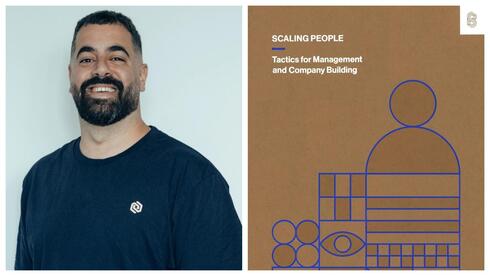
Dor Atias, Co-Founder & CPO at Cycode, shares insights after reading “Scaling People: Tactics for Management and Company Building” by Claire Hughes Johnson.
Dor Atias is the Co-Founder and CPO at Cycode, an agentic development security platform. He has joined CTech to share a review of “Scaling People: Tactics for Management and Company Building” by Claire Hughes Johnson.

Title: Scaling People: Tactics for Management and Company Building
Author: Claire Hughes Johnson
Format: Tablet
Where: Commute
Summary:
Scaling People by Claire Hughes Johnson, former COO of Stripe and longtime Google executive, is a practical guide to one of the hardest parts of building a technology company: scaling the organization behind the technology. The book focuses on the operating systems that become necessary as a company grows: how teams hire, communicate, make decisions, set goals, give feedback, and maintain alignment as more people join the organization.
Rather than treating management as an abstract discipline, Hughes Johnson approaches it as an operational problem and provides frameworks, templates, and examples that leaders can adapt to their companies.
A central idea throughout the book is that structure and process do not necessarily have to create bureaucracy. Designed correctly, they can reduce ambiguity and allow people and teams to operate with greater speed and autonomy. It makes the book particularly relevant to founders and technology leaders dealing with the transition from a small team, where context travels naturally, to a larger organization where it has to be designed intentionally.
Important Themes:
One of the most interesting themes in Scaling People is the idea that every company eventually develops an operating system, whether it designs one intentionally or not. As organizations grow, relying on a few people to carry context, make decisions, or connect different parts of the company stops working. Leaders need mechanisms that allow information and decisions to move through the organization without requiring them to participate in every conversation personally.
Another important theme is clarity. Hughes Johnson puts significant emphasis on self-awareness, direct communication, feedback, and making expectations explicit. One of her operating principles is to “say the thing you think you cannot say”: addressing difficult issues directly instead of allowing ambiguity or organizational friction to accumulate.
I also find the book’s treatment of process particularly relevant to technology companies. Engineers naturally tend to be skeptical of process, often for good reason. Bad process creates overhead and slows teams down. But the absence of process at scale creates its own overhead: unclear ownership, repeated discussions, missing context, and decisions that depend on knowing the right person.
The more useful question is therefore not whether an organization should have process, but which processes actually remove friction. A good operating system should create enough clarity that teams can make more decisions independently. In that sense, structure and autonomy are not opposites. The right amount of structure is what makes autonomy possible at scale.
What I’ve Learned:
One idea from Scaling People that strongly resonates with me is that scaling a technology company is not only a technical challenge, it is an organizational one. In engineering, we spend a lot of time thinking about architecture: what happens to a system as it grows, where bottlenecks emerge, which assumptions stop being true, and what needs to change before something that worked at one scale starts breaking at the next. Organizations have many of the same characteristics.
When a company is small, a lot happens naturally. People have context because they are in the same conversations. Decisions happen quickly because the people who need to make them are often sitting together. As the organization grows, you cannot assume that the same model will continue to work simply by adding more people.
That is where I connect with Hughes Johnson’s approach. The objective of the process should not be to control how talented people work. It should be to give them enough context, clarity, and ownership that they can operate independently without constantly escalating decisions.
For me, one of the hardest and most interesting challenges in scaling product and engineering organizations is preserving the qualities that made the company successful when it was smaller – speed, ownership, direct communication, and willingness to challenge assumptions – while introducing enough structure to operate at a much larger scale.
You can scale infrastructure by adding capacity. Scaling an organization is different. Every additional person changes communication paths, decision-making, and the way context moves through the company. Building that organizational architecture deliberately is just as important as building the technical architecture.
Critiques:
The book is intentionally tactical and contains a large number of frameworks, templates, worksheets, and suggested operating mechanisms. That is also its main limitation: not every framework makes sense for every company or every stage. For a very early-stage startup, implementing too much structure too soon can solve problems that do not yet exist and potentially remove some of the speed that gives small teams an advantage.
I would therefore treat Scaling People less as a system that should be implemented end-to-end and more as a toolkit. The useful question is not “how do we adopt this framework?” but “do we have this problem yet?” When the answer is yes, having a tested framework to start from can be extremely valuable.
Who Should Read This Book:
I would recommend Scaling People primarily to founders and engineering, product, and operational leaders whose organizations are growing quickly. It is especially relevant at the point where things that previously happened naturally start requiring intentional design: context no longer reaches everyone, founders cannot participate in every important decision, teams become more specialized, and adding people does not automatically translate into moving faster.
The book provides a useful way to think about that transition. For technology leaders in particular, there is an intuitive parallel between designing scalable software systems and designing scalable organizations. Both require understanding where complexity is accumulating, creating clear interfaces, removing unnecessary dependencies, and continuously changing the architecture as the system grows.



