









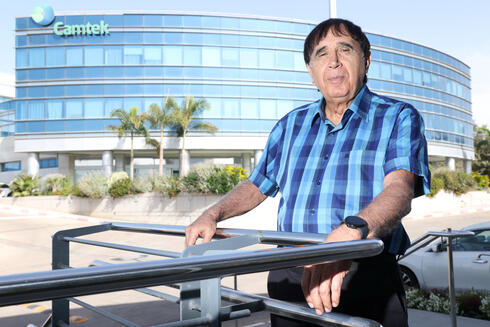
The 77-year-old former air-conditioning technician who built a $10 billion chip business and is still chasing the AI revolution
Rafi Amit turned a factory in Migdal HaEmek into a global supplier of chip inspection systems, with Camtek on track to reach record revenue of $595 million this year. Now, as AI fuels demand for increasingly sophisticated semiconductors, the 77-year-old founder is preparing for another major expansion and says he has no plans to slow down.
Rafi Amit makes a habit of traveling to hotels around the world with a voltage tester in his luggage. "If there's an issue, a flickering light bulb, a crooked picture frame, a squeaky door or a leak, I fix it immediately," he says. "Things like that drive me crazy. I have an innate urge to repair them. I simply cannot stand it when something isn't working properly."
His meticulousness, however, comes with a caveat. "You shouldn't be a perfectionist at an exorbitant cost. That's not smart," he emphasizes. "It's a matter of cost-benefit analysis. The challenge is striking the right balance between perfectionism and a reasonable price."
That balance between precision and cost lies at the heart of the business he built. Camtek, the company Amit founded in Migdal HaEmek, manufactures machines that inspect components during the complex chip-manufacturing process. The machines scan for defects, measure heights and check that microscopic connections function properly. As chip packages become increasingly complex and expensive, the cost of a defect that escapes inspection rises accordingly. "Over-detection is the industry's 'killer.' The more actual defects you manage to identify, the more of a king you are," he says.
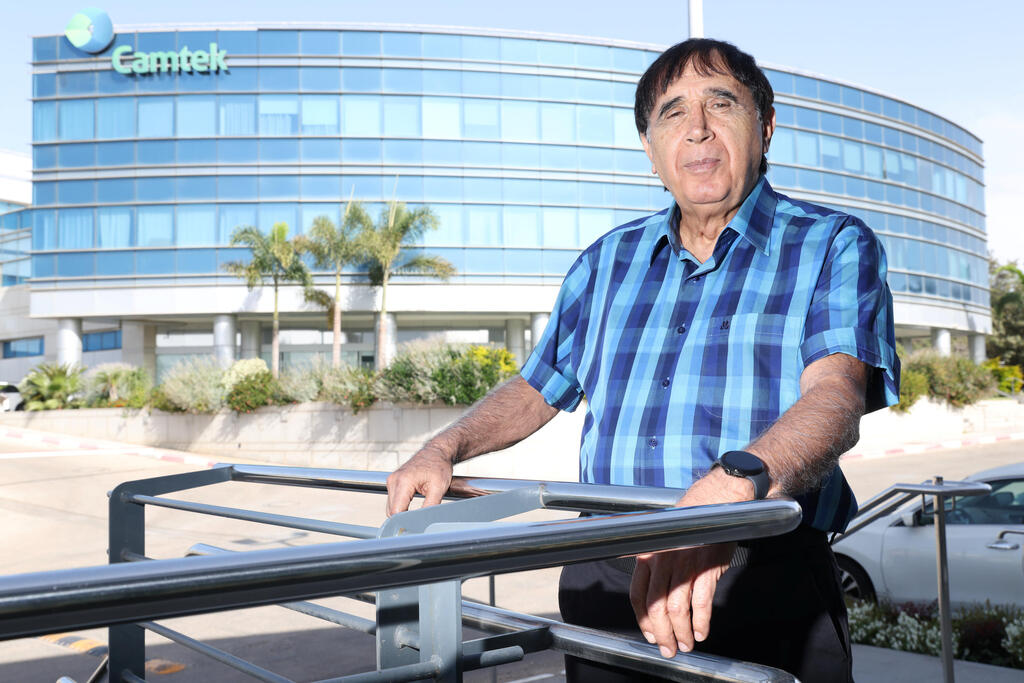
The AI revolution has made Camtek more sought-after than ever. The company joined the Tel Aviv 35 Index in 2023, and in May its market value reached a record of approximately $10 billion. It is expected to end this year with record revenue of approximately $595 million, an increase of about 20% from last year.
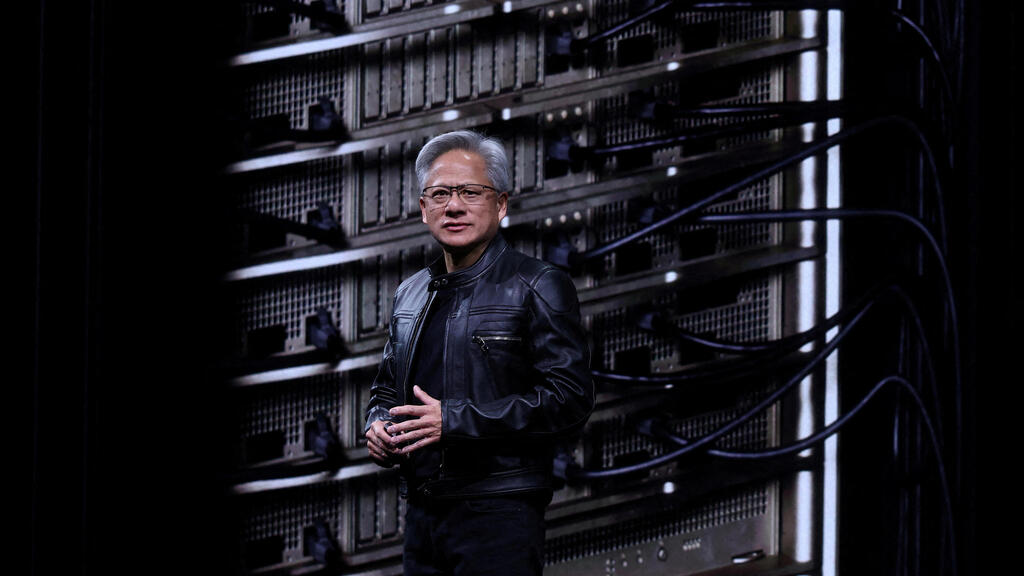
But in recent months, enthusiasm surrounding AI has begun to wane. Investors have grown increasingly concerned that the enormous sums being poured into the sector may not generate adequate returns, sending shares of many companies sharply lower. Camtek has not been spared: its stock has fallen by more than half in roughly six months. It is currently valued at approximately $4.17 billion. Reports surrounding Nvidia chief Jensen Huang have added another layer of uncertainty to an already unsettled industry.
"A strong company like Nvidia cannot depend on one person," Amit says in an interview with Calcalist. "Don't look at the immediate reaction of the market. It's always terribly nervous and hysterical at first. The reports about Huang's personal life are not the essential issue. The real concern is that Nvidia may have violated government decisions and sold components to China that it was not allowed to sell. In two weeks, the mess in the stock market will calm down, and it will become clear how much the company's real value has declined.
"This is a pendulum without economic logic. A company cannot be worth $100 billion today and, in the blink of an eye, $80 billion tomorrow. It has the same customers, the same performance and the same future. So what happened?"
In any case, Amit argues, even if Nvidia is fined and suffers damage, that will not change the underlying nature of the AI revolution or the direction in which the industry is heading. "What is happening today is not another cycle of growth. It is an infrastructural revolution," he says. "As more and more customers come to you with demands, you realize that you are in the right market, with the fastest growth and an opportunity that comes along once in a generation. If you don't take advantage of it, you won't forgive yourself."
The home: "I didn't understand what the school wanted from me. I was a late bloomer"
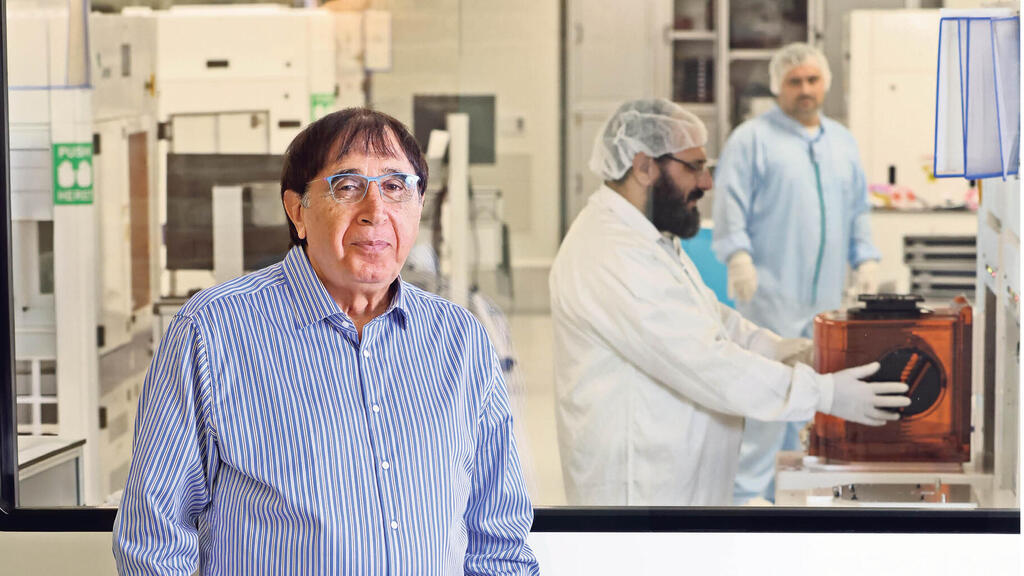
Amit walks with us across the factory floor in Migdal HaEmek, looking through a glass partition at engineers in sterile suits working among complex, delicate machinery. "Everything here is so delicate that getting dressed to enter a cleanroom is a nightmare," says the company's CEO and chairman.
Today, he divides his time between Singapore, Hong Kong, Thailand ("I vacation in Phuket whenever I need to 'clear my lungs' of all the air pollution") and Israel, where he spends only about two months a year.
"A single speck of dust can disrupt the inspection process," he says. "The importance of detecting defects early is one of the reasons why we, and other companies like ours, are growing as we are. The semiconductor industry needs yields of 99% or higher to be profitable. A single faulty component can force you to scrap an entire assembly worth thousands of dollars."
Amit grew up in Haifa's French Carmel neighborhood. He describes himself as a tenth-generation Israeli, with family roots in Morocco and Persia, and once worked as an air-conditioning technician.
"My father was an intelligent and curious man, but life led him to become a car mechanic," he says. "Back then, the world was divided into the wealthy and the working class. There was no middle class. I remember my father telling me, 'You don't want to be a mechanic in a garage like me? Then study.'
"I grew up in a world of Holocaust survivors. Everyone lived with very little. My mother grew up in a household that depended entirely on her brother's income. When he died, the family fell apart. My mother was still a schoolgirl, but she had to drop out to look after a household of eight siblings and a mother who was unable to function. Survival came before everything else."
"I'm what you'd call a late bloomer. I finished high school with grades of 5 or 6. I didn't even understand what was expected of me. But I excelled in the army, where I served as a commander in the Armored Corps. After my discharge, I worked for a while as an air-conditioning technician at Electra. That was the trade I had learned in school. I worked in the field for a few years and was quite content, but one thought kept nagging at me: 'Is this what lies ahead for the rest of my life?'
"So, at the age of 22, I enrolled in a preparatory course for the Technion and went on to study industrial engineering and management. I hit the reset button on everything I had ever been taught."
Amit began his entrepreneurial journey after working as a manager at medical technology company Elscint. "I managed a department and established a printed circuit board (PCB) factory in Ma'alot. At one point, I noticed that market demand for circuit boards exceeded supply, and I wanted to expand the facility. But I was told, 'No. Our focus is on medical equipment, not printed circuit boards.' So I decided, 'Fine, I'll do it myself,' and set out to establish a PCB business."
In 1981, Amit joined a group of senior executives from Elscint to establish a plant in Migdal HaEmek producing printed circuit boards for the electronics industry. The factory's operations required rigorous inspection, and the expertise developed in that process eventually led to the founding of Camtek in 1987.
"At first, our inspection process consisted of a woman looking at components through a magnifying glass, searching for short circuits, open circuits or scratches," Amit recalls. "I thought to myself, 'This makes no sense. What if she stops to scratch her head for a moment?' It was clear that the process had to be automated. I described my idea to Zvi Netter, a chief engineer at Elscint, and proposed a way to make inspection faster and more accurate. He turned that vision into reality."
Camtek's first machine was based on optical imaging technology. It could not yet identify defects automatically, but it helped direct the inspector's attention to anomalies. "Later on, the algorithms, the software capable of detecting defects independently, came into the picture," Amit says.
The next expansion came in 1997, when Amit established a sister company, Ametek, to develop advanced substrates for the chip industry. Access, an Ametek subsidiary that manufactures these substrates in China, is now preparing for an IPO on the Shenzhen Stock Exchange. Market estimates put its valuation at between $1 billion and $2.5 billion.
At the turn of the millennium, as profitability in the printed circuit board sector declined, Camtek moved into the semiconductor industry. "We realized we needed to move into a more challenging and sophisticated arena, one where it was actually possible to generate decent profits," Amit says.
The technological leap was considerable: Camtek moved from detecting defects measuring tens of microns on printed circuit boards to identifying microscopic defects at the nanometer scale. "We used to sell inspection machines for printed circuit boards for $15,000. Today, a machine for inspecting semiconductor chips costs more than $1 million."
Amit also moved closer to the company's customers, opening the door to markets in Asia. In 2003, he relocated to Hong Kong, following the growing concentration of Camtek's and the PCB business's customers in the region. His responsibilities included recruiting sales managers, establishing service and support infrastructure, and meeting customers.
"You need a personal touch. You have to understand the culture and the client's needs," he says. "A CEO isn't just another salesperson. He has the power to make things happen."
More than a decade ago, Camtek gradually moved into advanced packaging, the process of assembling specialized, sophisticated chips, including GPUs, central processors and high-speed memory components, into tightly integrated packages designed to work together with extreme precision.
"We realized that if the market was moving toward greater computing performance, this would become its main growth engine and, by extension, the growth engine of the entire semiconductor sector. We were among the first to identify this trend, and today it accounts for approximately 80% of the company's operations."
4 View gallery
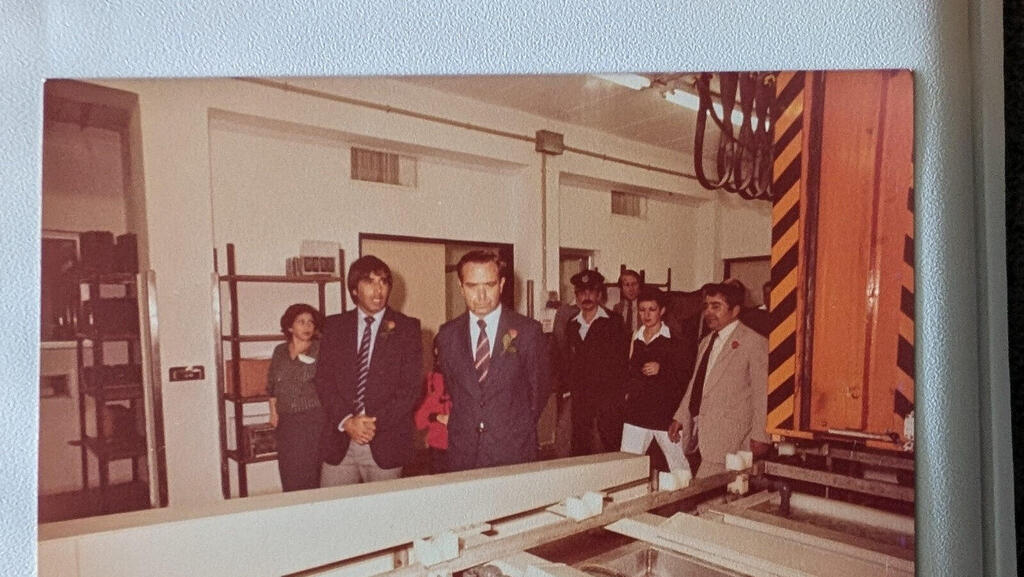
Amit at the 1981 PCB plant inauguration in Migdal HaEmek
(Photo: Courtesy of the interviewee))
As demand shifted toward chip inspection, Amit decided to shed other activities and concentrate on the business's emerging growth engine. "In 2017, we sold our printed circuit board inspection division to the Chinese fund Principle Capital for approximately $35 million. In 2018, we sold our controlling interest in the PCB business to the FIMI fund for approximately NIS 125 million."
When the AI boom took off, Camtek was well positioned to benefit. The demand for computing power surged, driving chipmakers to invest more heavily in specialized inspection equipment. Today, Camtek's machines are part of production lines at TSMC, the world's largest chipmaker, as well as Samsung, IBM and Intel.
"This is the result of many years of accumulated knowledge," Amit says. "The more machines you install, the more experience you gain. You begin to understand what the next generation will look like. That's a tremendous asset. When customers needed a quick solution, they discovered that we had already been around for quite some time. All we need to do is make sure we remain the best and avoid stumbling. When the revolution arrived, I was already prepared."
The challenge: "You can't stop the AI train. It's an arms race"
Amit has guided Camtek through several market upheavals, from its IPO in 2000, just as the dot-com bubble was bursting, through the lows of the 2008 financial crisis and the recent surge driven by AI companies. That experience has left him relatively unfazed by the latest pullback in AI stocks.
"During the 2008 crisis, the stock plunged to 30 cents. Investors pressured us to sell, telling us, 'Get rid of it at any cost.' Later, when the price jumped to $2 a share, investors again urged us to sell, this time out of fear that we would fall back to our previous low. So I don't get rattled. When you're running a public company, you have to know how to handle this."
The AI business continues to grow, yet investors are anxious. Is this a bubble that is about to burst?
"Developing artificial intelligence requires massive investment. Companies have taken on debt and are burdened by interest payments, yet they have not figured out a business model that generates a return on those investments. That's why we're seeing a downturn right now. Clearly, something has to change to justify the current situation. But ultimately, they will find a way to reach the break-even point. This infrastructure is simply too important for that not to happen."
This year, you set an ambitious goal of doubling revenue within three years. Do you still believe that is realistic?
"I'm very confident in the trajectory. Looking at my order book for the coming year, I can say that by 2028 we will be completely swamped with orders."
Over the past year, calls for greater regulation of AI have grown louder, particularly among Democrats in the United States, who made gains in this month's midterm elections. Are you concerned about the impact?
"Analysts are always looking for new sources of anxiety. In this case, the fear is that if the Democrats hold a majority in Congress, they might try to restrict the construction of data centers because of their environmental impact. That doesn't necessarily mean it will happen.
"Access, our company in China, is part of the semiconductor industry's supply chain. The current lead time for equipment in this sector is 28 months. It's a crazy situation, driven by sheer demand. Everyone is scrambling for equipment. This train has already left the station. AI cannot be stopped, because we simply cannot function without it. It's like suggesting that we strip the world of oxygen. Clearly, whoever controls artificial intelligence will control everything. No one can afford to lose this war.
"China is investing enormous sums in this field, and the Western world has no choice but to fight back. The United States is trying to prevent China from obtaining the chips it needs to build advanced server farms, knowing that if it loses its lead to China, it will be in serious trouble. This is an arms race, much like the race to acquire nuclear weapons. The market will not shrink. It will intensify."
What's the next step?
"The world of physical AI. That's the next revolution, and it will reach every end-user product. Instead of relying on the cloud, you buy a powerful computer, load it with all the necessary software and algorithms, and it provides answers locally, right where you are. You no longer depend on server farms in some distant corner of the world or on communication lines. For us, that means dealing with even more complex components that require rigorous testing."
The factory: "We were driven by incentives, not sentiment"
To carry out Camtek's growth plans, Amit must now deal with a series of practical challenges: building permits, recruitment and finding enough floor space for additional machinery.
"Becoming a global company based in Israel is an achievement in itself," he says. "Yet Israeli institutional investors only began investing in Camtek in recent years. Before that, they didn't even consider us. That wasn't the case with our American investors and customers. So if we're a Cinderella story, it's only from an Israeli perspective. We've been here all along. They just weren't paying attention."
How are you preparing to make sure you don't miss the opportunity?
"We have to plan three years ahead. We need to deal with building permits, which take two years to obtain in Israel. I currently have 600 to 700 employees in Israel, and I'll need twice that number. Where will I put them? We also work with three local manufacturers that build the base machinery for us. I have to make sure my manufacturing partners have enough parts in stock and are preparing for my expansion, so they don't leave me stranded. On top of that, I need space for cleanrooms and offices. All of this is going to happen right here."
That "right here" is Migdal HaEmek, where Amit arrived in the early 1980s looking for a location for his first printed circuit board factory.
"I was looking for a development town. I first went to Afula and met with the mayor, but the attitude there completely put me off. You come to build a factory and develop the city. You expect them to roll out the red carpet, but instead it felt as though they were doing me a favor just by talking to me. Then someone told me, 'Migdal HaEmek is about to be designated a development area. Give it a try.' Shaul Amor, who was head of the local council at the time, told me immediately: 'Whatever you need, it's yours.' He understood that industry is the lifeblood of these development towns. Look around. Today, this area is home to industry giants such as Tower, KLA, our company and Eastronics."
What makes this particular area a hub for the chip industry?
"Incentives. We didn't come here out of sentiment. State benefits for development zones attract investors, and we received a very significant incentive: loans and a grant covering 70% of the investment, along with tax benefits. If similar incentives were offered in Kiryat Shmona, factories would move there. This is an industry that requires endless investment, and the state shares that risk with us.
"Camtek pays a tax rate of less than 10%, indefinitely. In Tel Aviv, we would be paying 30%. This kind of production is possible elsewhere, too. For example, the Canadian investment group AWZ is currently looking to establish a chip manufacturing plant in Ashkelon. It's a massive NIS 5 billion investment. Without substantial government support, it simply wouldn't happen. You cannot talk about the fear of an embargo without developing local capabilities."
What could derail your plan to reach $1.2 billion in sales?
"Failing to meet development schedules, or losing our competitive edge because we fall behind technologically. And then there are black swan events, such as war. If Ben Gurion Airport shuts down and no planes can take off or land, parts for our machinery won't arrive. What do you do in that situation? Israel is classified as a high-risk country, and investors don't like that."
Many in the West believe China could invade Taiwan next year. What would happen to the semiconductor industry in that scenario?
"If that happens, everything is gone. It's game over. Taiwan is home to chip giant TSMC, which supplies components for everything from smartphones to weapons. The United States is building its own semiconductor plants, but production has not yet begun. So if China invades Taiwan, it is effectively declaring a world war, because TSMC's role is absolutely critical. Without it, the West would have no phones, no missiles, no aircraft, nothing. Who could afford to let that happen? That's why TSMC serves as an insurance policy for Taiwan. They know the world cannot function without their chips."
You find yourself caught between a rock and a hard place. You have a company in China, while Taiwanese and American companies are among your key customers. Could you be forced to choose between the United States and China?
"Theoretically, yes. Practically, less so. Ultimately, there is intense interdependence between these countries. China remains the world's largest manufacturing center, and giants such as Tesla and Apple rely on it. You cannot simply move a supply chain from China to another part of the world overnight."
The future: "Industry war games are how I keep my edge"
The controlling interest in Camtek is divided between Israeli holding company Priortech, which Amit helped establish and owns 21%, and Taiwanese technology company Chroma, which holds 17%. The remaining shares are held by the public.
"We have a strong, strategic core of shareholders who aren't looking for quick profits," Amit says. "That provides a great deal of stability, which is crucial given the cyclical nature of the semiconductor industry. A strong controlling group doesn't panic during periodic downturns. It focuses on the long term."
Don't you dream of an exit?
"The American company KLA has wanted to acquire us many times, but doing so would have meant losing the Chinese market, so we passed."
Why continue dealing with the pressures of running a public company?
"Sure, you could sit back and relax with a private company, free from all that stress. But there are advantages to being public. An employee can earn hundreds of thousands of dollars simply because the stock price rises. It's a powerful tool, but it also means you have to work hard to demonstrate growth."
You're 77. Haven't you grown tired of all the drama?
"Quite the opposite. War games are the best workout for the brain. When a competitor launches something new, you immediately start thinking about how to close the gap. You're constantly forced to come up with solutions, and that keeps you sharp. Going to the cinematheque or reading books is all well and good, but without these war games, you're just being passive."
How much longer will you keep going?
"I don't have an expiration date. As long as I remain sharp and can analyze things accurately, I'll keep at it."



