










BiblioTech
CTech’s Book Review: Practical tools for scenario creation
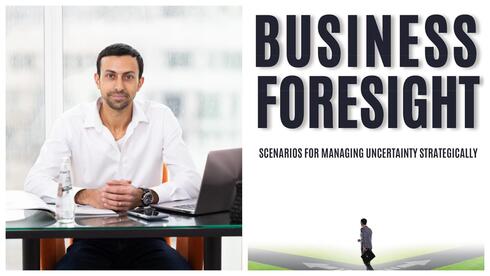
Alon Pinhas, CEO of WeCcelerate, shares insights after reading "Business Foresight" by Tony Grundy.
Alon Pinhas is the CEO of WeCcelerate, a startup consulting company. He has joined CTech to share a review of “Business Foresight: Scenarios for Managing Uncertainty Strategically” by Tony Grundy.
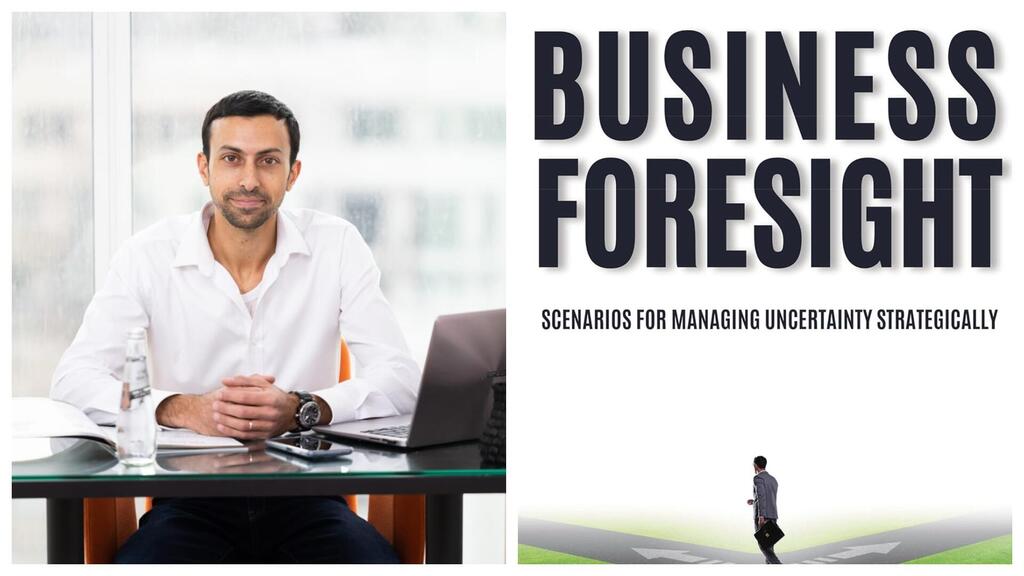
Title: Business Foresight: Scenarios for Managing Uncertainty Strategically
Author: Tony Grundy
Format: Book
Where: Home
Summary:
In this book, Grundy confronts the constant “fog” of uncertainty that has become an integral part of organizational management and business strategy. He offers practical tools for scenario creation and systems thinking that enable leaders to “look beyond the horizon” and plan strategic responses to situations that are inevitable but unpredictable.
His approach acknowledges that the future cannot be forecast with precision, yet organizations can develop the capability to manage multiple possible scenarios, identify risk hotspots, and cultivate greater strategic agility. The book includes real-world cases and exercises that help managers apply these ideas directly to their day-to-day work.
Important Themes:
A central theme is scenario planning, not only preparing for the ideal outcome but also for situations in which “things do not go according to plan.” Grundy outlines a structured methodology for developing several scenarios, analyzing their impacts, and pre-deciding the appropriate organizational response to each.
Another key theme is systems thinking and strategic flexibility. The book emphasizes the importance of internal mechanisms that enable rapid change, organizational learning, and adaptation to shifting environments. Organizations that simply “replay” old strategies will struggle in a world defined by uncertainty.
Grundy also highlights the importance of early warning signals like learning to detect small but meaningful changes in the environment, recognize emerging trends, and act before others do. This is especially critical during periods of geopolitical, technological, or consumer-driven change.
Finally, the book stresses that uncertainty is not a temporary crisis but an enduring condition. Therefore, organizations must build cultures that embrace fluctuations rather than resist them. Managers are encouraged to become “ready for uncertainty,” not merely to wait for stability to return.
What I’ve Learned:
Reading the book made it clear that tools like “what-if” scenario mapping are not luxuries but essential capabilities especially in today’s environment in Israel and globally. Grundy’s framework of “analyzing 3–4 scenarios, identifying risks and opportunities, and preparing response maps” provides a practical foundation for forward planning. For example, instead of building a single correct strategy and hoping reality aligns with it, he advocates crafting a primary plan alongside a contingency plan, supported by predefined trigger points. This approach clarified for me how to maintain both flexibility and control.
I was also struck by the concept of identifying early signs of change: rather than relying on assumptions that were valid yesterday, leaders must regularly reassess their environment whether through emerging trends, regulatory shifts, or new technologies. The book helped me appreciate that uncertainty is not only a threat but also an opportunity. Organizations that know how to leverage it can gain a real competitive edge.
Lastly, the psychological aspect resonated with me: embracing uncertainty, preparing teams for it, and building a culture capable of adaptation. Grundy repeatedly emphasizes not fearing change but accepting it as part of the strategic landscape.
Critiques
The book is highly practical and focused, but several aspects could be improved:
- It is geared primarily toward large organizations or consulting environments, making it slightly less accessible for small companies with limited resources.
- While the scenarios are comprehensive, there is less emphasis on how to implement them in smaller organizations or heavily regulated industries, where constraints are tighter.
- As the book leans heavily on conceptual frameworks, it includes fewer “real failure” stories and detailed case studies of organizations that collapsed due to lack of scenario planning. More of these would have added valuable depth.
Overall, these are minor limitations compared to the significant value the book provides, but they are worth noting.
Who Should Read This Book:
I would recommend this book to CEOs and senior executives leading companies in an era of geopolitical, technological, and regulatory uncertainty. It is also highly relevant for strategic planning managers or department heads responsible for preparing their organizations for multiple “what-if” situations.
Consultants and strategy teams who need practical tools for scenario planning and adaptive strategy will gain tremendously from it.
Finally, it is a strong read for management students and independent consultants seeking a broader perspective for advising clients or preparing to lead organizations themselves. The book offers a compelling mindset and framework for becoming “ready to respond,” not just “ready for what is expected.”



