










Israel’s tax revenues are booming. The real budget crisis is still ahead
Tax collection is expected to hit the state’s 2026 target of NIS 555 billion, but Tax Authority chief Shay Aharonovich warns that the fiscal picture will become far more difficult in 2027 and 2028 as defense costs remain high and the Compensation Fund runs dry.
Israel's state revenues in 2026 are masking a deeper fiscal problem. After nearly three years of war, a surge in defense spending, credit-rating downgrades and a sharp rise in debt, tax collection continues to surprise on the upside. “Collection this year is good, very good, and pleasantly surprising,” Tax Authority Director Shay Aharonovich said this week. “But expenses are surprising too,” he immediately qualified. He does not appear particularly worried about the current year, he estimated that even if revenue collection weakens in the coming months, the state is still expected to meet its annual revenue target of about NIS 555 billion, but rather about what lies ahead.
What Aharonovich said this week at the annual Duns 100 forum for senior tax-industry figures, held by Dun & Bradstreet, shows just how dangerous it would be to conclude that Israel's budget problem is behind it. In a conversation with Calcalist, Aharonovich elaborated on the thinking behind the numbers, speaking less about 2026 than about the fiscal challenges looming in 2027 and 2028.
The message is clear: strong revenues this year do not eliminate the need to find new sources of income in the coming years, and on the scale of billions of shekels.
1 View gallery
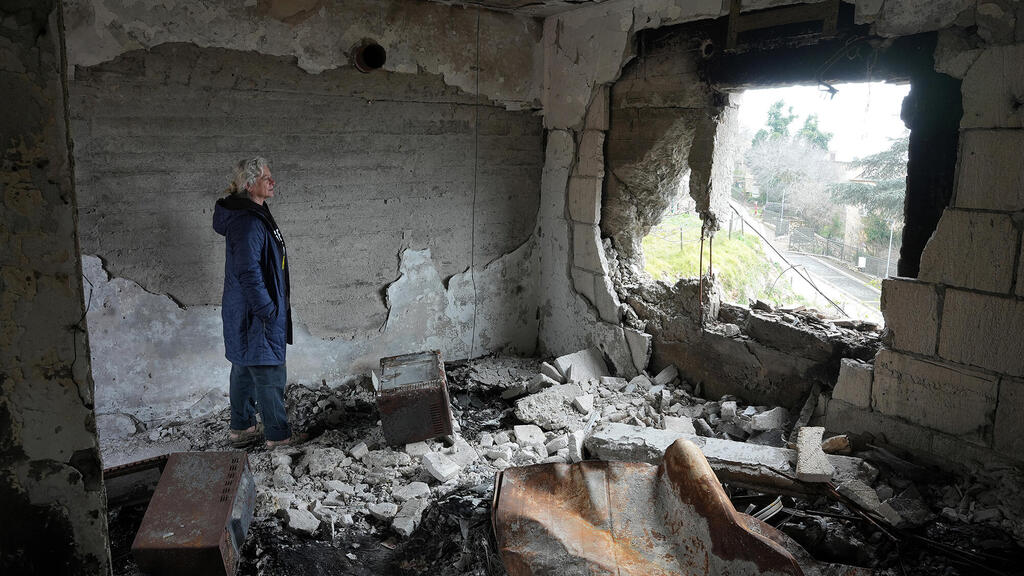
A house in Kibbutz Manara that has not yet been restored after being hit by a missile during the Iron Swords War.
(Photo: Efi Sharir)
The most prominent example is the Compensation Fund. Since the war broke out, the fund has paid out billions of shekels, and in 2024 and 2025 the full proceeds of the purchase tax were directed to it. At the forum, Aharonovich said only a few billion shekels remained in the fund and that “this story is over”: in all likelihood, as soon as next year, money will need to be transferred to it from the state budget.
In 2026, the share of purchase-tax proceeds allocated to the fund was cut again, to 25%. In his conversation with Calcalist, Aharonovich estimated that roughly NIS 4 billion remains in the fund and that no further extraordinary measure will likely be needed in 2026. But heading into 2027, he said, it will be necessary to reconsider directing 75%, or even 100%, of the purchase tax to the fund. The purchase tax itself yields about NIS 7-8 billion even in a weak year, he said.
And this is exactly where the good news on tax collection meets fiscal reality. Diverting the purchase tax to the Compensation Fund does not create new money. It simply takes revenue that currently funds the budget and redirects it elsewhere. At the same time, defense spending is not expected to return to pre-war levels, while some of the measures that have boosted state revenue in recent years were temporary.
Aharonovich is therefore already opening the toolbox for the 2027 budget. What alternatives are there? He does not support raising corporate tax because of the potential damage to growth. He is also not enthusiastic about another VAT hike, arguing that there is a limit to how much additional tax the public can absorb through consumption.
Instead, he proposes examining taxes and distortions that could have a smaller economic impact: reinstating the property tax on land, introducing a mileage tax on all vehicles, reinstating the tax on sweetened beverages and disposable tableware, and narrowing existing exemptions.
Property tax on land is perhaps the most important example. Aharonovich noted that the proposal had already passed significant legislative stages and reached the Knesset Finance Committee, but was halted when the war forced the government to scale back the Arrangements Law. In his view, this is the kind of tax that should be brought back to the table, mainly because it does less damage to growth than another increase in direct taxation.
Sacred cows are also starting to come under scrutiny in the housing market. At the forum, Aharonovich said that simply requiring the reporting of rental income could bring the state about NIS 1.5 billion, without changing the exemption itself. In his conversation with Calcalist, he added that the measure is already awaiting a vote in the Finance Committee and that he expects it to pass. As for the tax exemption on a residential apartment, he is not proposing to cancel it overnight, but he also does not think it should be off-limits for examination.
A proposed VAT collection reform also illustrates the direction. The idea is to move to cash-basis collection, meaning a business would remit VAT to the state when it actually receives payment. For the Tax Authority, this would also amount to an enforcement revolution. Aharonovich estimates that the move could add “a few billion a year” to state coffers, mainly by reducing fictitious invoices and tax debts.
The objections are clear, and Aharonovich acknowledges them: under the system, the state could receive VAT immediately while businesses would have to wait for input-tax credits. He says the new system would be fully synchronized to address that problem.
The most interesting part of the conversation with Calcalist concerns high-tech. Aharonovich says that according to data held by the Tax Authority, more than 50% of new startup companies are now incorporated in the US, whereas three or four years ago most companies were incorporated in Israel.
In his view, this is a shift that cannot be ignored. A company incorporated in the US can still be liable for tax in Israel if its control and management are located here. But as registration, directors and corporate activity move abroad, Israel risks gradually losing its business center of gravity, and eventually part of its tax base.
This is where Aharonovich's tax philosophy comes into sharper focus. On one hand, he proposes a “carrot”: examining a benefit similar to the American QSBS, which grants tax benefits to investors in qualifying young companies. On the other hand, he reveals that a “stick” has also already been proposed to the Tax Authority: conditioning the tax benefit for employees receiving options under Section 102 of the Income Tax Ordinance on the company being incorporated in Israel.
This is not a marginal proposal. Section 102 is one of the central mechanisms through which Israeli high-tech companies compensate employees with options and shares. Using it as an incentive for incorporating companies in Israel could turn it from an employee-taxation mechanism into an instrument of industrial policy. The fact that such an option is already under discussion shows how concerned the Tax Authority is about the trend.
And this is where the paradox lies. The Tax Authority is looking for new sources of revenue, but at the same time it knows that not every tax shekel comes at the same economic cost. Raising corporate tax can bring in money in the short term while potentially pushing companies and investment abroad over the longer term. A land tax or the narrowing of an exemption, by contrast, may generate revenue at a lower cost to growth.
This is essentially the approach Aharonovich laid out this week: fewer across-the-board tax-rate increases, more broadening of the tax base, eliminating distortions, improving enforcement, and taxing assets and exemptions whose economic cost is relatively low.
What is clear is that the Tax Authority director is not dazzled by one good year of collection. He understands that the economy remains in the midst of a serious fiscal problem. The future, he argues, is less encouraging: the Compensation Fund is running dry, defense spending will remain elevated, some sources of state revenue are temporary, and in 2027 and 2028 the structural bill for the war years will become harder to avoid.
The question is no longer whether the government will need to find more billions of shekels. It is where it will look for them, and who will ultimately pay the bill. The fact that the Tax Authority is already discussing alternatives suggests that the debate over Israel's post-war tax system has begun well before the war's fiscal consequences have been fully absorbed.



