










The US-China summit revealed a world no longer dominated by Washington
Economic interdependence and geopolitical rivalry now define the global order.
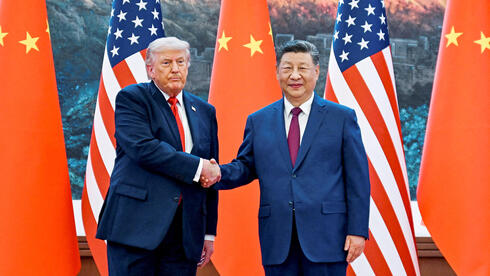
The meeting held last week between US President Donald Trump and his Chinese counterpart Xi Jinping may, in retrospect, be remembered as a turning point in global geopolitics: the moment the international system began shifting from a unipolar world dominated by the United States to a bipolar order shaped by two competing superpowers.
The significance of the summit did not lie in a trade agreement, tariff reductions, or even the reported multibillion-dollar deal for China to purchase 200 Boeing aircraft. The deeper shift was the implicit mutual recognition of a new global balance of power.
1 View gallery
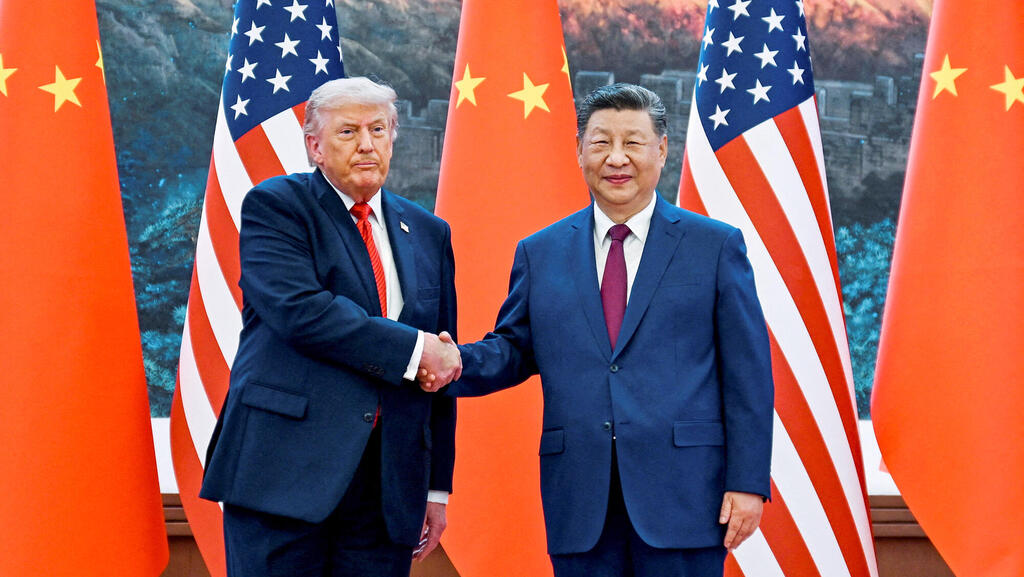
Chinese President Xi Jinping & US President Donald Trump in Beijing
(Kenny Holston/Pool via Reuters)
The essence of the summit was reflected in the language, tone, symbolism, and messages exchanged between the two leaders, and perhaps even more importantly, in what remained unsaid but clearly understood. For decades, Washington treated China as a rising power: a vast and increasingly wealthy nation operating within the US-led liberal order established after World War II.
Even after China became the world’s manufacturing hub, accumulated massive foreign exchange reserves, built the world’s largest navy, emerged as a technological powerhouse, and became one of the largest holders of US debt, many in Washington still believed Beijing would stop short of becoming a true peer superpower. The message emerging from Beijing last week suggested otherwise.
The summit may ultimately be summarized by one sentence: Xi’s warning to Trump about the “Thucydides Trap,” the theory popularized by political scientist Graham Allison describing the heightened risk of war when a rising power challenges an established hegemon. Xi’s remarks were not conciliatory. Rather, they amounted to a geopolitical declaration: the United States is the aging power, China is the ascending one, and the world is no longer unipolar.
Trump’s response was equally notable. Instead of the confrontational and often combative style that has characterized many of his meetings with foreign leaders, he adopted a restrained and respectful tone in Beijing. Trump praised Xi, referred to him as a “friend” and a “great leader,” and signaled recognition of China’s central role in the global order. In symbolic terms, it was Trump, rather than Xi, who made the diplomatic pilgrimage.
Interdependence and the Limits of Decoupling
Perhaps the clearest symbol of the summit was Trump’s delegation itself. Rather than a purely diplomatic entourage, it resembled a gathering of American corporate power. Among those accompanying Trump were Jensen Huang, Elon Musk, Tim Cook, Larry Fink, Stephen Schwarzman, along with senior executives from Citigroup, Goldman Sachs, Visa, Mastercard, Qualcomm, Meta, GE Aerospace, and Boeing.
The delegation highlighted a core contradiction in the US-China relationship. Despite years of rhetoric about decoupling, supply-chain diversification, tariffs, and technological containment, corporate America remains deeply dependent on China as both a market and manufacturing base.
This is not a Cold War in the traditional sense. Unlike the US-Soviet rivalry, the two powers remain deeply economically intertwined. That interdependence may itself be the defining feature, and constraint, of the emerging global order.
The reported Boeing agreement illustrates this reality. Beyond the numbers, the significance lies in China resuming large-scale purchases of American aircraft after years of tariffs, export controls, and technology restrictions. For Xi, it was a strategic gesture. For Trump, it offered a politically valuable promise of American manufacturing jobs ahead of the midterm elections.
Rare Earths and the New Strategic Order
Another key issue underpinning the summit is China’s dominance in rare earth minerals. Beijing controls more than two-thirds of global rare earth mining and roughly 90% of global processing capacity. These materials are essential for semiconductors, electric vehicle batteries, advanced weapons systems, and AI infrastructure.
A decade ago, geopolitical power centered on oil. Today, control over rare earth minerals increasingly shapes technological and economic influence. The United States may design the world’s most advanced chips, but many of them still depend on minerals processed through Chinese supply chains.
Technology has therefore become central to national power. The rivalry between Washington and Beijing is no longer merely commercial; it is a struggle over control of the technologies that will define the 21st century. While the US maintains advantages in AI and advanced chip design, China holds structural advantages in manufacturing, supply chains, market scale, and strategic materials.
Taiwan, Iran and Managed Rivalry
Taiwan also featured prominently in discussions between the two leaders. According to American sources, Xi warned that mishandling the Taiwan issue could lead to direct confrontation between the two powers. Taiwan sits at the intersection of Chinese nationalism, American military influence, and the global semiconductor industry, making it perhaps the most dangerous flashpoint in the emerging bipolar order.
At the same time, both leaders appear to recognize that direct confrontation currently serves neither side. China still relies on access to Western markets and global stability, while the United States remains dependent on Chinese manufacturing capacity, supply chains, and strategic minerals.
The Iranian issue reflected similar pragmatism. The two sides reportedly agreed that Iran should not acquire nuclear weapons and discussed the importance of keeping the Strait of Hormuz open. Yet neither side showed any willingness to abandon its broader strategic interests: China will continue cooperating economically and militarily with Iran, while the US will maintain arms sales and support for Taiwan.
The summit therefore did not produce a classic détente or major diplomatic breakthrough. Instead, it reflected something more restrained but potentially more consequential: an understanding that rivalry between the two superpowers is inevitable, but that escalation must be carefully managed.
After nearly a decade without a meeting between the two leaders, the summit ended with a clear signal that a new world order is emerging, one defined not by the end of globalization, but by deep economic interdependence alongside intensifying strategic competition between two rival superpowers.



