










After raising more than $40M, Mentee demonstrates practical use case for humanoids
Two V3 robots complete a multi-step logistics task autonomously, showing progress toward commercial deployment.
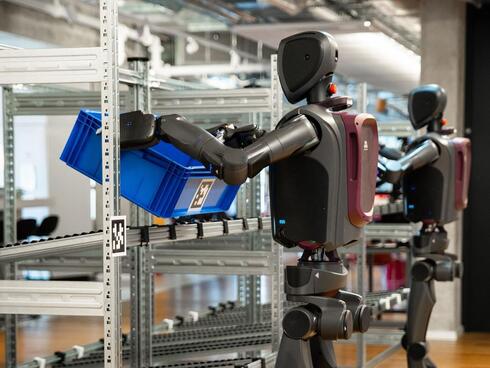
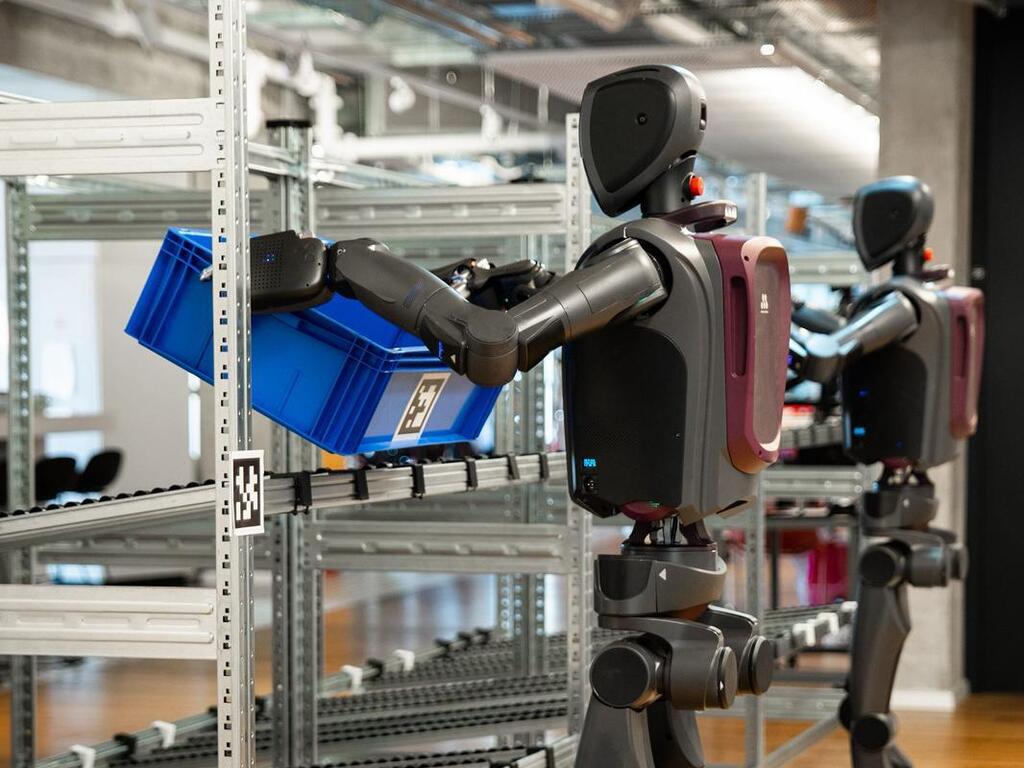
Mentee Robotics has released a new demonstration of its V3 humanoid robots, offering one of the clearest indications yet of how the company intends to translate years of academic research into practical, commercially relevant systems. In the latest test, two MenteeBots worked in tandem to complete a logistics task, autonomously picking boxes from piles of varying heights and placing them across multiple racks. The robots operated without any teleoperation, relying instead on locomotion, manipulation, and decision-making systems designed for real-world deployment rather than controlled lab conditions.
The company said the demonstration underscores how humanoid robots can support warehouse operations by taking on repetitive physical tasks that require stability and precision. Beyond the choreography of the coordinated workflow, the test is meant to show consistent behavior when interacting with real objects, a hurdle that has slowed progress across the broader humanoid robotics field.
Mentee Robotics was founded in 2022 by Mobileye founder Prof. Amnon Shashua, who serves as chairman; CEO Prof. Lior Wolf, formerly a senior scientist at Facebook AI Research; and Prof. Shai Shalev-Shwartz, a leading machine-learning researcher. The company has raised over $40 million and employs roughly 70 people.
The humanoid robotics sector is entering an inflection point, with two competing philosophies shaping how robots perceive and act in the world. One emphasizes end-to-end vision-language-action (VLA) models, single, unified systems that attempt to couple perception, understanding, and control. The other relies on modular architectures that divide navigation, perception, and manipulation across coordinated subsystems.
Mentee’s latest update makes clear where the company stands. While VLA systems are appealing for their elegance, the company argues they remain unreliable outside research settings due to their computational demands, brittle generalization, and difficulty learning new tasks from limited demonstrations. Mentee instead pursues a hybrid modular strategy designed to produce robots that are “reliable, adaptable, and easy to deploy” in real workplaces.
According to the company, the approach integrates three layers: strong pre-trained perception and language models; reinforcement-learning-based control policies trained at scale with new simulation-to-real techniques; and a robotic API language, powered by an LLM, that breaks down tasks into modular flows with built-in error handling and recovery. This structure, Mentee says, ensures that robots can be taught complex tasks from a single demonstration, refined through automatic curriculum learning, and adapted continuously without requiring large engineering teams.
The company emphasizes that all control and perception run onboard in real time, enabling “safe, reliable, and latency-free” operation, an important consideration for robots performing physical work alongside humans.



