








Analysis
Why Disney is licensing AI instead of fighting it
The OpenAI deal reflects a shift from blocking technology to shaping it
For nearly a century, Mickey Mouse was the most tightly protected character in popular culture, not just a cartoon icon, but a strategic corporate asset. Disney built around him a dense web of copyrights, internal rules, and legal enforcement that ensured near-total control over how he appeared and what he represented. Mickey existed only within contexts that adhered strictly to Disney’s code of ethics, with no room for deviation or reinterpretation. It was a model suited to an era in which content was created by a few and consumed by many.
Generative AI has disrupted that balance. Not because it produces better or worse content, but because it has turned creation itself into a distributed, everyday act, one that is increasingly difficult to police. Iconic characters no longer live solely in films and television series. They now appear in prompts, viral videos, and private experiments, far from studios and legal departments. Mickey Mouse has been there for some time already, not thanks to licensing and regulation, but despite them. In other words, he is there because technology, as it so often does, has moved ahead of the rules.
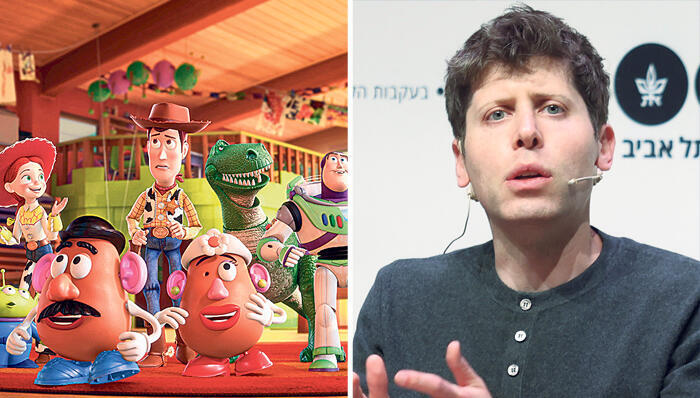
One version of Mickey Mouse
The agreement between Disney and OpenAI is born out of this new reality. Under the deal, Disney is investing an estimated $1 billion in OpenAI and granting it a limited, time-bound license to use its characters and fictional worlds, including Mickey Mouse, Marvel, Pixar, and Star Wars, to generate images and videos on platforms such as Sora and ChatGPT Images.
The license comes with clear restrictions: no use of human voices or likenesses, and no deviations from contexts that meet Disney’s brand standards. At the same time, Disney becomes a strategic customer of OpenAI, integrating its technology into internal workflows and potentially future content products. For Disney, the question is no longer whether Mickey Mouse will appear in generative content, that is already happening, but whether there will be a single authorized version that can serve as a reference point in an era where creation is decentralized and largely gatekeeper-free.
In this context, the $1 billion investment itself is almost beside the point. It is not an amount that materially alters Disney’s financial position, nor does it alone explain the controlled opening of its most valuable intellectual property. The real value of the deal lies in the position it gives Disney within the emerging value chain of the content industry. In a world where millions of users generate images, videos, and stories every day, power resides not only in owning a character, but in shaping the systems through which that character is created, distributed, and replicated. Disney is not simply buying technology; it is securing influence over the environment in which the rules of use are set, boundaries are enforced, and cultural authority is negotiated.
To understand how calculated this move is, it helps to look back a decade, to the rise of Netflix. At the time, Disney and other studios viewed Netflix as a powerful but temporary customer, a distribution channel that needed their content. They licensed their catalogs, enjoyed steady revenues, and retained ownership of their IP. Only in hindsight did it become clear that the real value was not in the content alone, but in the platform that controlled distribution, user data, and viewing habits. Netflix’s dominance did not stem from superior storytelling, but from control of the infrastructure.
Disney paid dearly for that miscalculation. It was forced to launch Disney+ late, invest billions in building its own platform, and fight to regain a direct relationship with its audience. That experience looms large over the OpenAI deal. Disney does not want to repeat the same dynamic with AI platforms, acting merely as an IP supplier while value, data, and power accrue elsewhere. Seen this way, the agreement is less about innovation than about positioning: securing a seat at the table before generative AI platforms solidify into the next layer of infrastructure.
This logic also explains Disney’s dual strategy of cooperation and confrontation. While it embraces OpenAI as a licensed partner, it continues to pursue legal action against other AI players, including Google, which is developing a competing video model. There is no contradiction here, only policy. Disney is not opposed to AI itself, but to the unlicensed use of its assets. The distinction it is trying to draw is straightforward: those who operate within a contractual framework are welcome; those who do not risk legal conflict. In this sense, copyright in the age of AI is not disappearing, it is evolving, from a mechanism of prohibition into one of pricing and control.
At a technical level, the deal is also an attempt to impose order on chaos. Models can already generate Mickey-like images, but they struggle to reproduce the precise proportions, movements, and expressions that define the official character. Licensing allows, at least in principle, the development of specialized adjustment layers that guide models toward producing only approved versions. This is not censorship after the fact, but predefinition, setting boundaries for what the character can and cannot be. In this framework, AI is not a free creator but a production system operating within coded constraints.
Here, the deeper transformation of Disney’s business model becomes visible. For decades, the company functioned as a linear content producer: stories were created in studios, distributed outward, and consumed passively. In the age of AI, a character like Mickey Mouse becomes something closer to infrastructure, a reusable asset that can be activated across platforms, contexts, and applications. Intellectual property shifts from being a closed narrative to a system of rules: what is permitted, where boundaries lie, and how value is extracted. If Disney does not define this framework itself, technology and the market will do it instead.
The courts will wait
The legal dimension fits neatly into this logic. Rather than wait years for uncertain court rulings on whether training AI models on copyrighted material constitutes fair use, Disney is opting for a contractual solution. Explicit licensing reduces uncertainty and establishes a practical precedent: access to premium content requires permission, boundaries, and payment.
Ultimately, the debate returns to Mickey Mouse. Not to the question of whether subversive or unauthorized versions will exist, they will, but to whether, in an age of mass creation, a single, authoritative version can still hold cultural power. Disney is betting that in a world of infinite variation, the official, accurate, and controlled version will become more valuable, not less. If that bet pays off, Mickey Mouse will stand not as a symbol of lost control, but as the first example of how a legacy media giant adapted to artificial intelligence by redefining, rather than surrendering, control.



