












"You'll probably hear a lot more ‘no’ than ‘yes’, but that's part of the magic"
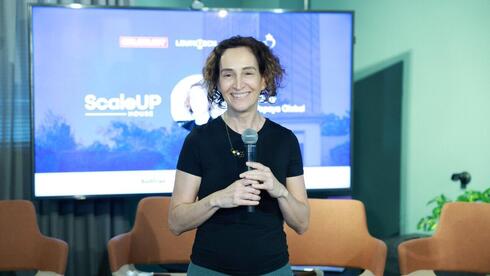
Eynat Guez, founder and CEO of Papaya Global, spoke at the ScaleUp House launch conference hosted by Calcalist and Showcase IL in collaboration with LeumiTech about the company’s journey from Google’s startup program during the pandemic to a global business with about 1,000 employees in 10 countries: “In the end, you’ll build the company you want to build.”
“You’ll probably hear a lot more ‘no’ than ‘yes’ about everything you do. The beginning is always pretty shitty for most of us, but that’s part of the magic,” said Eynat Guez, co-founder and CEO of Papaya Global, at the ScaleUp House launch conference hosted Tuesday evening by Calcalist and Showcase IL in collaboration with LeumiTech.
Guez, who founded Papaya Global nearly a decade ago, shared some of the lessons she has learned along the way with entrepreneurs participating in the event. Her central message was that the early stages of building a company are rarely as orderly or predictable as they appear in hindsight.
Papaya Global will celebrate its 10th anniversary next year, Guez said. She recalled that the company got its start through Google’s startup program during the pandemic, one of the most difficult periods in recent economic history.
It was an unusual experience. Even the refreshments provided through the program were delivered to participants’ homes, with a messenger bringing coffee and cookies. But Guez said the program was nevertheless important to her and demonstrated the value of frameworks that give entrepreneurs a place to meet, learn and develop, particularly at the beginning of their journey.
Since then, Papaya Global has grown into a global company with about 1,000 employees and offices in 10 countries.
“I started the company as a bootstrap with partners,” Guez said. “We went through hell on the way to raising money, but in the end we raised $450 million.”
Looking at Papaya today, she said, it would be easy to assume that its growth followed a clear and continuous path. It did not.
“It seems terribly far away to raise a lot of money and have offices all over the world, but it’s not linear,” she said.
For Guez, the messy beginning, the rejections and the setbacks are not necessarily signs that something is going wrong. They are part of what building a company looks like, even if they tend to disappear from view once a startup becomes successful.
That is why she urged entrepreneurs not to constantly compare their current situation with the finished product of companies that have already made it.
One of her main messages was the importance of filtering the many voices competing for an entrepreneur’s attention.
“I tell entrepreneurs, including my brother who started this: Think every morning about what you are keeping from the things you were told and what you are throwing away. There will be a lot of good noise, but also bad noise and noise that distracts. In the end, you’ll be very clear about your goal.”
Guez compared building a company to driving a car: Without a clear destination, it is easy to get carried away.
“There are lots of types of startups. In the end, you’ll build the company you want to build. Pay attention to what works and what doesn’t. Like with Waze, there are walls you need to hit and there are walls you don’t.”
That focus, she said, should also shape the day-to-day running of a startup. Entrepreneurs can easily become distracted by every new piece of advice, industry trend or metric, particularly at a time when technology makes it possible to measure almost everything.
“Always be true to what the goals are for the next month, three months and a year, and how to reach them. Today it’s so easy to measure and see, and sometimes this noise we create for ourselves distracts us.”
Guez also addressed the rapid transformation brought by artificial intelligence, but argued that one fundamental aspect of building a company is unlikely to change: the need to understand customers and remain close to them.
“One very fundamental thing will not change, no matter how much AI there is in the world: customers, personalization. Be on the ground,” she said. “They told us that Covid would mean there would be no people, and we are here. And AI too, and we are here.”
In her view, the rise of Zoom, remote work and AI tools makes it even more important for entrepreneurs to meet customers in person and understand what is happening on the ground.
She described an entrepreneur who had scheduled a Zoom meeting with a customer but accidentally arrived at the client’s offices instead. Rather than turning around and returning to his computer, he decided to hold the meeting in person.
For Guez, the story captures a broader principle.
“Bring yourself. As much as you want to be successful, see customers, be on the ground. After all, high-tech is the most in-the-trenches thing there is.”
She ended her remarks with a message to the entrepreneurs at the beginning of their own journeys: “You are at an exciting stage, and I look forward to seeing you all grow.”



