






Mind the Tech NY
"We are not a high-tech company, but AI changes everything - and we need to prepare for it."
At Calcalist's New York conference, Shai Babad, president and CEO of the Strauss Group referred to the state of uncertainty that has prevailed in Israel for three years. "We recruited a senior in the field of AI with the understanding that many of the positions in the company will change in the near future and we need to prepare for that."
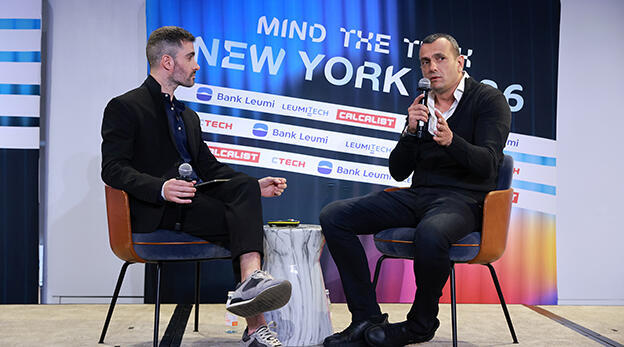
Shai Babad, President and CEO of Strauss Group at Calcalist's New York Conference
(Alex Kolomoisky, Tomerico)


"Unrest is the new reality and not a passing event, but rather a way of life, and this is not going to change anytime soon," according to Shai Babad, President and CEO of Strauss Group, speaking at the Calcalist and Bank Leumi New York 2026 Mind the Tech conference.
Babad addressed the question of how a CEO copes with constant uncertainty in a reality with zero quiet.
"We are advancing on three things: what needs to be done, leadership as a team, and self-care," Babad said. "The focus is on the most critical tasks that need to be carried out, when every manager and employee in the organization knows exactly what they need to do.
"The second component is leadership as a team. Even in the famous conversation between Shaquille O'Neal and Kobe Bryant, the phrase was said: ‘There is no I in team.’ In a world of rapid change, there is no place for a lone leader, only a team, and teamwork is essential.
"The third component is taking care of yourself, self-care, and the important part here is purpose. We wake up in the morning and do something we love. The second is balance. You need to find time even during a crisis for family, sports, and meeting with friends. Finally, you need to make sure you are taking care of the machine that is us, and that means good food, good sleep, and time for sports. When you maintain all these components, you work well even during a crisis that lasts three years."
What were the two things at the top of Strauss’s priorities during the war?
"We focused on two critical things. The first was business continuity, since we are Israel’s largest food and beverage company. There is an important effect on citizens when all the products are on the shelves. It is reassuring when all the beloved brands and products are in the supermarket even during war and crisis.
"The second thing was caring for employees. Strauss employs thousands of workers in factories in the north and south that are on the front lines of the fighting. It was necessary to ensure they received support in order to continue functioning amid the extreme imbalance of life. We also understood there are things you do not do during this time, such as discussions about computing infrastructure or strategy. You focus on continuity and business continuity."
How do you explain the flourishing and prosperity of the Israeli economy, as someone who worked in the Finance Ministry before moving to the private sector?
"The answer is that the crisis does not define the economy, but rather the productivity of the market. If you create value, the economy grows. Governments are not what matter, nor is the crisis. What affects things is productivity and value creation, and the proof is the largest exit in Israel’s history, signed in 2025, of Wiz. The growth engine is the private market, and in Israel’s case, cyber and AI create value around the world."
What connection does Strauss actually have to technology? How is AI affecting the traditional food industry?
"We are not a high-tech company, but AI is changing everyone and everything. That is why we recruited a senior AI executive with the understanding that many roles within the company will change in the near future and that we need to prepare for that. We are already working with the Israeli startup Wonderfull on digital support centers, for example in the customer service operations of Tami4. Alongside the upheaval, there are also advantages in the new reality.
"Digital employees do not have labor unions, they are not looking for promotions, and they are always satisfied both with the salary and the working hours."
What is the main challenge in implementing AI technology in organizations today?
"Our challenge today is to integrate innovative technology while also leading organizational changes in line with the new world. AI is a new tool that you need to learn how to use correctly, just like learning to ride a bicycle; and like with bicycles, often the bicycle moves faster than you do. I am certain that many work processes within Strauss will change in the near future."
Watch his full remarks in the video above.



