









Eight luxury cars burned. Then the insurance fight began
Auto Premium says Migdal must cover $1.6 million in damage from an arson attack. The insurer says its policy was never meant to cover arson and that a crucial exclusion was accidentally omitted.
About six months ago, at the end of March, security cameras near the Auto Premium luxury car dealership on Lishansky Street in Rishon LeZion captured an unusual scene.
At around 4 a.m., a heavy Benelli motorcycle entered a lot where vehicles worth millions of shekels were parked. The rider, wearing a helmet and carrying two bottles filled with liquid, got off the motorcycle and poured the contents over two BMWs. When his attempt to ignite the substance failed, he drove across the road to a gas station, calmly refueled the motorcycle, filled another bottle with gasoline and returned to the dealership to finish what he had started.
This time, the arson succeeded.
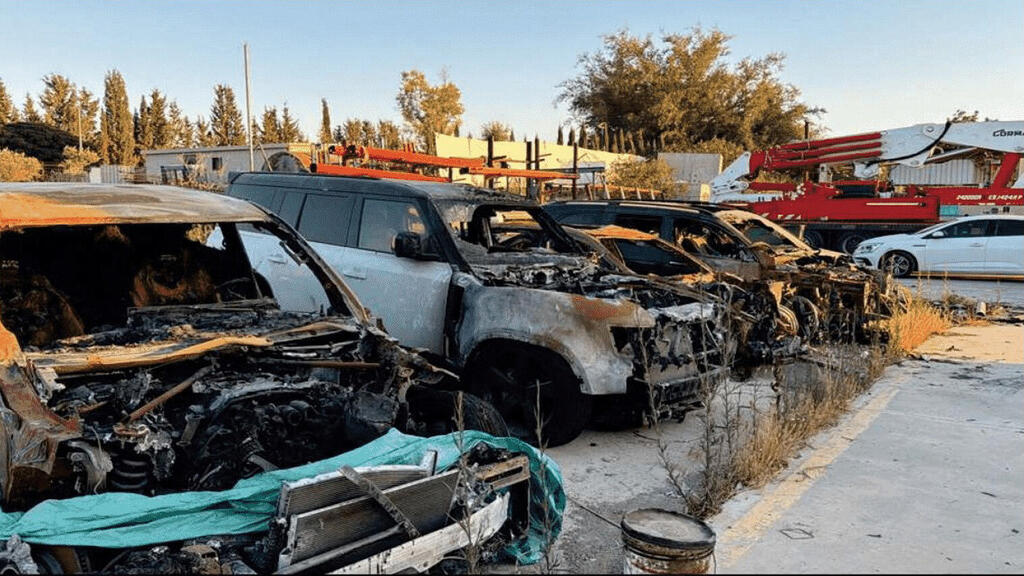
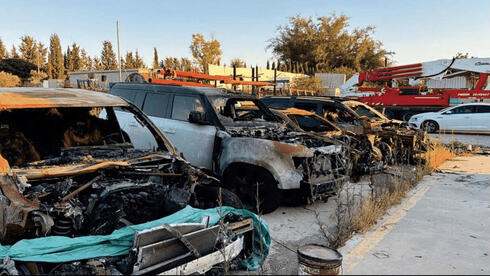
Eight vehicles were damaged in the resulting fire. Four, two BMWs, a Mercedes and a Land Rover, were completely destroyed, while another four, a Porsche, an Audi, a Land Rover and a BMW, sustained partial damage. According to an appraisal report, the total damage, including damage to the dealership itself, amounted to NIS 4.8 million ($1.6M).
Several weeks later, police arrested a suspect in connection with the arson: 38-year-old Yitzhak Revivo of Kiryat Malachi. In May 2026, the State Attorney's Office filed an indictment against him on charges of arson. Revivo denies the allegations.
According to a request for his detention until the end of the proceedings, filed by the Central District Prosecutor's Office through attorney Eliran Ashkenazi, the motive for the alleged arson remains unknown.
The evidence will ultimately determine whether police have arrested the person responsible for the fire. But for Auto Premium, the battle did not end with the arrest. It has now moved to a very different arena: the insurance system.
Migdal insured the dealership's vehicle inventory against damage of up to approximately NIS 13 million, for a monthly premium of NIS 49,000. Yet according to a lawsuit recently filed by Auto Premium, Migdal has refused to compensate the dealership for the damage caused by the fire.
"The policy does not cover malicious damage and/or arson," Migdal said in a letter rejecting the claim.
In principle, an insurer can refuse to pay if it has evidence that an insured deliberately caused the damage in order to collect insurance proceeds. The Insurance Contract Law provides that when an insured event is caused by the insured, the insurer may be exempt from its obligation.
But Migdal is not making such an allegation against Auto Premium.
A Calcalist examination of the police investigation file found no evidence, indication or testimony pointing to an attempt to stage the arson as part of an insurance fraud scheme.
So why is Migdal refusing to cover the damage?
The insurer's explanation is that the policy contains a mistake.
"Due to a human error, a clause was also omitted from the 2025 policy that explicitly excluded malicious damage and/or arson," Migdal wrote in its June 2026 letter rejecting coverage.
The company added that the clause had been omitted "solely due to a human error by the underwriter," and that Auto Premium had not requested such coverage before the policy was issued because, according to Migdal, there had been no agreement to provide it.
In other words, Migdal argues that the policy was never intended to cover arson or malicious damage and that the omission of the exclusion clause from the written policy was simply an underwriting error. The insurer's position is effectively that the contract should be read as if the missing exclusion had been included.
That puts the case squarely in the territory of contractual interpretation.
One established principle is that when a contract is drafted by one party, ambiguity in its provisions may be interpreted against the party that drafted it. The argument is particularly relevant when the drafter is the stronger party in the transaction.
In this case, Auto Premium argues that Migdal, rather than the insured, should bear the consequences of the insurer's own drafting error.
The dispute also touches on the Afromim doctrine, a landmark approach in Israeli contract law that gives courts greater latitude, in certain circumstances, to interpret contractual language in light of the purpose of the agreement and the parties' intentions.
The doctrine has long been controversial, and legislation and subsequent case law have sought to narrow the scope of judicial intervention in contracts.
The issue in the Auto Premium case is unusually concrete: Can a court effectively add to an insurance policy an exclusion that the insurer says was accidentally omitted?
Migdal is expected to argue that the missing provision should be taken into account when interpreting the policy. Auto Premium, by contrast, is asking the court to enforce the policy as it was actually written when the fire occurred.
Auto Premium's statement of claim describes the case as a "serious, serious and proven fire insurance case" involving the deliberate destruction of eight luxury vehicles. It accuses Migdal of attempting, in bad faith, to retroactively introduce an exclusion that was not part of the policy at the time of the incident.
Migdal Insurance and Finance said: "Migdal will study the claim that was filed with the court and will present all of its arguments in the legal process, as is customary."
Attorney Chen Gilad, who represents Auto Premium, said the case highlights what he described as a broader problem with the way insurance claims are rejected in Israel.
"The time has come to denounce the improper method adopted by insurance companies in Israel, in which rejecting claims serves as a lever of pressure on policyholders, both business and private, in order to get them to compromise and settle for insurance benefits that are significantly lower than their rights according to the terms of the policies and the law," he said.
Auto Premium, he added, believes that the Capital Markets, Insurance and Savings Authority and the insurance regulator should impose "strict regulation" and effective, deterrent sanctions to prevent insurers from turning what he described as unjustified claim rejections into a routine business practice.
The court will now have to decide a narrower but potentially important question: when an insurer says it made a mistake in drafting a policy, can it ask the court to correct that mistake after the insured event has already occurred?



