











Elementor CEO says company’s headcount is down 60% as AI reshapes work
Yoni Luksenberg says AI is changing how businesses operate and will eventually create new professions, while Minute Media’s Asaf Peled predicts that the technology will stimulate economic activity and ease employment pressures over time.
“AI is causing an immediate upheaval in the labor market, but within a decade, there will be no employment-related issues,” said Asaf Peled, founder and CEO of Minute Media, at the Tech1 conference in Tel Aviv.
Peled spoke during a session moderated by Yonatan Lavender, deputy managing partner and head of advisory at KPMG Israel, on AI’s impact on industries, organizations and the workforce.
“I am optimistic,” Peled said. “Throughout the last few centuries, every technological revolution has been accompanied by fears of change and concerns about a potential decline in the number of jobs. AI will stimulate economic activity, and within five to ten years, there will be no employment issues. While sectors such as software and technology may experience turbulence and job losses, new roles will emerge to replace them.”
1 View gallery
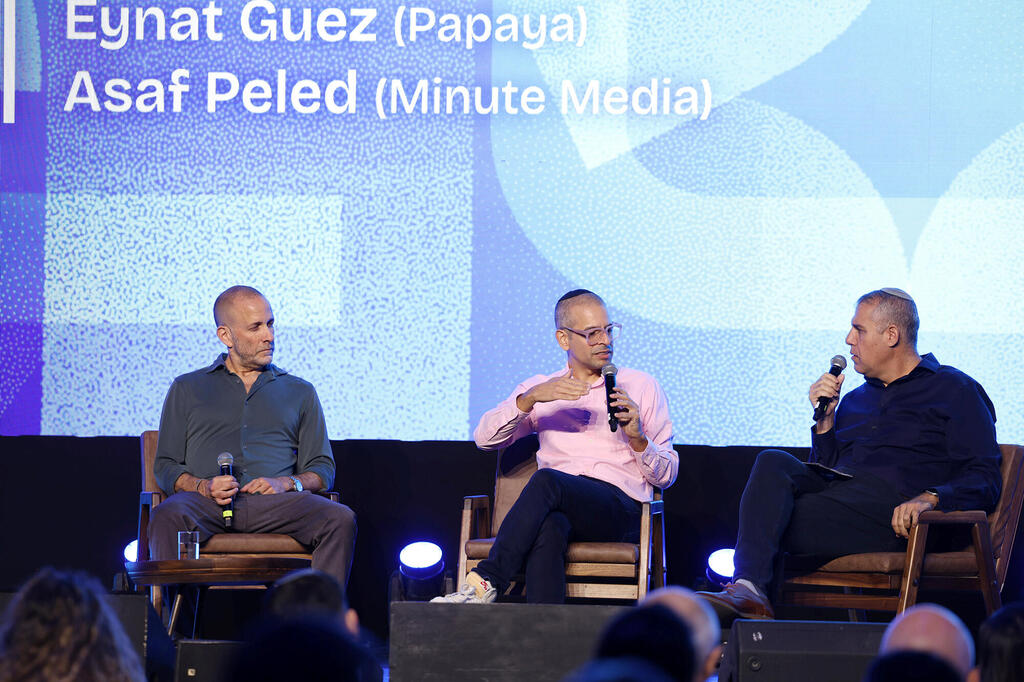
TECH1 2026 Conference. From right: Yonatan Lavender (KPMG), Yoni Luksenberg (Elementor), and Asaf Peled (Minute Media).
(Photo: Orel Cohen)
Peled acknowledged that the transition was already affecting businesses. “As a business, we have grown, yet there were specific areas of operation where we parted ways with employees.”
Yoni Luksenberg, founder and CEO of Elementor, described a more immediate impact on staffing at his own company.
“Our company’s headcount is about 60% lower. AI has transformed the way we work. In the long run, everything will be fine; new jobs and roles will emerge. You cannot compare the professions of today with those of 50 years ago. Back then, there were no software developers or product managers.
“Regarding AI, we are only at the beginning of this shift. While the immediate consequence is that certain tasks are no longer necessary, new professions will eventually arise. There will be fewer redundant roles, but new types of jobs will be created.”
Anthropic’s valuation and the threat from cheaper AI models
Lavender asked Peled and Luksenberg for their views on Anthropic’s anticipated initial public offering (IPO).
“Many organizations are still trying to figure out the long-term scenarios surrounding AI,” Peled replied. “Most of Anthropic’s revenue comes from a relatively small segment of its business clients, mostly technology companies. We started using Anthropic’s Claude last year, but now there are many cheaper, or even free, alternatives, largely from China. While not all of them are as good as Anthropic, they are ‘good enough,’ which poses a threat to the company’s business.”
The discussion also turned to AI company valuations and the gap between investor expectations and the technology’s ability to generate tangible business value.
“When we talk about valuations for Anthropic ranging from one to two trillion dollars, a significant question arises regarding the entire AI market: to what extent does this valuation reflect the creation of real value, as opposed to high expectations for the future?” Lavender said.
According to a recent KPMG CEO survey, 79% of CEOs rank AI as their top investment priority, but only 17% expect to see a return on that investment within a year. Meanwhile, 56% identify a lack of appropriate skills as a key challenge in implementing AI.
The findings highlight the gap between companies’ investment ambitions and their ability to translate AI adoption into measurable business results. In the coming years, the ability to identify high-value investments, build trust in the technology, and redesign workflows and organizational structures around it will be a key factor in determining business success.
A web built for AI agents
Luksenberg argued that AI is ushering in a new economic era that will fundamentally change how people interact with the internet.
“Once someone begins using this technology, they realize that this is how work should be done for the next decade. In the not-too-distant future, people won’t be using websites; they’ll be using agents.
“The internet as we know it began in 1991. For the last 30 years, we’ve been browsing websites. But now, a significant portion of web traffic consists of agents. When you ask Claude a question, it browses a website and provides an answer. Yet the web wasn’t designed for agents. This is a new era, and the web needs to be redesigned.
“If you ask a chatbot a question and it costs me $4 to generate an answer, that’s not economically viable. The infrastructure needs to be adapted.”
Luksenberg also opposed strict regulation of AI, arguing that it could impede technological progress.
“You cannot halt human progress; you cannot prevent workers from becoming more modern or tell them they must continue working the way they did in the past,” he said.
Peled expressed a similar view, favoring a market-driven approach to AI adoption.
“I’m not a big believer in over-regulating AI,” he said. “I believe that model developers and customers will figure out the right way to use AI. Therefore, our role is to focus on learning as much as we can. I don’t put much stock in the negative scenarios, so I’m more inclined to favor market-driven processes.”
Sports media looks to AI to keep fans engaged
Minute Media acquired the publishing license for Sports Illustrated magazine in 2024. Asked about AI’s impact on sports, Peled argued that the sector has a built-in advantage: the value of live competition and elite athletes cannot easily be replicated by technology.
“Sports is one of the sectors least likely to be affected by AI. After all, technology can’t replace LeBron James. Consequently, the value of sports assets continues to rise significantly.
“We anticipate that AI will have an impact on us, but we know how to effectively leverage the inherent value of sports. We serve tens of millions of sports fans through the Sports Illustrated website. Google used to be a primary source of traffic, but that has dropped by 50% in recent years.
“Users now expect a personalized experience, so we use AI to tailor that experience to each individual based on the teams they support. If we don’t do this, we risk becoming less relevant.”



