










Israeli drone maker XTEND hits NYSE this week at $1.5 billion valuation despite widening losses
XTEND has deployed 12,500 systems worldwide and is winning defense contracts, but its $5.8 million first-quarter revenue remains a fraction of the figures it once projected for 2026.
Israeli drone company XTEND will begin trading on the New York Stock Exchange this Friday at a valuation of $1.5 billion. The company is going public through a merger with the publicly traded real estate company JFB, following an agreement signed between the two companies in February. Although JFB still has some operating activity, its trading symbol will change to XTND.
Under the structure of the merger, XTEND is not raising capital from public-market investors. Instead, it is receiving funding through an investment agreement with a group of private funds. The original plan called for a $152 million investment, but the final amount will be $100 million. Of that sum, XTEND has already received $42 million, transferred when the merger agreement was signed in early 2026 in the form of a SAFE, a financing instrument that converts into shares at a later stage. In the coming days, the company is expected to receive the remaining $60 million.
According to Aviv Shapira, XTEND's co-founder and CEO, the reduction in the size of the investment was not caused by a lack of investor interest, but by existing shareholders' desire to limit dilution. However, JFB's performance in New York tells a less enthusiastic story: its shares have fallen 36% in the six months since the expected merger with XTEND was announced, signaling limited enthusiasm among Wall Street investors for the transaction.
The new investor group includes American Ventures, Aliya Capital and U.S. drone company Unusual Machines. Eric Trump, the son of U.S. President Donald Trump, is a prominent investor in American Ventures. Other shareholders include Israeli defense-tech fund Protego, founded by Lital Leshem and Lee Moser, which led XTEND's previous funding round; Union Tech of the Horesh family; Chartered Group; Len Blavatnik; and TAU Ventures, the venture fund of Tel Aviv University.
XTEND completed its previous funding round about a year ago at an estimated valuation of $500 million, raising $70 million. The new transaction therefore represents a significant increase in the company's valuation and a positive outcome for its long-time investors.
Union and Chartered were the company's largest shareholders before the new investors entered, with approximately 14% each, while Protego held about 7%. Following the transaction, their stakes will fall to 12.5% and 6%, respectively. American Ventures will become the company's largest shareholder, with a 15% stake.
XTEND was founded in 2018 by Aviv Shapira (CEO), Matteo Shapira (CXO), Rubi Liani (CTO) and Adir Tubi (CQO). Shapira and Liani together hold approximately 3.8% of the company's shares. XTEND employs 267 people, about 60% of them in Israel, and has acquired two companies over the past two years, one in Latvia and another in Singapore, as it expands its product portfolio.
The company's origins are unusual for a defense technology business. XTEND began as a gaming company founded by brothers Aviv and Matteo Shapira, who had previously founded Replay, which was sold to Intel for $200 million.
The brothers initially envisioned XTEND as a gaming company built around drone-operating-system technology. But even before October 7, as incendiary balloons were being launched from Gaza toward Israeli communities near the border, they began to see that the technology could have applications in the physical world rather than being limited to games.
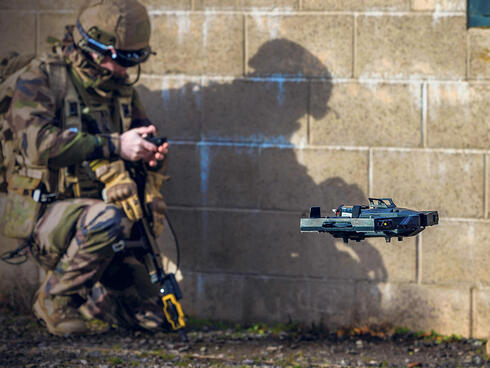
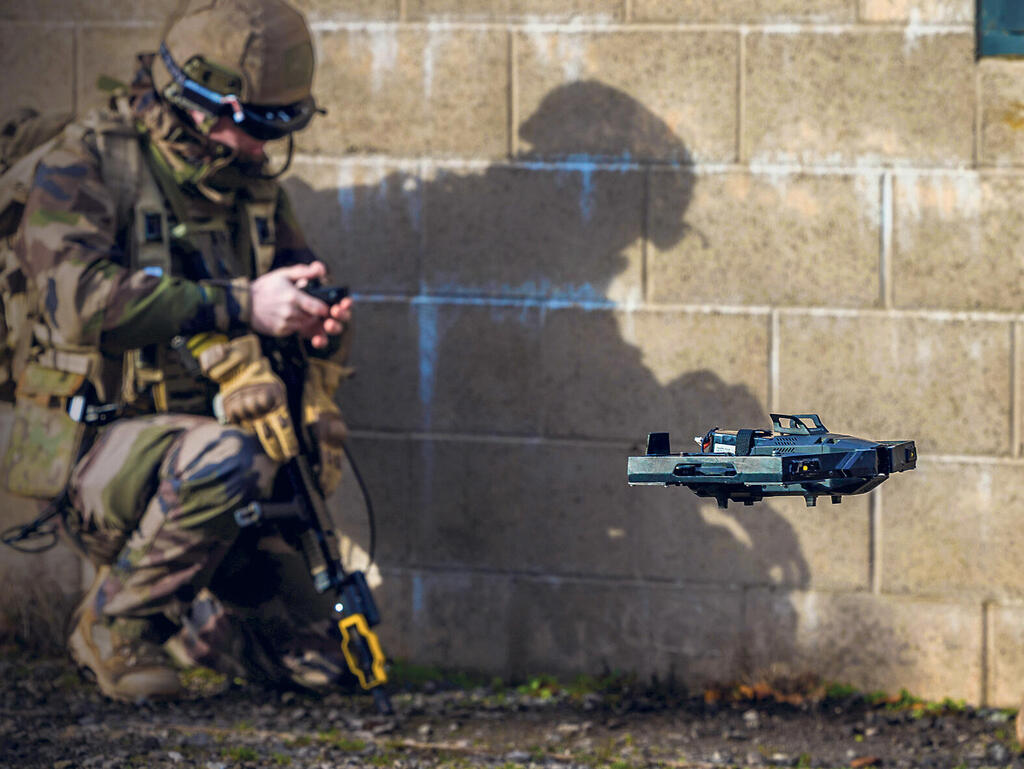
Today, XTEND describes its technology as an operating system for autonomous robots. Shapira says the company sits at the intersection of three of the world's hottest technology sectors: robotics, AI and drones.
The decision to enter the public markets through a merger with an existing listed company was also intended, he said, to accelerate the process and allow XTEND to capitalize on investor interest in defense technology and autonomous systems.
At XTEND, Shapira said, the company has watched the surge in the stock of Ondas, which has become an active buyer of Israeli defense companies and has recruited former senior figures from Israel's defense establishment, including Dadi Barnea, the former head of the Mossad. Ondas' stock has risen 750% in two years.
“XTEND's activity meets all the hottest trends in the world and it is also the only one that has revenue from software and not just hardware,” Shapira told Calcalist. “It is both more profitable and allows for faster growth. Also, unlike Ondas, which is a holding company without a unified theme, we have a common backbone of operating systems and we want to be the Android of the robotics world.”
“Our systems were born from a reality in which humans are required to enter dangerous and complex environments every day and from an understanding that technology can and should change this equation,” he added.
XTEND says it has deployed 12,500 systems in 30 countries. It recently signed a multi-year framework agreement worth $15 million with the defense ministry of a NATO member country, as well as a $12 million agreement with the U.S. Department of Defense.
The contracts point to growing demand for the company's systems, but its financial results remain small by the standards of a public company, and losses remain substantial.
In the first quarter of 2026, XTEND generated $5.8 million in revenue, up 234% from the corresponding period. At the same time, its net loss more than doubled to $11.5 million from $5.7 million.
The company ended 2025 with revenue of $20 million, up 20% from the previous year, with most of the increase and the majority of revenue coming from the United States. Its net loss widened to $27 million from $17 million in 2024.
The numbers show a company growing rapidly from a relatively small base, but they also highlight a significant gap between XTEND's current performance and the projections it presented when it began the merger process with JFB.
According to the prospectus, XTEND initially projected 2026 revenue of $85.6 million, followed by $150 million in 2027 and $381 million in 2028. The forecasts implied that revenue would roughly double each year and that the company would reach profitability in 2027.
XTEND is able to provide such projections because its route to the public market is not a conventional IPO, but a transaction resembling a SPAC merger, allowing it to present forward-looking financial estimates.
The company now says those optimistic, if not, by its own admission, highly ambitious, projections were based on the order backlog and leads it had approximately a year ago. It does not intend to update the projections in either direction.
That leaves XTEND entering the public markets with a sharply different story from the one investors were initially shown: a rapidly growing defense-technology company operating in some of the market's most fashionable sectors, but one that remains loss-making, has relatively modest current revenue and must now demonstrate that the demand and pipeline behind its earlier forecasts can translate into the scale required to justify a $1.5 billion public valuation.



