









“We won’t get rich from work”: Why young investors are flocking to Polymarket
From ceasefire bets to election wagers, a new generation is chasing fast money in binary markets.
The Reservist
"We are a generation that has been torn apart; our spirits won't allow us to just go to work."
Gonen, 25, was recently released from more than 500 days of reserve service, following three years of regular service in an elite unit.
"I gave three years to the IDF in an elite unit, and then more than 500 days of reserve service. After all that, our spirits don't allow us to go out now and work like crazy just to earn a living," says Gonen when asked what drew him to Polymarket. "Young guys understand that you can make money in other ways, not just through labor. I don't see myself becoming an employee for the rest of my life; it’s simply not worth it. To earn a high salary as an employee, you have to study for eight years, gain seniority, and earn multiple degrees."
Don't you feel that work provides stability and security?
"Even if I start working at a Renuar clothing store, for example, what’s my future? Working 12 hours a day for 50 shekels an hour? Is that what I came into the world for, to be a slave by default? Even if I become a shift manager, I won't be able to buy a house, and if I do, I’ll be a mortgage slave for 30 years. We have to find another way to generate income."
And Polymarket speaks to you?
"You keep reading about the betting there, hearing that people made insane amounts of money during the war, and it's intriguing. The war is what's driving Israelis there now. I only started a week ago, and it's interesting. I made some money betting on the ceasefire with Iran. I read a lot of news; I had a feeling the escalation would stop."
How much did you make?
"300-400 shekels, that's all. I don't even have a clue how to withdraw the platform's currency (USDC). And I know it's a risk because people lose money there in large quantities."
So why do it anyway?
"That day, something attracted me. I downloaded Telegram, joined news groups, and saw that Pakistan was entering the fray. I said, 'Come on, let's put some money in.' I bet on the farthest date for a ceasefire."
And have you stopped since then?
"Gambling makes you want more. I said, 'Let's also bet on a ceasefire with Hezbollah,' because surely after Iran, that would come too. But then I felt like I was going to lose and quickly withdrew the money. On the one hand, there's a desire to touch the dream and make a profit; on the other hand, it puts you under immense stress. After I won the bet on the ceasefire, I started beating myself up over why I didn't put in 20,000 shekels, I could have made a fortune. That’s the thing about Polymarket: that feeling of 'Wow, I'm so right,' so you bet more. Before you notice, it draws you in."
Does this have anything to do with your long service in the war?
"We are a generation that has been flattened. It's hard for me to look at the world as a good place after the last few years. After the things we've become accustomed to, Polymarket provides a sick amount of dopamine. It's exciting, especially for those who have invested large sums. You follow it all day, living in fear that you've made a profit once but might fall into an abyss you can't escape. Because if you lose, it really sucks."
Do you see this as a replacement for traditional investments?
"Absolutely not. It's gambling, plain and simple. It's like playing the lotto over and over, just on Polymarket. You can feel like you 'know,' and that's how you wind up in bad places. It's not the S&P 500, where the risk of total loss is near zero. But the temptation is great. You hear about someone who put in $170,000 and made $700,000. We all dream of putting in a small amount and waking up rich. Unlike the complicated graphs of the capital market, you don't have to be a genius to use Polymarket. You just have to watch the news. The questions are simple, and the answers are 'yes' or 'no.' That makes it more attractive."
If you're wary of Polymarket, how do you plan to build wealth?
"Maybe I'll start studying real estate. I'm teaching myself about the capital market because there is risk there, but it's not gambling. Investing is an informed bet; Polymarket, on the other hand, is all or nothing. I decided to study investing so I know how to play the game properly."

The Student
"I'm a trader, not a gambler. It's 80% knowledge and only 20% luck."
Yadin Eldar, 21, is an economics student at Florida State University (FSU). The son of journalist Shlomi Eldar and playwright Michal Aharoni, he moved to the United States as a child and stayed there. He was recently ranked 1,500th on the Polymarket "Best Traders" leaderboard.
"Polymarket is very nerdy and internet-oriented; it’s associated with young people like me," says Eldar. "As with anything new, the profits for those who understand it early are astronomical, at least until the big players enter. Right now the market is full of kids, but it will enter the mainstream. Investment houses want in; I even received a call from a bank interested in setting up a pilot for a 'prediction market' investment house. Once the banks get involved, it won't be so profitable anymore."
What brought you to Polymarket?
"At age 14, I asked my dad for permission to register with PredictIt. It was a small market for nerdy 'traders' like me, capped at $850. I come from a political family, so we bet that Bibi wouldn't be Prime Minister, we were very wrong. I lost $5, but I learned how it works. Since then, I've watched platforms come and go, until Polymarket and Kalshi arrived."
How did this arena suddenly explode?
"America is addicted to gambling, and it’s a destructive addiction. In every sport today, there's betting on every play. When Polymarket arrived, people were already primed for it. But on Polymarket, you aren't betting 'against the house' like in a casino. It works like a stock market; I buy or sell contracts to other users. That makes it very different from traditional gambling."
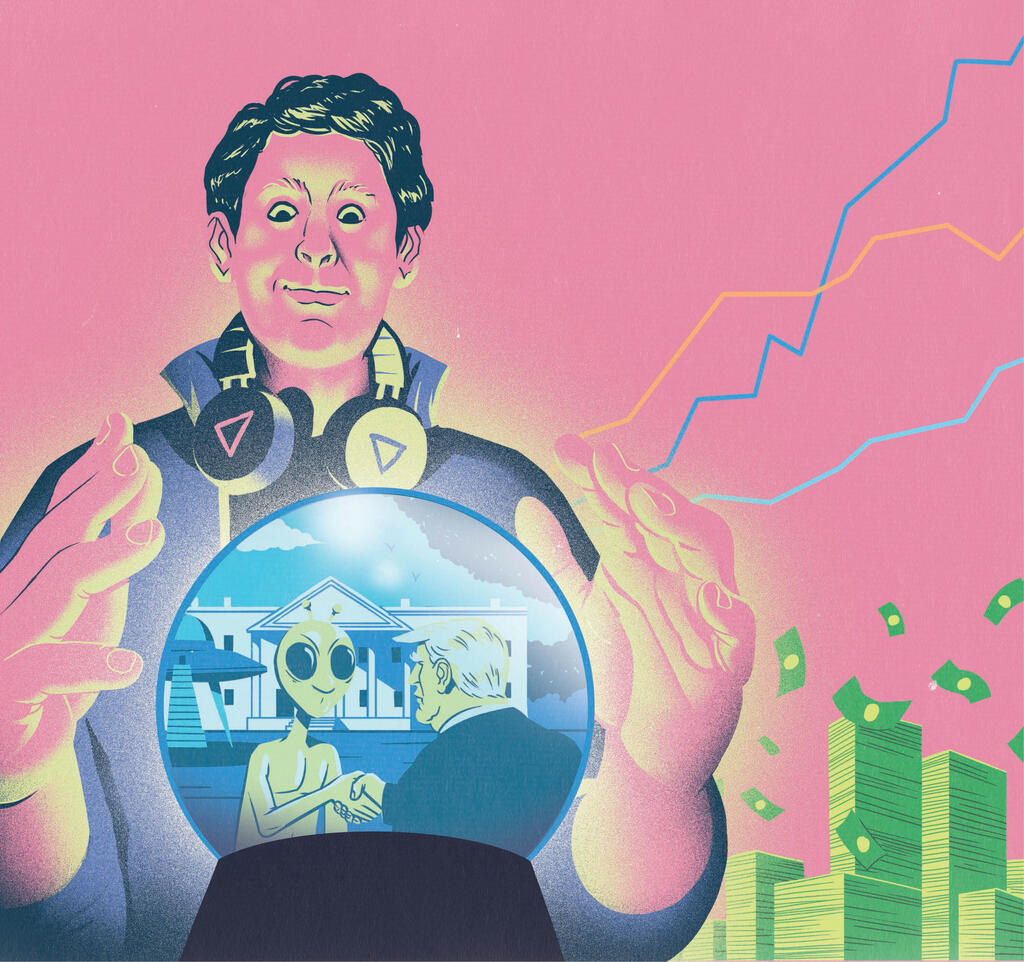
But it's not a regular exchange. You bet on anything, even the appearance of aliens.
"I don't like the word 'gambler.' I use the term 'buying a contract.' When you trade oil stocks, which are volatile right now, you don't call it gambling. Everything you invest in is a 'prediction' of what will happen next. Whether you buy an apartment in Tel Aviv or take out a mortgage, every investment is a prediction about the political or economic situation."
"I'm a trader. It’s not a lottery; it’s a combination of 80% knowledge and 20% luck. Anyone with a solid understanding of politics or a specific field can succeed, the market behaves logically. You need to understand Iran, the Israeli government, or international relations to put money on the line. For example, I bet heavily against an extremist figure being elected UK Prime Minister while 'dumb money' was betting on them. I look for mispriced contracts and use arbitrage strategies. It’s called gambling, but it behaves like a stock market."
How do you know you aren't addicted?
"I've never been to a casino or played poker; I have no interest in those things. I love the market mechanics, and I view it exactly like the stock market."
What attracts young people to Polymarket over Nvidia shares or real estate?
"The advertising is smart and creates trendy bets. Polymarket is based on the idea that you can trade anything; there are currently ten thousand 'questions' on the platform. Now that it’s gained legitimacy, they even brought on Donald Trump Jr. as an advisor. This bought the platform political cover in Washington, and you'll find a lot of young men my age there."
During the tensions with Iran, there was a bet: "Will Khamenei remain Supreme Leader until the end of the year?" Everyone knows that's a bet on whether he’ll be assassinated.
"I followed that closely. Analyzing Netanyahu's speech, I calculated the chance of elimination was about 80%. I put money on it, and 25 minutes later, there was confirmation. I won't say how much I earned, but it was a good amount."
Does that feel ethically comfortable?
"No. I don't like questions about war; I prefer election results. You shouldn't profit from life and death. I have no sympathy for Khamenei, but what if there was a question like 'Will Netanyahu be PM by the end of the year?' That might incentivize someone to take action. War questions are ethically problematic."
But you bet anyway.
"I don't initiate these markets. I’m like many people who work in fields they don’t love. When I graduate, I hope to work in institutional investment, but in the meantime, I need to make a living, and I'm using my knowledge."
How much did you invest?
"I can't answer that."
When did you bet the war would end?
"I bet on June 30. Anyone who understands Israel knows that after taking missile hits day after day, the situation won't stay stagnant for another two months, though this country is crazy enough that you never know for sure. With Israel, it really is a gamble; you can't always apply logic."
You must also lose quite a bit.
"I win about 55% of my bets. In economics, a bank is considered successful if it hits a 55% success rate on investments. I study everything I bet on. I use AI, and a British friend helps me with UK politics. If it's related to Hamas, I consult my dad. Not everyone comes with a learning mindset; there’s a lot of 'dumb money' coming in. But those who understand statistics and economics know how to use strategies."
Who should stay away?
"Those who bet based on ideology. There is only room for logic."
What would you bet on the Israeli elections?
"That’s one area I won't touch. It’s like betting on the finale of your favorite TV show. I wouldn't be able to remove my emotions and think rationally."
The One-Off
"Everyone says they aren't on Pornhub, either. It’s the same thing."
Oren, 25, is an analyst at an investment fund in Tel Aviv.
"I had a one-off experience on Polymarket when I bet on a basketball game," says Oren. "I hopped on the carousel for a moment just for the thrill and to see how the platform worked."
Do you even like basketball?
"I have no interest in sports, but a friend suggested it. It ended up being a dopamine hit. It’s much more fun to watch a game when you have 100 shekels on the line."
Did you win?
"No. I lost, just like a lot of the 'dumb money' on Polymarket."
Will you go back?
"Experience taught me this isn't a reliable source of passive income. I'm a student; I don't have money to burn, and what’s the fun in betting small amounts?"
What about your friends?
"They claim they don't gamble, but I know they do. They bet big on geopolitics and sports. It’s like Pornhub, no one admits to being on it, but the data shows these platforms are exploding."
The Soldier
"Instead of working your ass off at a store all day, you can sit online and succeed."
Eli, 21, is a soldier and a retail clerk from Afula.
"Living on a military salary is hard. I discovered Polymarket a few months ago after taking a course on the subject."
There’s a course for Polymarket?
"It was a short course by Yakir Abadi that I paid 2,000 shekels for. I learned that it's much more than guessing 'yes' or 'no.' There are trading strategies just like in the capital market. You also get access to 'The Money Radar,' Abadi’s website, which provides analysis. My mother was worried; she asked if it was gambling. I explained that it’s about the knowledge behind the bet. I made a profit on the ceasefire with Iran because of information."
Insider information?
"No. At first, I bet 'no ceasefire.' But then I joined Telegram news groups and saw a report that Trump was taking the possibility of a ceasefire very seriously. I immediately moved everything from 'no' to 'yes.' I made a few hundred dollars in 90 minutes."
Were you interested in the news before this?
"Even as a soldier, I wasn't interested in anything. Polymarket made me a news junkie. I only bet on things I have advance information on; if I don't, I only put in $20 or $30. I'm trying to build a side income. I also bet on sports, Champions League, tennis, etc. I don't see Polymarket as gambling because there’s a difference between wanting something to happen and predicting it will happen. In sports, I bet; in current affairs, I predict."
Are you winning or losing overall?
"I lost when I bet on the Bitcoin exchange rate over a five-minute window. That was a risk I took for the thrill. When I bet like that, I know the money could go to waste, just like at a casino."
What makes you feel in control?
"Timing. As soon as you follow the information flow, your chances of 'guessing' the future increase."
What about your regular job?
"I work at a clothing store. Yesterday was a losing day because I couldn't stay consistent with the tweets and articles. If you catch the wave, Polymarket provides great money without much effort. My friends are in the capital market, but I don't connect with mathematicians. To succeed there, you have to study for years. The goal is to reach $2,000-$3,000 a month, which is what I make 'working my ass off' at the store. The world is moving this way. Instead of manual labor, you can sit at a computer and succeed."
How do you keep from losing your way?
"I know when to stop."
The Professional
"For me, Polymarket is just another revenue stream."
Itay, 27, is a tech professional and co-founder of the "Polymarket Israel" community on Facebook and Telegram.
"We don't gamble. Things happen or they don't, but we use statistical methods and take calculated risks. We use entry and exit strategies based on news events rather than gut feelings," says Itay. His group has about 1,200 active members.
Why are young people so attracted to this?
"It has the excitement of the stock exchange, but it’s accessible. You can invest in things that were previously 'un-investable,' like the weather or news events. Plus, it’s decentralized crypto. You don't need a traditional trading account or even to use your real name. You just transfer crypto to a Polymarket wallet and start."
Do you have a day job?
"I'm a programmer in high-tech. I consider myself a trader. I also invest in stocks and crypto; Polymarket is just another tool."
How do you find patterns in what looks like gambling?
"When I started, I looked for systematic patterns. I thought I knew more than everyone else, but I learned that wasn't always true. Still, I found a way to profit."
But a bet is a bet, right?
"I avoid pure betting markets like sports. Current events are like trading options. If there's a market for a Russia-Ukraine ceasefire that isn't moving, and a report drops that Putin is willing to talk to Trump, you can make 100% profit if you’re among the first to react. You can also hedge by buying contradictory positions and exiting at the right time."
Why are there so few women in these groups?
"There are some, but they are few. It’s the same in the traditional capital market."
Is Polymarket a paradise for insiders?
"There’s truth to that. I’m sure intelligence organizations use the platform as a data-gathering tool. But you can still succeed without inside info by tracking 'smart money.' You can see wallet addresses, their success rates, and what they’re buying. If a wallet made $50,000 in a month, you can just mirror their trades."

The Intuitive
“It allows me to back my intuitions financially.”
Lior Mesika, 30, Founder of a blockchain investment fund.
“Some people are addicted to betting on whether Trump will say a specific word, but that’s not how I use it,” says Mesika. “I use it to test my theses. I don’t see it as a bet, but as a way to put money behind my analysis.”
Did you bet on the Iran situation?
"Absolutely not. How could I possibly know what would happen there?"
What’s the draw for you?
"These are binary markets, you're either right or wrong. You win or lose everything. For me, it's a tool to back my intuition. I didn't sell my Google shares to bet on Trump, but I did win when I bet on him in 2024."
"However, young people with only a few pennies who go 'all-in' thinking they have an edge are living in a dream world. They don’t have an edge. It’s a shark’s arena. Most people will lose money; the only ones profiting consistently are the professionals and trading companies. The average person will not get rich here."
The Skeptic
"What looks like money on the floor is never actually money."
Alex, 32, works at a consulting firm in Rishon LeZion.
"I entered Polymarket last year with a bet about Trump and Greenland," says Alex. "I usually bet 'no' because it's easier to predict what won't happen. I'm still just testing the platform."
What attracted you?
"I had some extra crypto in my wallet. It was an experiment to test my geopolitical knowledge. I check it once a day, like reading the news."
How have you performed?
"I've made a few bets, and I've lost most of them. Unlike the lottery, you can bet until the last minute. But the reality is that people with inside information and bots dominate the results. If someone puts $5 million across 1,500 predictions, that’s an arbitrage bot, not a person. Some profiles make hundreds of millions. They bet 'yes' and 'no' simultaneously and exit one position early to scalp profits. If you don't have inside info, waiting for the final result is just gambling."
So, what’s the conclusion?
"It gives you the feeling of being in the capital market, but it's dangerous. There’s a lot of fine print. For example, there was a 'Will Jesus return by 2026?' bet. It created buzz, and people thought it was a safe 'no,' but the fine print said it would resolve as a 50-50 split if it didn't happen, meaning no profit. What looks like easy money never is."
The Realist
"I'm not a gambler, but a gambler will end up in a hole very quickly."
Tal, 37, a high-tech entrepreneur.
"I joined in March after taking a 1,200-shekel course. I thought it fit me like a glove," says Tal. "I started betting on Bitcoin exchange rates in 15-minute intervals because I don't have the patience to wait a week. I lost money. You have to work at this; I just took a spin on the carousel."
How is it different from the stock market?
"In the stock market, you might get 10% a year. here, you can get hundreds of percent, but you have to treat it like a full-time job. You have to be glued to the news. Also, you can't compete with insiders. If someone at Google knows when 'Nano Banana' (the AI photo editor) is launching, they can bet half a million shekels and win for sure. Most people lose. That’s the bottom line."
The $9 Billion "Yes or No" Game
Capital Market and Crypto Veterans are certain: The youth enthusiasm for Polymarket is temporary and will end in tears.
Polymarket is the world's largest prediction market. Launched in 2020 by Shayne Coplan, a 28-year-old New Yorker who dropped out of college, the platform has reached an estimated $9 billion valuation. It allows users to trade "stocks" representing "yes" or "no" answers to future events.
The platform gained a reputation for the "wisdom of crowds" after its users accurately predicted Trump’s 2024 victory while traditional polls showed a dead heat. However, it has also been mired in controversy. In Israel, two individuals were recently indicted for allegedly using classified military information to profit from bets on an Israeli attack on Iran. Such incidents have prompted the U.S. Congress to consider legislation banning federal employees from trading on these platforms.
According to Similarweb data from March 2026, 70% of visitors are men, and 65% of active users are under the age of 35. The growth is staggering: competitor Kalshi saw its weekly turnover jump from $30 million to $3 billion in just one year.
Micha Catran ("Micha Stocks"), a YouTuber in the field of investments and a former VP at NICE, calls Polymarket and similar platforms “a blockchain hack for global events.” According to him, “Young people are attracted to it, but you wouldn’t risk your pension on an attack on Iran, because you know that if you lose, you have no pension. What does a young person have to lose? What they earned from babysitting?”
And why do you think young people are so drawn to it?
“It has sex appeal because of the risk and reward. The appeal lies in the possibility of taking a small amount of money and turning it into a lot. It used to be crypto, but now it’s the season of Polymarket. For young people, the learning curve is zero. It’s alive, cool, and colorful, and you can constantly get in and out and live it. Young people tend to take higher risks because the amount of money they risk is much smaller. Someone who made a hit, put in 100 and earned 1,000, can easily market it as the next big thing, and Instagram charlatans will say, ‘Come make a career in Polymarket.’ It hasn’t fully arrived yet, but in two or three months you’ll see videos of young guys with beards and tattoos sitting in luxury villas saying: ‘I made my money in Polymarket, and you’re a sucker for not being there.’ I believe that dozens of ‘smart trading in Polymarket’ courses will be launched, and by the end of the year we’ll see articles about families who lost their entire pensions in Polymarket under the headline ‘I was sure I wouldn’t lose.’ In practice, it’s neither trading nor investing - it’s gambling.”
Yariv Gilat, co-founder of the algorithmic trading company Final and a leading investor in crypto startups, uses his personal experience in the field to explain why young people are flocking to the platform: “When I was discharged from the army, I opened a bank account and was introduced to someone at the branch who was responsible for trading. He told me about the forex market and said, ‘Look what you can earn,’ and I thought I understood more than I really did. I bought a South African rand against a short position on the dollar, which sounds more sophisticated than betting on a football game, but at an early stage I realized it was a gamble and learned to stop. It’s simply the platform that is responsible for attracting young people, this new blood. I went through it in 1992, but they do it all the time. It doesn’t change.”
Are algorithmic trading companies already there?
“Sure. I think any brand you can think of is already there.”
What do novice investors need to look out for in an arena where sharks swim?
“Why do people buy lottery tickets? Same thing. It’s all about dopamine. There’s no difference. It’s just easier at Polymarket.”



