









After years of delays, IDF prepares to deploy Elbit’s new Ro'em artillery systems
The Ministry of Defense is investing $190 million in a dedicated training center as the military gradually replaces its decades-old American-made howitzers with Elbit’s more mobile system.
The IDF has only recently begun incorporating new self-propelled howitzers supplied by Elbit Systems, despite ordering them in 2019 as part of a deal valued at approximately $2 billion. Now, the Ministry of Defense is entering into a new agreement with the Israeli defense contractor, worth approximately NIS 600 million ($190M), to establish a dedicated training center for commanders and combat personnel who will operate the artillery systems.
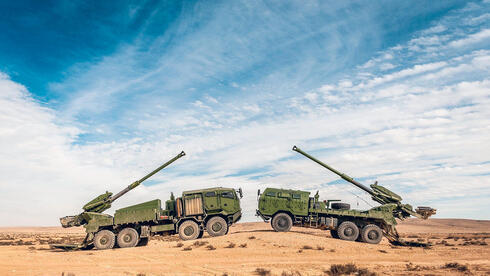
The new howitzer, designated the “Ro'em” (Thunder), is based on Elbit’s ATMOS artillery system, manufactured at the company’s facility in Yokneam. It is expected to gradually replace the “Doher” (Galloper), the American-made M-109 howitzers that have been in service with the IDF’s Artillery Corps since the 1970s.
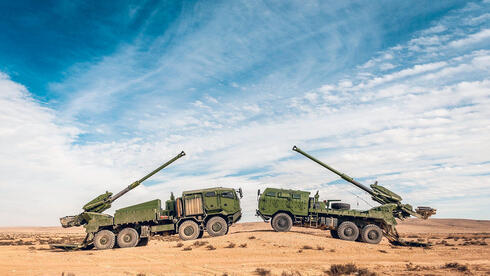
The Ro'em is mounted on a ten-wheeled Oshkosh truck chassis and can travel on roads at speeds of approximately 90 kilometers per hour. Its mobility is intended to enable rapid movement between combat sectors and improve the military’s ability to respond to operational requirements. Unlike the older artillery systems still used by the IDF, including during the current war, which can fire up to four shells per minute, the Ro'em can fire up to eight rounds per minute at ranges of up to 40 kilometers. It is also designed to fire while moving.
The first deliveries were originally scheduled for the beginning of the decade, but the new howitzers only began entering service with the Artillery Corps last year. It will take several more years for the full order to be delivered.
Defense officials told Calcalist that Elbit has already supplied the IDF with several units for testing and operational evaluation, and that deliveries will continue according to a structured schedule. The supply of the systems to the first artillery battalion is expected to be completed by early 2027.
According to the Ministry of Defense, the new agreement with Elbit covers the establishment and operation of a dedicated training center over a period of 15 years. Elbit will provide instruction and training services for crews operating the Ro'em howitzers, as well as the “Lahav” system, the company's PULS multiple-launch rocket system.
“Elbit has developed one of the world’s most advanced training and instruction systems for the IDF, an artillery school, which will enable high-quality, efficient training to ensure the fire support array maintains the highest level of operational readiness,” said Boaz Cohen, general manager of Elbit’s Land Division.
Zeev Landau, head of the Ministry of Defense’s Defense Procurement Administration, said the agreement “strengthens the IDF’s power and readiness. It will assist the Artillery Corps in fully leveraging the firing potential of the new systems, while ensuring cost-efficiency and optimal resource utilization.”
The training center is intended to shorten certification and training periods for combat personnel and will include a range of simulators and other training facilities.
The new agreement comes against the backdrop of controversy surrounding the original procurement of the Ro'em. In 2020, State Comptroller Matanyahu Englman published a critical audit report identifying serious flaws in the decision-making process that led the Ministry of Defense to select Elbit’s self-propelled howitzer system.
Among the issues raised in the report was the Ministry’s handling of a planned demonstration of a competing German-made artillery system. The demonstration was canceled at short notice, with officials claiming it was no longer necessary. The Ministry subsequently selected Elbit’s system and awarded the company the contract through a single-source procurement process, exempting it from a competitive tender.