











From the Red Sea to Mediterranean ports, Israel’s supply chains face mounting pressure
International dockworkers’ protests are adding another source of uncertainty to shipping routes already affected by regional conflict, higher insurance premiums and costly detours.
The campaign against Israel is expanding beyond the military arena and into international supply chains. On Friday, protests and work stoppages took place at approximately 100 ports across 22 countries under the slogan “Dockworkers do not work for war.” The organizers, a coalition of port workers’ unions from several countries, called on dockworkers to refuse to load or unload weapons, ammunition and military equipment destined for combat zones, particularly Israel. But the suspension of terminal operations and delays to vessels could also affect civilian cargo, delivery schedules and import costs for Israel, as has happened in the past.
Although Friday’s action was presented as a single day of international protest, it forms part of a broader campaign by port workers’ unions against the transportation of arms and military equipment. Since the beginning of the year, the unions have held two international days of protest, alongside separate incidents in which the movement of ships and cargo was obstructed at individual ports. In May, union representatives even gathered in Istanbul to issue a joint statement outlining the next steps in their campaign. No date has yet been announced for another international strike. However, the expansion of the protest, from dozens of ports in February to more than 100 in October, suggests that cooperation among the unions is becoming increasingly established and raises the prospect of recurring disruptions to maritime trade.
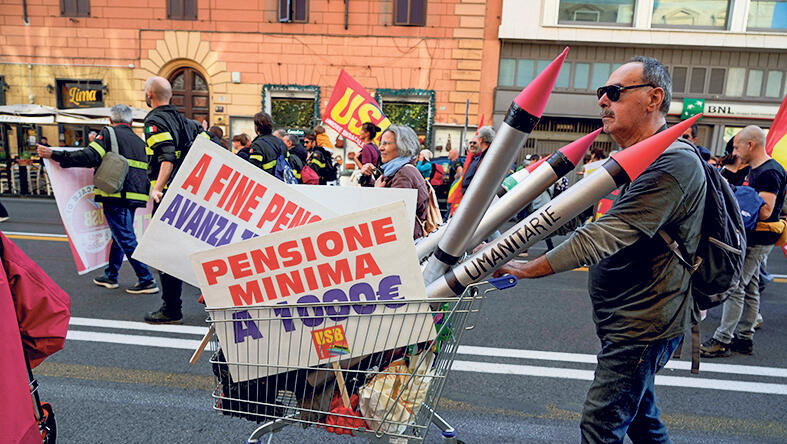
Alongside their political protest against Israel, the organizers have used the strike to advance demands concerning port workers’ employment conditions. These include a 12% wage increase as part of collective bargaining agreements, improved working conditions and safety standards, a reduction of the working day to seven hours, and a requirement that medical personnel be stationed aboard ships.
According to a special report issued by the Ministry for Diaspora Affairs and Combating Antisemitism ahead of the protest, the action could delay container shipments through Mediterranean ports, particularly major transshipment hubs such as Piraeus, Marseille and Gioia Tauro. The report also outlines the figures cited by the campaign organizers to support their claims. They say that, over a 14-month period, at least 315 shipments linked to the defense company Elbit were identified passing through 56 ports in 29 countries. They also claim that approximately 3,400 U.S. military shipments moved through 67 ports in 42 countries over a 10-month period. In addition, the organizers allege that 25 merchant vessels transported cargo for Elbit through Spanish ports, despite Spain’s embargo on arms exports to Israel.
The potential economic impact extends well beyond the loss of a single workday. When port operations are suspended, cargo can be left waiting outside terminals, vessel schedules can be disrupted, and storage and container detention charges can rise. At major transshipment hubs, delays can spread to other ports and continue even after a strike has ended. Such disruptions could also push up maritime insurance costs in a market already facing significant price increases.
The impact begins even before a ship reaches port
The economic threat to maritime trade is not limited to the possibility of terminals being blocked. Since the start of Operation “Roaring Lion” in March this year, shipping lines including MSC, Maersk, CMA CGM and Hapag-Lloyd have imposed fuel surcharges and risk levies on shipments to the Middle East, ranging from tens to thousands of dollars per container. Insurance costs have also surged by 300%.
Shipping companies, vessel owners and insurers assess security risks well before a voyage begins. The result is a sustained increase in costs across the sector, even when ports remain operational. During Operation “Rising Lion” in June 2025, war-risk insurance premiums for voyages to Israeli ports rose to approximately 0.7%-1% of a vessel’s value, up from around 0.2% just a week earlier. Depending on the vessel’s value and the terms of the policy, that translates into tens of thousands of dollars in additional costs per voyage.
In November 2023, insurance quotes reached a peak of more than 2% of a vessel’s value. By March 2026, premiums for ships transiting the Strait of Hormuz had climbed to 3%. These increases illustrate how the perception of risk can raise the cost of transporting goods even when Israeli ports continue to operate normally. Shipping companies must account for potential threats, adjust routes, secure insurance and prepare for operational changes. Those additional expenses are ultimately passed on to customers.
The stakes are particularly high for Israel, where approximately 96% of imports arrive by sea. Higher shipping and insurance costs can affect the price of raw materials and imported products, eventually feeding through to consumer prices.
“We do not want to contemplate a scenario where insurance companies refuse to cover shipments to certain countries,” says Avraham Novogrodsky, president of the Manufacturers Association. “This is already happening at some ports in Russia and Ukraine. We hope that tensions will subside and not lead to further cost increases.”
The Port of Eilat: From hundreds of millions in revenue to paralysis
The Port of Eilat offers a striking example of how threats to a maritime route can reshape Israel’s trade landscape. Before the war, vehicle imports from the Far East were one of the port’s main sources of revenue. In 2023, before the full impact of the Houthi blockade was felt, the port generated approximately NIS 212 million in revenue. Under normal conditions, it handled around 10 vessels a month, approximately three of them vehicle carriers.
Houthi attacks on shipping routes in the Red Sea prompted shipping companies to stop calling at Eilat. For more than two years, the port was virtually paralyzed, with only limited activity in support of the Israeli Navy, until signs of recovery emerged in 2026.
In March, an alternative route was introduced. Instead of sailing directly to Eilat, a route shipping companies considered too risky, vehicles are now unloaded at the Port of Aqaba in Jordan and then transported to Israel aboard dedicated vessels. The workaround comes at a cost: the port absorbs some of the additional expenses associated with the indirect route, while many shipping companies remain reluctant to call at Eilat.



