










Mind the Tech NY
"If your service is replaceable by a prompt, the competitive advantage is gone"
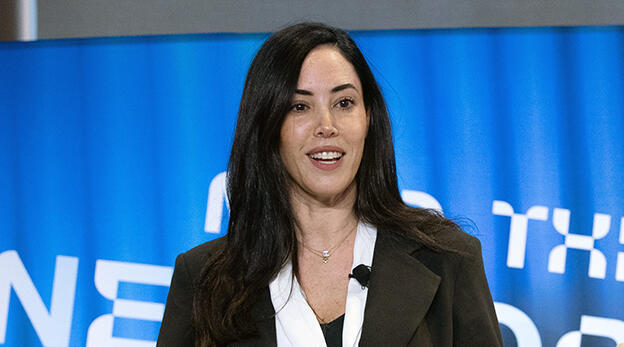
Keren Danziger, GM, Pagaya's Israel Investment Funds, was speaking at Calcalist and Leumi's New York 2026 Mind the Tech conference. "In the next decade, Pagaya’s goal is to become the preferred technology partner of every major consumer lender in America."
Keren Danziger
(Alex Kolomoisky, Tomerico)


In the tech world, everyone loves “Cinderella stories” – those glittering companies that soar overnight. But as Keren Danziger, GM of Pagaya's Israel Investment Funds, noted at the Calcalist and Bank Leumi Mind the Tech New York 2026 conference, the real question is whether these stories last or fade like a pumpkin carriage at midnight. “In my last 15 years in the world of finance, I’ve seen companies at different stages,” Danziger shared, “and unfortunately, the story of healthy growth is often much less magical.”
Danziger began by addressing the complex Israeli reality, saying: "We were supposed to be standing here together a month ago. The geopolitical conflict forced us to stop, but while the world followed the headlines, something amazing happened – the Israeli high-tech sector did not shut down and continued to deliver results. This is what our customers and partners expect from us, and this is our famous 'Israeli resilience.'"
In her remarks, Danziger made a clear call for market maturity, arguing that the era of hype around generic AI is giving way to a phase where only companies with deep fundamentals will thrive. While Wall Street remains confident in infrastructure giants like Nvidia and Microsoft, the mindset in the rest of the software sector has fundamentally changed. “People are now skeptical about the early winners of the AI breakthrough,” she explained. “If the service created is generic and replaceable tomorrow morning, the competitive advantage is gone. The market fears that every software subscription will soon be replaced by a few smart ‘prompts.’”
This new reality, where artificial intelligence (AI) agents can do the work of many people at once, has made the old model of selling “seats” irrelevant. This shift created a brief existential crisis in the industry in early February, when the market value of software companies in the S&P 500 index fell by $1 trillion in just seven days.
Despite the volatility, Danziger identified a specific group of “winners”—including companies like Pagaya, Stripe, Plaid, and Intuit—that share a strategic blueprint based on three pillars that create significant barriers to entry. The first is outcome-based pricing: “We don't charge for the tool; we charge for the result. If the customer profits, we profit." The second pillar is creating a proprietary data-driven barrier to entry, based on decades of trillions of dollars worth of private consumer credit data that generic AI has never seen. The third pillar is solving “high-stakes” problems that require 100% accuracy.
“Even if a genius programmer built a perfect copy of AI tonight, they would struggle against a brick wall,” Danziger said, coining the term “AI resilience.” “Tier 1 relationships with leading financial institutions cannot be programmed, historical performance data cannot be downloaded, and trust cannot be generated through a ‘prompt.’” She said the value today is not in the user interface but in the infrastructure and the ability to see shifts in the economy before they make headlines.
As Pagaya enters its second decade, Danziger defined a bold vision for the future. The company’s goal is to become the preferred technology partner for every major consumer lender in the U.S., a mission driven by advanced AI, backed by proprietary data, and built with unwavering Israeli resilience.
Watch her full remarks in the video above.



