










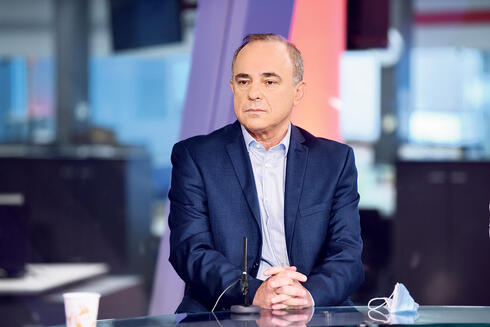
Iron Dome and Iron Beam developer Rafael to extend chairman Steinitz as defense activity surges
Ministers are set to back a second term for Yuval Steinitz amid heightened activity at the state-owned defense contractor.
Defense Minister Israel Katz and the minister responsible for government companies, David Amsalem, intend to extend the term of Yuval Steinitz as chairman of the defense company Rafael, Calcalist has learned.
Steinitz, a former Likud minister and Knesset member, is due to conclude his three-year term as chairman this April. Katz and Amsalem plan to grant him a second term, despite a long-standing dispute between them. Political sources said Steinitz maintains good relations with both ministers, as well as with Prime Minister Benjamin Netanyahu, and that none of them is expected to obstruct his reappointment.

However, uncertainty remains regarding the timing of appointments to Rafael’s board of directors. Katz and Amsalem have yet to name replacements for board members whose terms ended several months ago: former MK Ayelet Nahmias-Verbin and Michal Abadi-Boiangiu. Abadi-Boyanjo is expected to return later this month to the position of Accountant General at the Ministry of Finance, a role she previously held between 2011 and 2017.
The potential extension of Steinitz’s term comes against the backdrop of renewed government deliberations over Rafael’s future ownership structure. As Calcalist reported last month, the Government Companies Authority is expected to hold discussions with Steinitz and Rafael CEO Yoav Turgeman regarding the company’s preparations for a possible initial public offering.
Rafael is fully owned by the state and develops and manufactures Israel’s core air defense systems, including Iron Dome, David’s Sling, and Iron Beam. Iron Beam, a high-power laser-based system, was delivered to the IDF last month.

In August, Calcalist reported that Steinitz had been pressing the Ministries of Finance and Defense to allow Rafael to go public, following progress in plans to float Israel Aerospace Industries (IAI).
If IAI’s IPO proceeds, Rafael would become the only one of Israel’s three largest defense companies to remain fully government-owned and subject to extensive regulatory constraints. Such restrictions do not apply to publicly traded companies. Steinitz has warned that under these circumstances, Rafael’s ability to compete with Elbit Systems and IAI would be significantly weakened.
In recent months, the Government Companies Authority has been cautious about advancing a Rafael IPO in parallel with efforts to take IAI public. The primary obstacle is the classified nature of significant portions of Rafael’s operations. Unlike IAI, which already has bonds traded on the Tel Aviv Stock Exchange and publishes financial statements, Rafael would need to begin the IPO process from scratch, including the preparation of a prospectus and a formal valuation.
Until now, Rafael has been unable to conduct such a valuation due to the secrecy surrounding parts of its activities. In closed-door discussions, Steinitz has argued that effective mechanisms can be established to allow the company to go public while safeguarding classified operations.



