










What Nebius really bought when it bought Tavily
Beyond the exit price, a struggle over who controls the web gateway for AI agents.
When Nebius agreed on Tuesday to acquire the Israeli startup Tavily for up to $400 million, the headline numbers were striking: a company founded in late 2024, with just $25 million in funding, turning into one of the fastest exits in the local AI scene. But the real story is less about speed than about architecture. The deal offers a window into how the industry is quietly redefining what it means to build artificial intelligence.
For years the race centered on models, who had the most parameters, the most compute, the most fluent chatbot. Now attention is shifting to the connective tissue around those models: the systems that allow AI agents to find reliable information, verify it, and act on it without human supervision. Tavily’s “agentic search” is one such piece, and Nebius is betting it will become indispensable.
“We were born into the world of agents,” Tavily founder and CEO Rotem Weiss told Calcalist. Traditional search, he argued, assumes a human user who can judge relevance. Autonomous agents need something different, tools that retrieve data in real time, filter it, and prioritize what matters for a specific task.
That distinction explains why Nebius, better known for cloud infrastructure and high-performance inference, chose to buy rather than build. The company has spent the past year positioning itself as an alternative to the hyperscalers, assembling a stack that can power enterprise AI without locking customers into a single vendor. Tavily gives it the missing web gateway.
Roman Chernin, Nebius’s co-founder, framed the acquisition as part of a broader ambition. “We’re not just an infrastructure-as-a-service company, we’re building the complete platform for anyone who wants to build AI products, agents, or services,” he said. Bringing search in-house, he added, lets developers “focus on their applications instead of managing multiple vendors.”
Industry forecasts cited by Nebius project the agentic AI market to swell from about $7 billion in 2025 to as much as $200 billion by the early 2030s. Within that expansion, the volume of machine-generated queries is expected to surpass human search within a few years. Whoever controls the pipes that feed those queries could occupy a position similar to that of search engines in the previous internet era.
Tavily has managed to insert itself early into that flow. The company says its platform has passed one million monthly downloads and is used by Fortune 500 organizations as well as AI firms such as Groq and Cohere. Financial institutions rely on it to detect fraud, logistics providers to manage supply chains, and academic groups to accelerate research.
“Companies are looking for a unified search layer that can operate across a wide range of models,” Weiss said. “If every organization had to build its own search capability, the burden would be enormous.”
The acquisition is another sign that infrastructure, not only cybersecurity, is becoming a central export for Israeli tech. Nebius was recently chosen by the Israel Innovation Authority to build the country’s national AI supercomputer, a system equivalent to 1,000 Nvidia B200 accelerators, most of which will be allocated to commercial companies training large models.
Nebius itself is an unlikely protagonist. The company is the successor to the non-Russian assets of Yandex, reconstituted after sanctions following the Ukraine invasion. Now headquartered in Amsterdam and led by Yandex co-founder Arkady Volozh, it has been investing heavily in data centers across Europe and the United States while cultivating a growing presence in Israel.
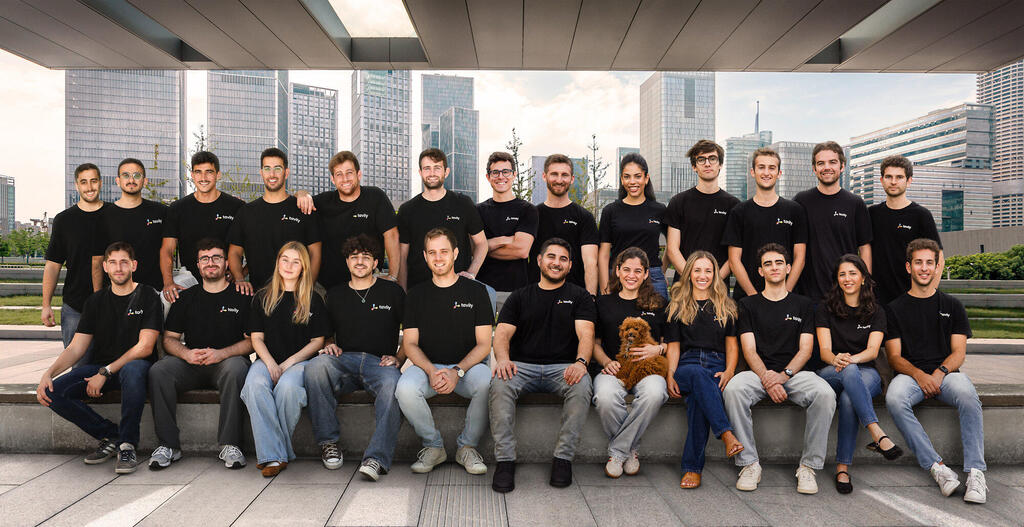
Buying Tavily gives Nebius more than technology; it provides a developer community of over a million users and a team split between Tel Aviv, New York, and Abu Dhabi. The startup plans to double its 30-person workforce this year and will continue operating under its own brand.



