










Palo Alto’s $25 billion CyberArk deal nearly collapsed before it closed
CyberArk’s near-exit from talks forced Palo Alto to revive its top offer. The report in Calcalist that Palo Alto might be in talks with another cybersecurity target prompted Arora to accelerate the timeline, fearing competitors could intervene.
The second-largest acquisition in cybersecurity history began, fittingly, with a rejection. In May 2023, Palo Alto Networks’ CEO Nikesh Arora approached CyberArk founder and chairman Udi Mokady with an offer to buy the Israeli identity security firm. Mokady said no. CyberArk would stay independent.
Two years later, the answer changed.
1 View gallery
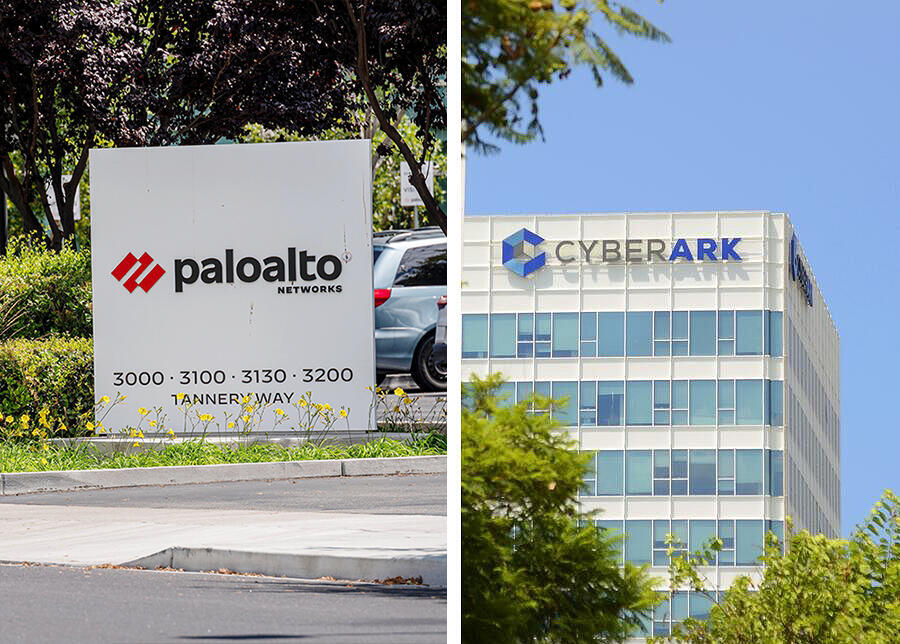
Palo Alto and CyberArk.
(Photo: David Paul Morris/Bloomberg, ShU studio/Shutterstock)
CyberArk disclosed in a Tuesday filing to the U.S. Securities and Exchange Commission how the $25 billion deal with Palo Alto came together, a story of persistence, brinkmanship, and boardroom brink-of-collapse moments.
After a two-year silence, Arora reached out again in June 2025, asking for a meeting. He and Mokady sat down on June 17. By the end of the month, the two companies had signed a nondisclosure agreement, and on July 1 Palo Alto submitted a non-binding offer: an all-stock acquisition valuing CyberArk at $457.99 per share.
CyberArk’s board judged Palo Alto to be uniquely positioned as a buyer. The two firms’ technologies were strategically aligned, and a merger could accelerate CyberArk’s global ambitions. Still, price and terms were another matter.
Mokady countered on July 6 with a steep demand: $525 per share and a $2 billion “reverse termination fee,” to be paid by Palo Alto if regulators blocked the deal. Arora balked, returning with $480 per share and no termination fee.
For days, the two sides volleyed. Mokady insisted on stronger protections; Arora resisted, arguing regulators had no reason to interfere with such complementary businesses. On July 10, the stalemate nearly broke off negotiations until Palo Alto agreed to double its termination fee offer to $1 billion. That kept CyberArk at the table.
Both sides then signed an exclusivity agreement to negotiate solely with each other. But the report in Calcalist that Palo Alto might be in talks with another cybersecurity target prompted Arora to accelerate the timeline, fearing competitors could intervene.
Then came July 27. Arora told Mokady that Palo Alto’s board had withdrawn support for the existing $495 per-share offer because of changes in both firms’ stock prices. He proposed $475.21 instead.
CyberArk’s board rejected it outright, instructed advisors to halt work on the deal, and even demanded Palo Alto return confidential documents. For a few tense hours, the merger appeared dead.
The following day, J.P. Morgan, advising Palo Alto, reopened back-channel talks with CyberArk’s bankers at Qatalyst. By evening, Palo Alto submitted a “best and final” offer at $495 per share, reviving negotiations and restoring momentum.
On July 30, after securing stronger closing certainty and a $750 million breakup fee payable by CyberArk under certain conditions, the board unanimously approved the deal. Hours later, before markets opened, Palo Alto and CyberArk jointly announced the $25 billion acquisition.
In its SEC filing, CyberArk wrote that the transaction “represented the best proposal and economic value available to shareholders” and provided terms most favorable to the company.
First published: 14:33, 01.10.25



