










"If an engineer in Ireland costs 20% less, it is clearly part of the consideration when deciding where to expand"
Eilon Reshef, co-founder and CPO of Gong, was speaking at the Calcalist and Migdal Financial Future conference. Neil Corney, CEO of Citibank Israel: "If I told my colleagues there would be a war here for 3 years, and we would see the shekel and the stock market soar, they would think I was an idiot"; Eyal Podhorzer, founder and CEO of Econergy: "Capital is not the bottleneck. The challenge is to develop projects that can quickly connect to the electricity grid."
“If an engineer in Ireland costs 20% less, it is clearly part of the consideration when deciding where to expand,” said Eilon Reshef, co-founder and CPO of Gong, during a panel held as part of the Calcalist and Migdal Financial Future Conference, moderated by Amir Kurz. The panel also included Neil Corney, CEO of Citibank Israel; Eyal Podhorzer, founder and CEO of Econergy; and Tami Mazel Shachar, CEO of quantum computing company Qubit IL.
Neil, how does Citibank see Israel today from the perspective of a global financial institution?
Neil Corney: “What we've seen over the past three years, since October 7, is extraordinary. If I had told my colleagues that there would be a war here for three years, and at the same time we would see the shekel strengthening, the stock market soaring, and Israel closing major deals worth tens of billions of dollars, they would have thought I was crazy. I think the resilience the country has shown, and the fact that today we are in a much better position than we were on October 7, means that investors are looking at Israel and want to invest more and more.”
1 View gallery
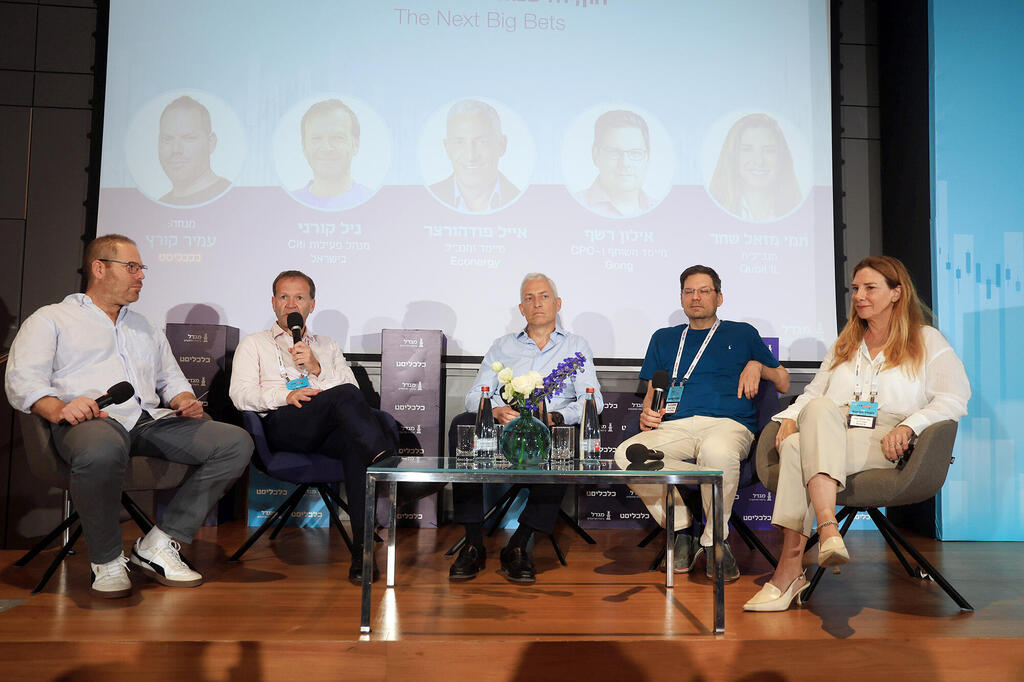
Financial panel (from right): Tami Mazel, Shachar, Eilon Reshef, Eyal Podhortzer, Neil Korney, Amir Kurtz.
(Photo: Avigail Uzi)
What is Citibank doing to support the Israeli market?
Corney: “We've been here for 25 years and operate in almost 100 countries. We connect Israeli companies to the world and international companies to Israel. Our management continues to invest here, and 12 years ago we established Citi’s largest development center outside the United States in Israel, where about 300 developers currently work.”
Doesn’t the AI revolution replace them?
Corney: “Like everyone else, we have seen a certain decline in the number of technology professionals, but what we have in Israel is unique. The cost here is higher, but the quality is exceptional. We manage to do things better here.”
Eilon, Gong develops AI-based tools for the sales world. What is expected to happen in the labor market?
Eilon Reshef: “The rumors about people being replaced by AI are very premature. In the end, it’s a technology, and technology has always created opportunities for productivity. At Gong, we serve sales organizations. A salesperson who uses these tools can sell more. In most professions, it works this way. AI is an added capability, a kind of superpower for employees, whether they are programmers or salespeople. Only at the margins do we see professions disappearing.”
The strengthening of the shekel against the dollar affects technology companies that employ workers in Israel. How do you feel about it?
Reshef: “Our revenues come in dollars, while a large portion of our expenses are in Israeli shekels. This increases costs by about 20%. We have not raised prices for customers by 20%. Fortunately, we are a company that is growing by more than 50% a year, so we can absorb this change. There are companies for which a 15% increase in salary costs is something they simply cannot absorb.”
What does this mean when deciding where to expand operations?
Reshef: “It is certainly part of the consideration. Ultimately, we want the best engineers, but if our engineer in Ireland costs 20% less, it is obviously part of the decision-making process regarding where to expand. We are responsible to our shareholders for building the most efficient company possible.”
Reshef emphasized that despite cost considerations, Gong continues to expand in Israel and is recruiting more than 100 employees for its local development center.
Eyal, let’s move to the world of energy. Where are the biggest opportunities today?
Eyal Podhorzer: “All of our activity is in Europe. To understand the scale of the opportunity, you need to look at demand for electricity. We are on the verge of a revolution. Over the next 20 years, demand for electricity is expected to double.
“If, in the past, investments in renewable energy were primarily intended to replace polluting energy sources, today demand for electricity is growing rapidly, partly because of AI and data centers. At the same time, Europe is accelerating investments in energy infrastructure to strengthen its energy independence.”
Will demand for electricity continue to grow in the coming years?
Podhorzer: “Demand for electricity has grown significantly, and at the same time we continue to see a shift from fossil fuels to renewable energy sources. Today, from a cost-benefit perspective, it is often cheaper to build renewable energy facilities than facilities based on conventional energy sources.”
Where are the main challenges?
Podhorzer: “The first challenge is the electricity grid. Solar facilities can be built, but the electricity has to reach places where there is demand. This requires huge investments in transmission infrastructure. The second challenge is energy storage. Renewable energy is not always produced when demand is highest. Therefore, storage has become critical, and a significant part of our portfolio is focused on that area.”
Tami, during our preliminary conversation, you said that the next major revolution might not be AI at all.
Tami Mazel Shachar: “The word ‘quantum’ still sounds far away, but that’s an illusion. Already today, governments and organizations are collecting and storing information with the understanding that, in a few years, quantum computers may be able to break some existing encryption methods. All the technology giants are already there, and tens of billions of dollars have been invested in the field worldwide. Israel also has an opportunity to become a leader.”
Can Israel compete in this field?
Mazel Shachar: “We will have no choice. We have already seen cases in which the U.S. government has restricted access to advanced technologies. If we don’t develop our own capabilities, we simply won’t have access to them. We need to return to being a country that builds infrastructure and hardware, because we have no alternative. Not everything will be sold to us. We must build independent capabilities here.”
Neil, where do you see the opportunities in the financial world?
Corney: “We see major opportunities in both AI and digital assets. In Israel, we are developing a significant portion of the infrastructure that enables the safe use of artificial intelligence for Citi globally. Another area is tokenization, which allows companies to move funds around the world faster and at lower cost. Some of these developments are being carried out in Israel for Citi’s global operations.”
Eilon, where is AI already generating measurable business value today?
Reshef: “When you look at a very specific area, such as sales, it’s easy to see the results. If a salesperson previously closed seven deals a year, with the right tools they can close eight. When you apply artificial intelligence within a clearly defined professional discipline, it becomes much easier to measure its impact.”
How should companies prepare for the next technological revolutions?
Reshef: “Technology companies are the first to feel every change. They need to constantly ask themselves how to work faster and more effectively using new technologies.”
Mazel Shachar: “Every company needs a strategy for the next revolution. Quantum brings both enormous opportunities and significant risks. Those who prepare early will be able to lead the market.”
Eyal, what do you see ahead in the energy sector?
Podhorzer: “The demand for electricity is already here, and it is only going to grow. For us, capital is not the bottleneck. The challenge is developing projects that can connect to the electricity grid quickly. Our advantage is our ability to develop and manage the entire value chain ourselves.”



