










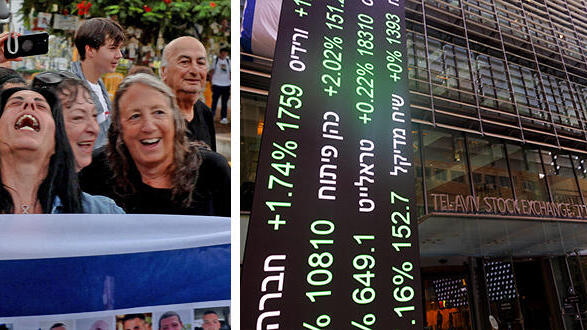
TA-125 surges 51% in 2025 as foreign investors pour billions into Israeli stocks
Tel Aviv Stock Exchange outpaces global markets, led by defense and insurance shares.
Exactly one year ago, in the 2024 summaries, the Tel Aviv Stock Exchange (TASE) received wall-to-wall praise: its top indices, the TA-35 and TA-125, jumped by almost 30% in the first and challenging year of the war in the south and north, outperforming most markets worldwide (the S&P 500 index recorded a 24% increase in 2024).
The prevailing assessment at last year's results was that the de-escalation of the war, and, of course, its end, would give an even stronger boost to the local market in the coming year. However, it is highly doubtful whether anyone anticipated that the breakthrough of 2025 would be so strong, sweeping, and dizzying.
The TA-35 index closed 2025 with a jump of 51.6%, the TA-90 recorded a positive return of 46.6%, and the TA-125, which includes both and reflects the trend in the local market more than anything else, jumped by 51%.
2 View gallery
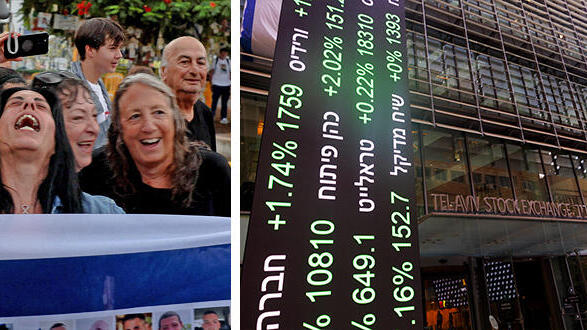
Celebrations at Hostage Square (left), TASE
(Photos: Kobi Wolf/Bloomberg, Reuters/Ronen Zvulun)
To put it mildly, the stock that led the TA-125 in 2024 was Beit Shemesh Engines, which recorded an annual jump of 153%. A stock that rose 153% this year does not even make it into the top ten in the TA-125 index.
The market being in the green is a local story. It does not stem from a global "green" investment trend but largely from the re-entry of foreign investors into the Tel Aviv Stock Exchange (more on that later).
A comparison with the world's leading markets further highlights the local success. The S&P 500 index climbed 16.9% this year, the Dow Jones posted a 13.3% return, and the Nasdaq closed 2025 with a 21% increase.
In Europe, the London Stock Exchange’s FTSE index rose 21.4%, Frankfurt's DAX climbed 23%, and Paris’s CAC increased 10.4%. In Asia, the Nikkei index closed 2025 with a jump of 26.2%, the Hang Seng rose 27.8%, and Shanghai by 18.4%. The Seoul Stock Exchange stood out above all others, with the KOSPI index closing 2025 with a 75.6% increase, the only market surpassing Tel Aviv.
Prominent Sectors on the Local Stock Exchange
Foreign investors mostly channeled capital into financial stocks, especially insurance. Tel Aviv Insurance recorded an annual rise of 152.2% and was the top-performing sector in 2025.
Other indices performed strongly as well: TA Insurance and Financial Services (mainly insurance companies, investment houses, and non-bank credit) rose 134.2%, TA Finance (including banks) gained 91.7%, and the TA Banks index increased 60.9%. Outside of finance, the TA Energy Infrastructure index recorded a 76.9% annual return.
The slowdown in the residential real estate sector was reflected in weaker performance: the Israel Yield Index rose 34.8%, the Real Estate Index gained 24.7%, and the Construction Index (residential developers and contractors) rose only 10.3%, though still outperforming the Overseas Yield Index, which fell 6.3%.
2 View gallery
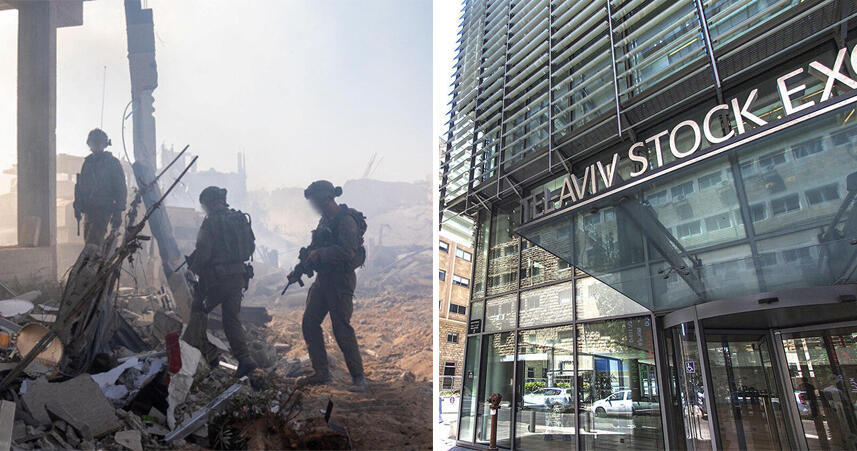
IDF soldiers fighting in Gaza (left), Tel Aviv Stock Exchange
(IDF Spokesperson's office, Bloomberg)
Foreign Investment
According to TASE’s research department, by the end of the third quarter, foreign investors had poured over 8 billion shekels ($2.3 billion) into the exchange since the beginning of the year. This inflow, alongside sharp market increases, boosted foreign institutional holdings to $19.2 billion at the end of Q3, up from $11.2 billion at the end of 2024.
Beyond the stock market, the Ministry of Finance reported that foreign direct investment flows into Israel reached $10.2 billion in the first half of 2025, the strongest half-year since 2021, an increase of 35% from the same period in 2024.
Standout Stocks and Defense Sector Surge
Although 2025 is remembered for the ceasefire agreement, it was largely another year of the Swords of Iron war. Defense systems companies saw soaring demand, both domestically and internationally, fueled by the ongoing Russia-Ukraine conflict, Israel’s defense prowess, and despite global attempts to impose arms embargoes.
Financial stocks also benefited from capital inflows. Within this rally, some stocks underperformed, most notably in technology. The top performer in the TA-35 index was the defense manufacturer NextVision, which soared 253% in 2025, moving from the TA-90 to the TA-35.
NextVision, which develops stabilized cameras for drones and UAVs, has gained momentum since the Russia-Ukraine war began nearly four years ago. Two weeks ago, the company received its largest order ever, worth $77 million, causing its stock to jump over 17% in one day and 7% the next.
Other top performers in the TA-35 included insurance stocks: Menora Mivtachim rose 178%, The Phoenix 165%, Harel 151%, and Cl 145.3%. On July 9, insurance stocks surged over 6% in a single day, and The Phoenix overtook the International Bank in market value, reaching 26.1 billion shekels. Harel followed, with The Phoenix and Harel trading at 33.4 billion and 25.6 billion shekels, respectively, compared to the International Bank at 25.1 billion.
Banking was not absent from the gains: Bank Leumi reached a market value of 100 billion shekels, joined by Bank Hapoalim, which later declined slightly. Teva regained its status as Israel’s largest company by market value in the domestic market, at 115.7 billion shekels.
The TA-90 index was led by Aryt Industries, a fuse manufacturer, which jumped 408%. Aryt has surged 2,212% since the start of the Swords of Iron War, effectively increasing its value more than 23-fold since October 2023. Other top performers in the TA-90 included More Investments (302.9%), Meitav (293.1%), Turpaz (238.3%), and the energy sector (219.6%). Stocks at the bottom included retailers (-41.7%), G-City (-37.1%), and Palm (-31.4%).
Bonds: Ceasefire and Falling Yields
Even in 2025, the bond market mirrored political and security concerns. High yields early in the year reflected fears of prolonged conflict, while sharp declines after the October ceasefire signaled renewed confidence.
The 10-year Israeli shekel bond yield fell from 4.48% at the start of the year to 3.91% by year-end, reversing the 2024 trend (3.92% → 4.48%). Notable fluctuations occurred: March saw yields spike to 4.525% amid political uncertainty, and late May climbed to 4.61% due to EU pressure. By mid-June, during Operation Rising Lion against Iran, yields declined steadily, reaching under 4% in October after the ceasefire and hostage return agreements. The annual low was 3.853% on October 16.
Shekel Strength and Interest Rate Cuts
The dollar traded at 3.65 shekels at the start of 2025, peaking above 3.80 in April before steadily declining to under 3.19 by year-end. Drivers included global dollar weakness, improved Israeli risk premiums, and foreign investment inflows.
The strengthening shekel allowed the Bank of Israel to cut interest rates on November 24 from 4.50% to 4.25%, supported by declining inflation and stable labor markets. For foreign investors, the shekel appreciation amplified returns: an American who invested $1,000 in the TA-35 on January 1 would have converted it back to $1,700 by year-end, reflecting a 72% return versus 52% for a local investor.
Cryptocurrencies: Peaks and Corrections
Bitcoin had a volatile 2025, opening at $95,000 and peaking at $126,000 in October before correcting to around $87,000. Institutional adoption via ETFs has shifted Bitcoin’s narrative from speculative to structural. Ethereum benefited from positive regulation and ETFs, ending the year around $3,000 despite forecasts as high as $7,500.
Crypto stocks surged early in 2025 but fell sharply by December as Bitcoin corrected. Mining companies were impacted by halving events, rising energy costs, and a transition to GPU-based AI data centers. Analysts noted increased preference for ETFs over leveraged individual crypto stocks.
Precious Metals: Gold and Silver Rally
Gold rose approximately 70% in 2025, surpassing $4,000 per ounce, while silver increased around 150%, reaching $82.6 per ounce. Drivers included U.S. fiscal deficits, geopolitical tensions (Ukraine, Taiwan, Middle East), and central bank purchases in developing nations. ETFs for gold and silver attracted tens of billions in inflows, while retail demand surged in India and China.
Analysts warn that volatility remains high, and a correction is possible in 2026, but gold and silver continue to act as portfolio anchors.



