










The Flydubai hijacking attempt exposes a gap in Israel’s aviation security system
Israeli airlines operate under extensive security requirements and state-funded protections, while foreign carriers carrying the same Israeli passengers face a different set of rules.
The attempted hijacking of a Flydubai flight has raised difficult questions about commercial aviation security and sparked criticism of the security standards of foreign airlines. The pilot involved was an Omani national, from a country with which Israel has no diplomatic relations, and was therefore prohibited from flying to Israel under Israeli aviation regulations. The incident remains under investigation. It is suspected that dozens of Omani pilots have operated flights to Israel for Emirati airlines, potentially by using dual passports.
There is a widespread conviction in Israel that Israeli airlines are the safest, both in terms of security and reliability. They continue to operate flights to and from the country even during emergencies, under a security system designed specifically to address the threats facing Israeli aviation.
The body responsible for the security of Israeli airlines is the “Ofek” unit. It operates under the authority and supervision of the Shin Bet, while its operational and logistical management is handled through El Al. The arrangement follows government decisions regulating the security of Israeli flights and is almost entirely state-funded.
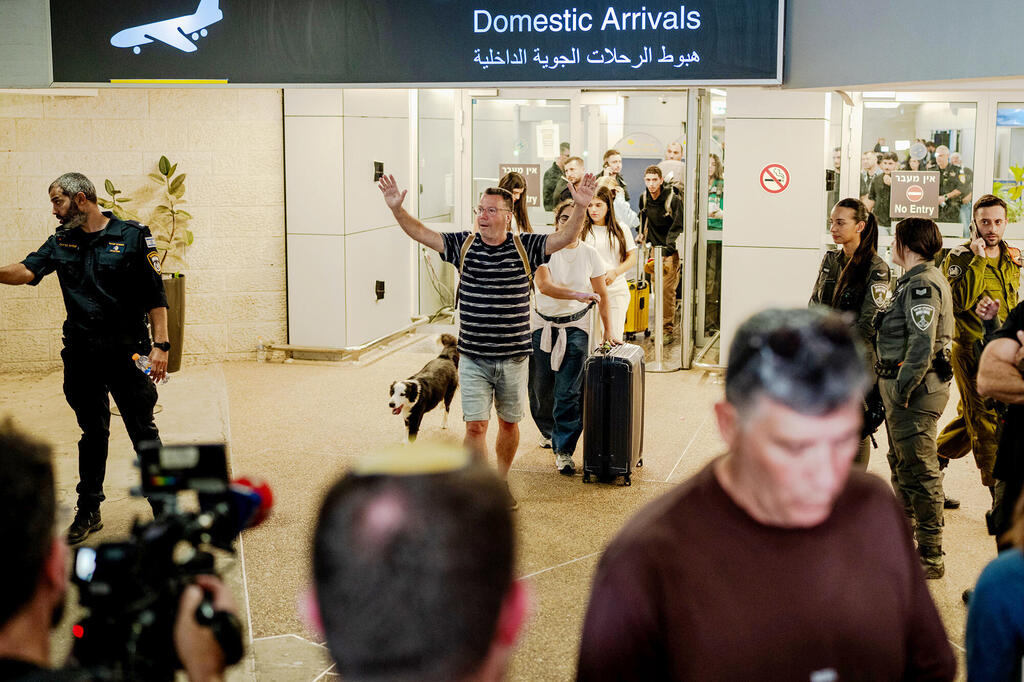
Ofek’s responsibilities include passenger security screening and aircraft security, both on the ground and in flight, in cooperation with local security agencies in the countries where Israeli airlines operate. Since October 7, the system has increased its activities and adapted to the new security environment. Security measures are now implemented against a backdrop of heightened threats to Israeli aviation, occasionally requiring changes to the scope and deployment of security personnel, particularly in countries where hostility toward Israel is increasing.
Details of operational procedures, personnel, security measures and deployment patterns are not disclosed for security reasons. Nevertheless, aviation security has become a central issue in the industry, as demonstrated by the recent crisis over Israeli airline flights to Dubai.
Since Operation “Roaring Lion,” Israeli airlines have been prohibited from flying to Dubai following a dispute between Israel and the UAE. The Shin Bet had raised concerns with Emirati authorities regarding security procedures at Dubai airport, even as Flydubai and Etihad continued to operate flights between the countries, carrying an overwhelmingly Israeli passenger base.
Following the attempted hijacking of a Flydubai flight, the dispute is expected to be resolved, potentially allowing Israeli airlines to resume the route under stricter security protocols.
The cost of Israeli aviation security is largely borne by the state. In 2024, the State Comptroller issued a critical report on aircraft security, highlighting the lack of a comprehensive, systemic approach and the absence of clear regulation governing responsibility and funding.
The criticism accelerated efforts to change the system. A government decision in March 2025 determined that the state would gradually reduce its share of aviation security expenses.
After the state covered 97.5% of the costs in 2024, the reduction began in 2025, when its share fell to 95%. In 2026, the state covers 94%, with Israeli airlines responsible for the remainder. Under the agreement, the state's share is scheduled to decline gradually over the coming years, reaching 92.5% by 2029. That level is expected to remain in place at least through 2031, with an option to extend the agreement until 2034.
The decision established a budgetary framework for state participation totaling approximately NIS 8 billion between 2025 and 2031. This includes NIS 1.1 billion in 2026, NIS 1.25 billion in 2027 and NIS 1.4 billion in 2028.
It is important to note that this budget covers the state's participation in aviation security for Israeli airlines as a whole, rather than solely the costs associated with the Ofek program.
Industry estimates indicate that the four Israeli airlines spent NIS 22.5 million on security in 2024. That figure rose to NIS 45 million in 2025 and is projected to reach NIS 66 million in 2026. A rough estimate puts the figure at NIS 81 million in 2027.
The cost is linked to the airlines’ volume of operations. As a result, El Al, Israel’s largest airline, incurs significantly higher security costs than the other carriers. As Israeli airlines expand their flight schedules and destinations, as they have in recent months, their security costs rise accordingly.
However, while the expenses run into tens of millions of shekels, the increase in security spending generally tracks the growth in flight volume. The additional expense therefore does not necessarily translate into a loss for the airlines.
Security concerns have also been at the heart of opposition to the establishment of an operational hub in Israel by Hungarian low-cost carrier Wizz Air. Israeli airlines objected to the decision to grant Wizz Air aviation rights allowing it to base aircraft in Israel overnight and operate flights to destinations outside Europe, effectively enabling it to operate in some respects like an Israeli carrier without being subject to the same security requirements.
Those requirements impose a burden on Israeli airlines not only financially but also operationally. Israeli crews must maintain strict proficiency and comply with rigorous security procedures. Many pilots also serve in the military reserves and are required to maintain their Air Force proficiency.
These are obligations that a foreign carrier such as Wizz Air does not face to the same extent.
This creates a striking disparity at Ben Gurion Airport. The Ofek security system and the requirements imposed on Israeli carriers operate alongside foreign airlines departing from the same airport. Those foreign flights can be filled with Israeli passengers, yet they are subject to different security requirements.
The attempted hijacking of the Flydubai flight has brought that disparity into sharper focus. Any aircraft departing from or arriving in Israel with a large number of Israeli passengers can potentially be viewed as a target by those seeking to harm Israelis, regardless of whether the aircraft belongs to an Israeli or foreign airline.
The disparity is particularly evident in charter flights operated by Israeli airlines such as El Al, Israir and Arkia that use “wet leasing.” Under such arrangements, an airline rents an aircraft from another carrier together with its crew, maintenance and insurance. The practice is common worldwide and allows airlines to quickly increase capacity or operate routes when they face shortages of aircraft or crew.
For Israeli consumers, however, wet leasing can come as a surprise. Travelers may arrive at the airport expecting to board a flight operated by an Israeli carrier, only to discover that the aircraft and crew are provided by a foreign airline. The arrangement is disclosed when tickets are purchased, although many passengers may overlook the information.
According to Israir’s reports, the government approved a significant easing of security requirements for wet-leased flights in August 2021.
“This relaxation allows for operational flexibility, particularly during the summer season, and reduces Israir’s reliance on operating flights under foreign codes due to security constraints,” Israir said in its 2024 report.
The Pilots’ Association has taken a more cautious position. It recently said that wet leasing should be treated solely as a temporary measure, limited in duration and based strictly on operational necessity. It also called for full approval and oversight by the Civil Aviation Authority and compliance with rigorous standards covering safety, training, maintenance and crew management.
“We do not oppose solutions that enable the Israeli aviation sector to cope with exceptional circumstances,” the association said. “We oppose a temporary solution turning into a permanent dependency and a substitute for building a professional, stable workforce in Israel.”
Ultimately, the attempted hijacking of the Flydubai flight brings the discussion back to a broader question: Is it appropriate to maintain different security requirements for Israeli and foreign airlines when, in practice, they can transport the same passengers from the same airports?
The Ofek security system and the requirements imposed on Israeli carriers were designed to address a threat unique to Israeli aviation. But the security landscape has changed, and foreign airlines have become an essential part of Israelis’ ability to travel in and out of the country.
The incident involving the Flydubai flight demonstrates that the distinction between an Israeli flight and a foreign flight does not necessarily correspond to a difference in the passengers’ exposure to risk. That raises the question of whether Israel’s aviation security policy should be reconsidered through a broader and more uniform framework.



