











Israeli photonic computing startup LightSolver to go public through CollPlant acquisition
The deal brings LightSolver’s laser-based computing architecture into a Nasdaq-listed company as it moves from research and testing toward commercial deployment.
CollPlant, an Israeli company best known for its work in regenerative medicine and medical aesthetics, is making an unusual move into high-performance computing by acquiring Israeli deep-tech startup LightSolver in a transaction that will make the privately held company part of a Nasdaq-listed business.
The deal, announced Monday, is structured primarily around CollPlant shares, pre-funded warrants and additional warrants tied to LightSolver achieving technological and commercial milestones. The acquisition is expected to close this week.
At its core, the transaction is a bet that LightSolver’s attempt to replace electrons with light as a computing medium can develop into a commercially viable new layer of computing alongside conventional CPUs and GPUs.
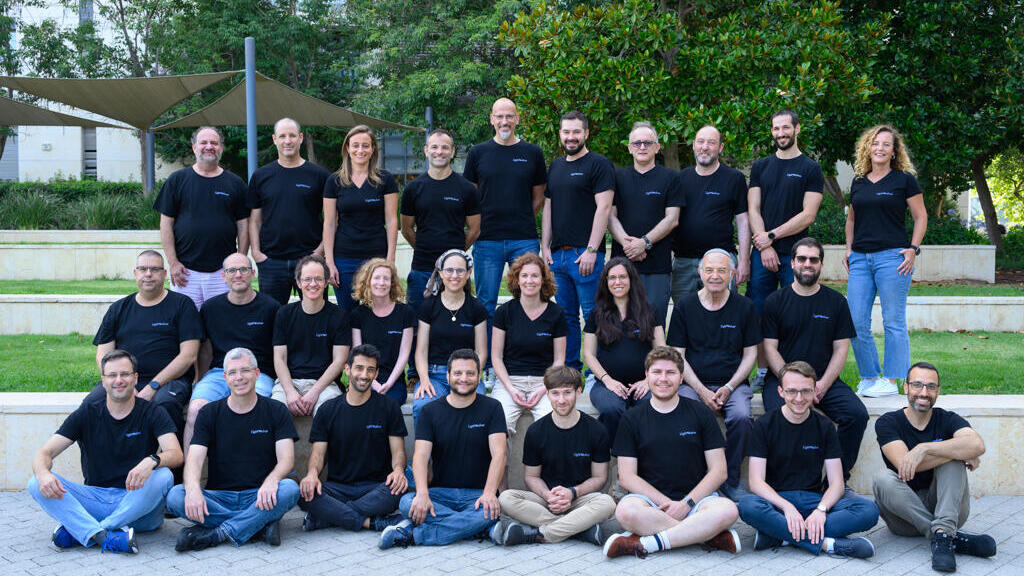
LightSolver, founded in 2020 by Weizmann Institute physicists Ruti Ben Shlomi and Chene Tradonsky, has developed what it calls a Laser Processing Unit, or LPU, an optical computing system that uses the physical interaction of lasers to perform calculations.
Rather than carrying out mathematical operations primarily through electronic transistors and moving data between processing and memory, the system maps mathematical problems onto an optical architecture in which large numbers of variables can interact simultaneously.
The company says the approach can deliver highly parallel computation without the extreme conditions associated with some quantum-computing systems. Its LPU operates at room temperature and does not require cryogenic cooling or a vacuum.
That distinction is central to LightSolver’s pitch. Quantum computers have attracted enormous attention as a potential route to solving problems beyond the practical capabilities of conventional machines, but their technological requirements can make them difficult to deploy. LightSolver is instead pursuing a system based on the physics of light that can ultimately be deployed in more conventional computing environments.
The company is targeting workloads including scientific and engineering simulations, large-scale linear systems, optimization and partial differential equations. Those calculations underpin applications ranging from robotics and Physical AI to weather prediction, plasma physics, chip design, materials research, drug discovery and mission-critical decision-making.
But LightSolver is not yet a commercial computing platform. The company is working toward commercial availability of its LPU in 2028.
That leaves the acquisition at an important point in the company’s development: LightSolver has moved beyond fundamental research and is now seeking to demonstrate that its technology can work on real-world problems for potential customers.
Among those engagements is a partnership with Boeing focused on using LightSolver’s technology to accelerate physics-based aerospace simulations. The collaboration is targeting simulations of degradation-driven structural effects that affect asset lifespan and maintenance planning.
LightSolver also says it is working with major engineering software and technology companies on applications including mechanical design, structural analysis, fluid dynamics and multiphysics simulation. Aerospace and defense companies are using the platform for optimization and simulation problems, while a global financial institution and companies in oil and gas and energy are also involved in commercial validation.
Ben Shlomi described the strategy as a response to what she sees as a fundamental limitation of conventional computing.
“Computing is reaching an inflection point,” she said. “We believe the next great leap will come not from making transistors smaller, but from changing the very medium of computing from electrons to light.”
She added that LightSolver had turned the concept “from fundamental physics into a working machine” and said the company’s ambition is to compress workloads that can take minutes, hours or weeks into milliseconds of LPU computation.
The acquisition gives CollPlant a way to pursue that opportunity through the public markets, while also taking the company considerably beyond its traditional healthcare focus.
CollPlant said it will remain committed to regenerative medicine and medical aesthetics even as it enters photonic computing. The company’s existing business is based on recombinant human collagen produced using plant-based genetic engineering technology, with applications in tissue repair, aesthetics and organ manufacturing.
The structure of the LightSolver deal also limits the amount of cash that CollPlant is putting up immediately, while making much of the eventual consideration dependent on LightSolver reaching specified milestones.



