










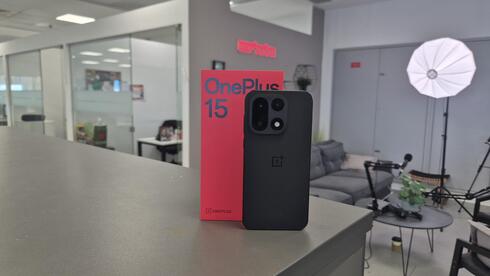
Smartphone review
OnePlus 15 review: Bigger battery, lower price, and a familiar flagship formula
The latest OnePlus leans on value and performance rather than radical reinvention.
Top line
After several years of incremental updates, OnePlus’ new flagship introduces a number of meaningful changes, some more visible to users than others. The end of the long-running collaboration with Hasselblad, for example, is unlikely to be felt by most consumers.
The bottom line is that the OnePlus 15, like its predecessors, is a strong flagship device offered at a noticeably lower price than its main competitors. Pricing starts at NIS 3,300 ($1,009) for the model with 256 GB of storage and 12 GB of RAM, and reaches NIS 3,600 ($1,100) for the 512 GB / 16 GB configuration. This is also cheaper than the previous model, which launched at NIS 3,500 ($1,070) for the base version.
Price alone is rarely enough in the fiercely competitive smartphone market, but in OnePlus’ case it is reinforced by a solid reputation and a track record of consistently capable devices. This year, the company adds a significantly larger battery than most rivals and generous hardware specifications, ingredients that allow the OnePlus 15 to compete credibly with other premium flagships.
Details
The OnePlus brand has been around for many years, and both in Israel and abroad it still enjoys a loyal following. Its original promise was to deliver powerful, user-friendly devices at a reasonable price, earning it the nickname “the flagship killer.”
Since then, the company has undergone several transformations and even changes in ownership, but the name, and the “Never Settle” motto, has remained. In practical terms, that philosophy translates into a constant effort to refine performance and the overall user experience.
Less than a year after launching its previous flagship, the OnePlus 13, the company has unveiled its successor: the OnePlus 15. The missing “14” is no mystery, within Chinese culture, the number four carries negative connotations, so it was simply skipped.
We tested the device courtesy of Cell-Now, the official OnePlus importer in Israel.

Design: A Familiar Phone with a New Look
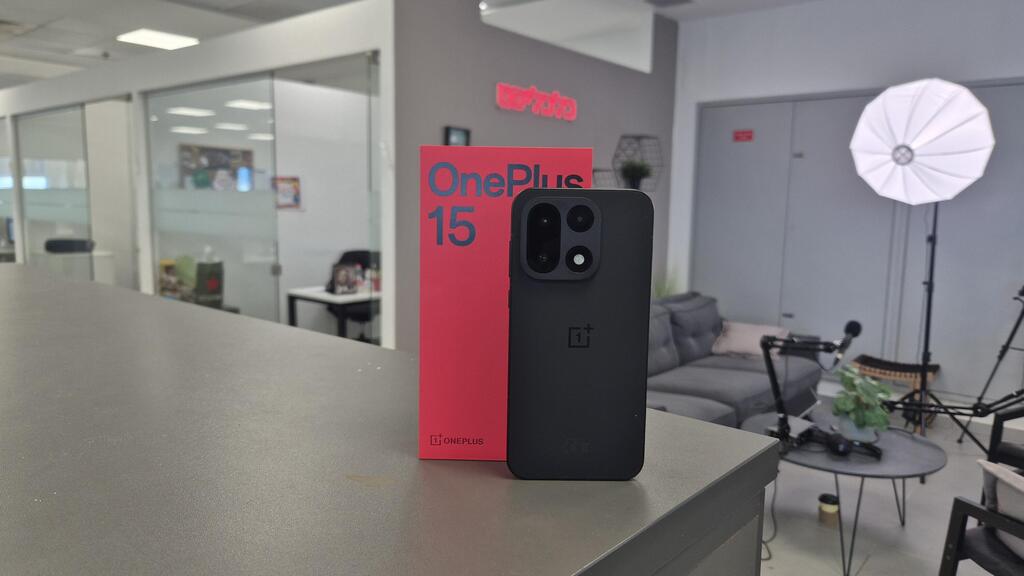
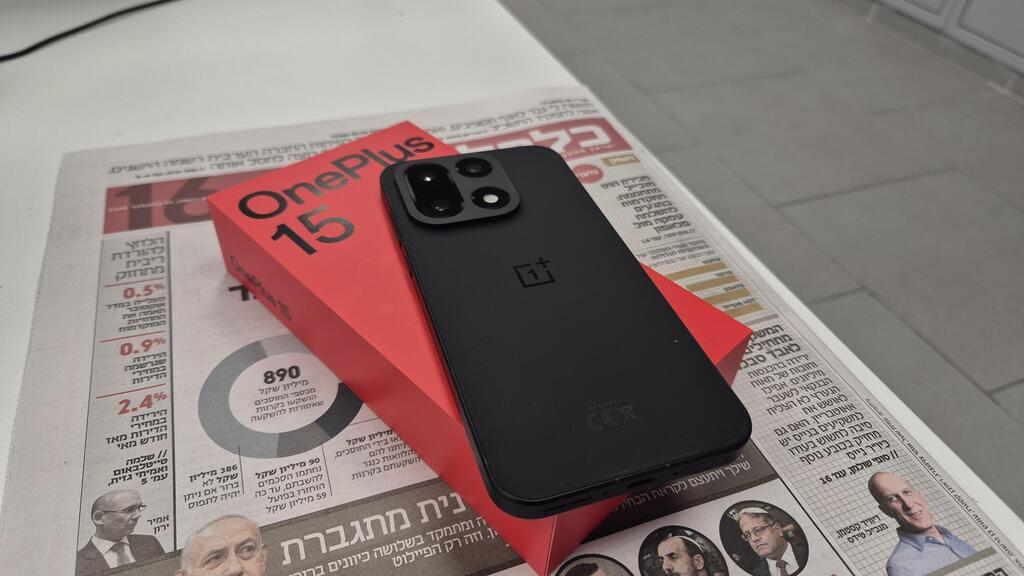
Recent OnePlus models have looked nearly identical, but this time the company opted for a modest design refresh. With screen size and overall dimensions largely fixed by convention, the most noticeable change comes at the rear: the camera layout has been completely redesigned. There are still three lenses and a flash, but arranged in a new visual configuration.
OnePlus is not chasing the trend toward ultra-thin and lightweight devices such as Apple’s iPhone Air or Samsung’s Galaxy S25 Edge. The OnePlus 15 is large and heavy. While it is marginally thinner on paper than its predecessor, it still feels substantial in the hand. The device weighs about 210 grams, and its 6.78-inch display makes it comparable in size and heft to the iPhone 17 Pro Max or the Galaxy S25 Ultra.
The front remains conventional: a flat, edge-to-edge display with very thin bezels, a small punch-hole selfie camera, and physical buttons on the right for power and volume. On the left is OnePlus’ familiar alert slider, which can also be customized to perform other functions, such as activating the flashlight, opening the camera, or launching the voice recorder. Its functionality, and even its menu, now closely resembles Apple’s configurable side button.
Durability has improved slightly. The device is rated to withstand immersion in water up to two meters for 30 minutes, strong water jets, and dust ingress. The display is protected by Gorilla Glass Victus 2, and the rear panel uses either Gorilla Glass 7i or Crystal Shield Glass, depending on the variant. While the back is smooth, it does not feel overly slippery in daily use.
Hardware: Strong Specs, with a Nod to Gamers
OnePlus currently enjoys a brief advantage over competitors by integrating Qualcomm’s latest flagship processor, the Snapdragon 8 Elite (fifth generation). The phone is offered with either 12 GB of RAM and 256 GB of storage, or 16 GB of RAM and 512 GB of storage.
That advantage is likely to be short-lived, as rival devices with the same processor are expected to arrive soon.
The company also highlights an upgraded Wi-Fi component, improved touch-response sensors, and other refinements, features that are marketed primarily toward gamers. In practice, while testing, no dramatic improvement in Wi-Fi performance or gaming responsiveness stood out, though more demanding users may notice subtle gains.
In everyday use, however, the device feels extremely fast. Apps launch instantly, multitasking is smooth, and even graphics-heavy games run without issue. The phone does warm up slightly during extended gaming sessions, but not to a level that affects comfort.
Software and Interface: A New Home for AI
The OnePlus 15 runs Android 16 with the OxygenOS 16 interface. Android users will adapt quickly, as the experience remains clean and largely uncluttered. Alongside Google’s standard apps, a handful of additional applications come preinstalled, including social media and media-streaming services, but overall the system avoids unnecessary bloat.
Navigation is gesture-based by default, with no on-screen home or back buttons. The quick-settings panel offers a wide range of shortcuts, each accompanied by brief explanations—useful without being overwhelming.
Artificial intelligence features, already present in the previous model, have been expanded and centralized under a new “OnePlus AI” menu. These include tools for text proofreading and writing (with Hebrew support), translation between languages (excluding Hebrew), and audio transcription (also without Hebrew support).
In practice, these tools are uneven. In one test, a writing prompt entered in Hebrew produced output in English; in another, text expansion yielded only minimal additions. They are helpful in certain scenarios, but not yet reliable enough to replace manual input.
OnePlus also borrows a page from Apple’s design playbook. While it lacks a “Dynamic Island,” the area around the selfie camera is used to display contextual information, such as music playback controls or an active timer.
Photography: New Hardware, Familiar Results
The OnePlus 15 features three rear cameras, each with a 50-megapixel sensor: a main camera, an ultra-wide lens, and a periscope telephoto camera offering 3.5x optical zoom. The selfie camera uses a 32-megapixel sensor.
The partnership with Hasselblad, which shaped previous OnePlus cameras, has ended and leaves no visible mark on this model. In practice, image quality remains very strong. Photos are sharp, well-exposed, and natural-looking in both daylight and low-light conditions, without excessive processing.
AI-powered photo tools are also included, such as removing unwanted objects or people, enhancing sharpness, correcting blur, and reducing reflections. A “Perfect Shot” feature allows users to swap faces in group photos, for example, replacing a blink with a better expression, assuming enough reference images exist.
These tools are accessed through the photo gallery after images are taken and require a one-time download before use. While this extra step is slightly cumbersome, installation is quick and ensures that users opt in rather than having AI features forced upon them.



