











VC Survey 2026
“Israel should stop using resilience as its national brand going forward”
Mobilion Ventures Managing Partner Avi Feldman joins CTech to discuss the branding of Startup Nation, the current liquidity environment, and the emergence of Physical AI as a global game-changer, as part of the VC Survey 2026: The Next Leap.
“I don't think that the national brand is transforming itself into ‘Resilience’ and I don't think that it should be our guiding star in 2026 and onward,” says Avi Feldman, Managing Partner at Mobilion Ventures. “2025 shows that eventually resilience is a supportive stratum for our main brand of innovation and scale despite obstacles.” According to Feldman, the term should not be the primary draw for investment, but rather an "insurance certificate" for the Israeli tech ecosystem proving that even in bad times, the sector can still perform well.
Following the turbulence of recent years and the stabilization of 2025, the Israeli tech ecosystem is entering a new era: The Next Leap. Feldman joined CTech to share insights for its VC Survey 2026, which invites prominent investors to discuss the topics, trends, and “leaps” expected in the year ahead.
1 View gallery
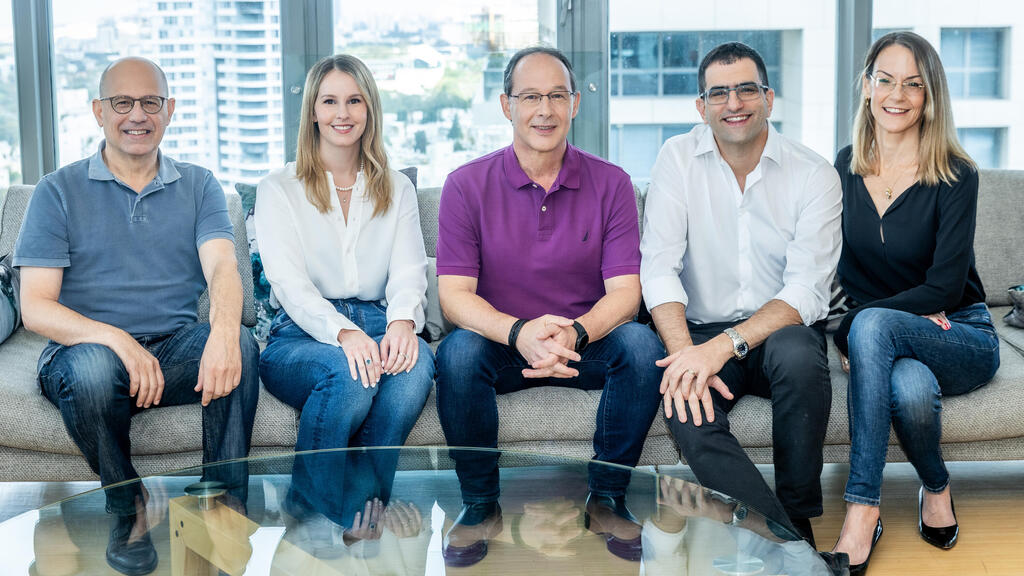
Mobilion Team (L-R): Dr. David Abraham, Anna Leizerovici-Ekstein, Avi Feldman, Eyal Zbeda, Dr. Anat Bonshtien
(Photo: Mobilion Ventures)
Feldman predicts that the advent of Physical AI will be a "game changer" for the high-tech sector. However, while he believes DeepTech "is an excellent investment area that could bring great returns and that Israel has much to play in," he warns the country currently lags in follow-on investments. "Most of the money goes to initial early-stage investment by early stage only Funds," he explains, adding: "If you are looking to build a blockbuster company in this sector you need to crack this potentially vicious dilemma."
You can read the entire interview below:
Fund ID
Name of Fund: Mobilion Ventures
Total Assets Under Management (AUM): $30M and in the process of fundraising for a $70M 2nd Fund
Partners/Managers: Avi Feldman, Eyal Zbeda, Dr. Anat Bonshtien, Dr. David Abraham, Gael Escribe
Notable Portfolio Companies (Active): Click-Ins, Capow, Clearly, DriveU, Ki-Mobility, Service Next, Silib and CartEAV
Notable Exits: Algolion (M&A General Motors) plus several IPOs under former Fund
The Liquidity Leap: After a period defined by cash preservation, will 2026 see the reopening of the IPO window for Israeli tech, or will M&A remain the sole viable liquidity event?
We're already witnessing the re-opening of capital markets to new tech companies, mostly outside of Israel, but as this transition is in its first term this is a slow, cautious and gradual transition and the IPOs we see today are mostly late-stage companies having substantial sales to present. Examples include Navana, Via and eToro, per the 2025 Q4 ISRAELI TECH REVIEW.
The obvious reasons for this initial change in 2025 is of course based on geopolitical changes as fewer conflicts are on the global map, interest rates have come down and expected to continue in this vector and pace over 2026, and the hype around AI, Cyber and few other tech areas fuels investors' appetite to take part in the party through their capital market investments.
We believe that this trajectory will continue in 2026, gradually and slowly trickling down to smaller companies with lower financial performance. The hype of capital markets' IPOs in 2019-2021 is still away from us but the momentum that is being built is the right one for tech companies.
The Global Leap: How is the 'Israeli Tech' asset class being rebranded to global LPs in 2026? Are we shifting the narrative from 'Innovation' to 'Extreme Resilience'?
I don't think that the national brand is transforming itself into “Resilience” and I don't think that it should be our guiding star in 2026 and onward. We’ve demonstrated resilience due to the rough two to three last years and the challenges that were forced upon us, and it was a good interim branding as we proved our performance by playing the “Resilience” card. But, having said that, 2025 shows that eventually resilience is a supportive stratum for our main brand of innovation and scale despite obstacles, so this term should remain as an insurance certificate that even in bad times we can perform well.
I think that we should stop using it as our national brand going forward as it might have a negative impact along with the positive one. Investors want to invest in what brings them value, and the resilience card may bring them to conceive that we have a low return on investment ratio.
By the way, the “Resilience” term is used today by global companies seeking enabling technologies slash solutions, allowing them to perform despite environmental, logistic and supply chain or national defense challenges.
The Deep Tech Leap: With the rising focus on hardware-heavy sectors (Defense, Climate, Quantum), is the Israeli VC model adapted to fund high-CAPEX ventures?
We believe that DeepTech is an excellent investment area that could bring great returns and that Israel has much to play in. We have a great innovation pool of DeepTech researchers and entrepreneurs, and the Israeli entrepreneurs are highly multi-disciplinary in nature which gives them an additional necessary edge over their peers in other countries. So we have great companies that start their journey here.
But (and this is the tricky part of DeepTech investments in Israel) we are lagging in follow-on investments as most of the money goes to initial early-stage investment by early stage only Funds. If you are looking to build a blockbuster company in this sector you need to crack this potentially vicious dilemma.
We, at Mobilion, are after playing it a bit differently than regular VC investments. Our way is by having a built-in strategic partnership with global tech companies that can assist, technologically and commercially, in the early stage and can invest in the DeepTech companies in the second-slash-third phase of their life cycle.
Related articles:
- "Geopolitical shifts reinforce that Israeli tech is fundamentally resilient, and the innovation engine here is hard to replicate"
- "Israel’s competitive advantage has never been abstract creativity alone; it has been the ability to innovate under constraint and to overcome the status quo."
- Fintech mafia: How Israel’s veteran founders are shaping the sector’s future
The Efficiency Leap: In the era of AI-driven hyper-productivity, is the traditional correlation between 'Headcount Growth' and 'Company Success' permanently broken?
I believe that the correlation will stay to some degree but for sure the ratio between headcount and company growth will change dramatically due to the AI revolution. When we reach the era of AGI (Artificial General Intelligence) and ASI (Artificial Superintelligence) then the correlation will be permanently broken.
The Next Engine: Cybersecurity has been Israel's primary export engine for a decade. Which domain is best positioned to take the lead by 2030?
We've discussed earlier DeepTech investment versus the pure Software ones, and I believe that within it there is a segment of Physical AI that combines the two and is going to be the real game-changer, globally and locally. To better explain, Physical AI refers to any AI object that has a physical manifestation – robots, vehicles, or even appliances. To bring an AI entity to perform in the real world, under environmental, physical and regulatory constraints, is extremely challenging. If you look at autonomous vehicles for example – in 2017 to 2018 we were certain that we'll drive in AV by 2020 or shortly after. Almost a decade later and we're just at initial POCs of that and we're still far from mass adoption.
We all heard Nvidia CEO Jensen Huang at CES announce autonomous vehicles as “the first large-scale commercial market of the Physical AI era.” This focus by a market leader such as Nvidia will accelerate the investment, transformation and deployment of Physical AI, thus putting a spotlight on this domain.
Since Israel has a very strong defense demand for new technologies, we believe that many of the new local Physical AI innovations, developed in the triangle of basic research, startups, defense industries, will start as dual-use applications that will quickly be transformed into pure civic ones. Furthermore, we believe that within this new Physical AI domain, the industrial, logistic and transportation operations, will be the segments that bring the quickest ROI for investors.
Finally, what are 2-3 startups that, in your opinion, are likely to make a leap forward in 2026?
We believe that the following portfolio companies will leap forward this year towards being the leading solution in the market in their domain:
1. Capow – Bringing power-in-motion (wireless electricity solution) to robots and vehicles, mainly in industrial and logistic operations. Capow is already winning a few major customers with multiple sites in the US market and quickly becoming the go-to solution in the industry.
2. Click-Ins – Bringing an unmatched AI solution, trained on synthetic data, to the vehicle inspection domain with zero dependency on the human or physical element is the solution that fleets, insurance and vehicle dealerships are craving for. Scaling the solution this year in the US and EU markets will transform the company into a real blockbuster.
3. DriveU – With its combination of fully autonomous and teleoperated technology, DriveU is poised to become the transforming solution for logistics' ports and yard operations. Following its success in the Ashdod Port project, this year the company is set to scale and become the leading solution in this segment.



