










Foreign airlines are returning to Israel. Can Ben Gurion handle them?
Fifty-five airlines are expected to operate during the Jewish holidays, compared with 45 last year, as Wizz Air, Delta and United expand or resume flights. But the airport enters the peak season after a summer marked by baggage disruptions, staffing tensions and operational strain.
The Israeli aviation market is entering the Jewish holiday season facing a complex picture. On the one hand, more foreign airlines are returning to Ben Gurion Airport, new routes are opening, and seat capacity is increasing. On the other, the airport is entering this peak period after a summer that exposed infrastructure limitations, staffing challenges and difficulties related to dozens of U.S. military refueling personnel whose operations place additional pressure on ground and air services.
Some 2.5 million passengers are expected to pass through Ben Gurion Airport during the fall Jewish holidays, a significant increase from the 1.84 million passengers recorded during the same period last year. Fifty-five airlines will operate at the airport, compared with 45 during the corresponding period last year. Although Rosh Hashanah passed relatively quietly, a sense of heightened alert remains palpable at the airport.
1 View gallery
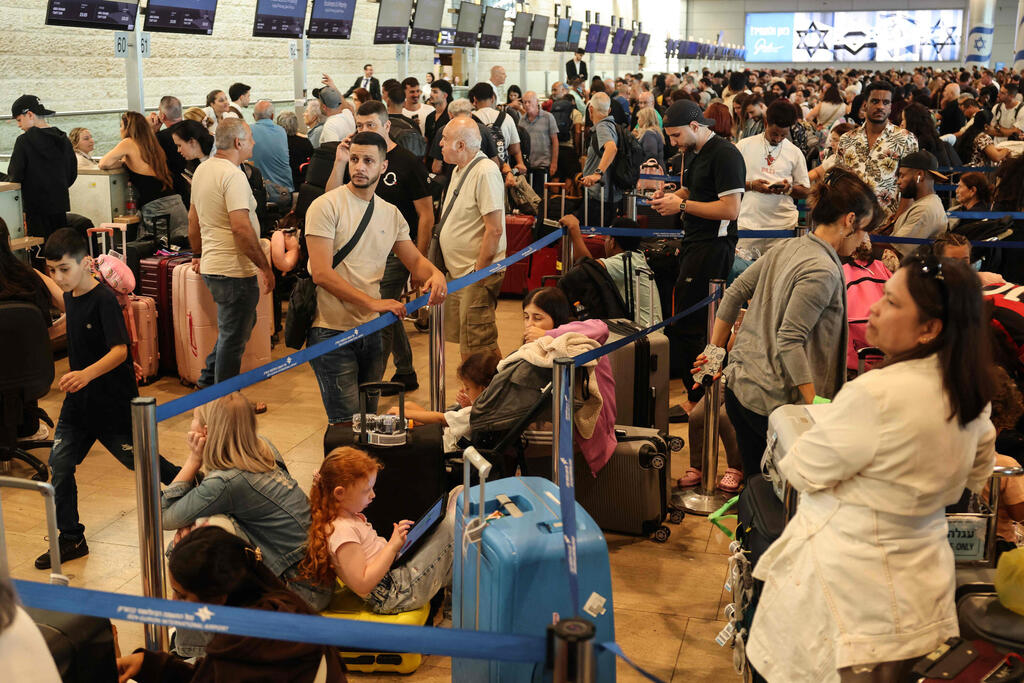
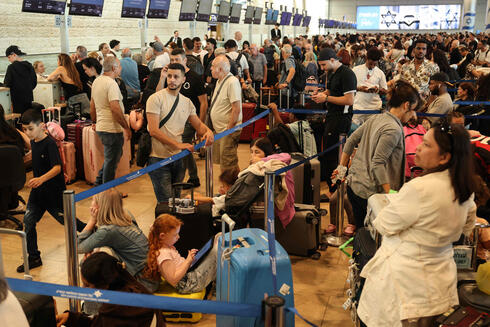
Congestion at Ben Gurion Airport following disruptions last August.
(Photo: Jack Guez / AFP)
A recovery in Israel's aviation sector has become increasingly evident in recent weeks. Transavia, which resumed operations in Israel in late August with a route to Paris, has already expanded its activity and now operates routes from Ben Gurion Airport to Lyon, Marseille and Orly. Last week, Wizz Air announced an expansion of its Israeli operations, adding dozens of weekly flights from Ben Gurion Airport. The airline is relaunching five routes to Catania, London, Venice, Cluj and Iași, while adding 45 weekly flights across 11 existing routes. The move is expected to increase seat capacity from Israel to European destinations and intensify competition for passengers.
The market for flights to the U.S. is also heating up this week. Delta and United Airlines resumed operations from Ben Gurion Airport to the U.S. last week. For the first time in months, Israeli carriers El Al and Arkia no longer dominate the U.S. flight market. The shift follows Arkia's decision to increase capacity on its New York route using a 345-seat Boeing 787-9 aircraft.
The return of U.S. carriers and the resulting increase in competition prompted Israir to bring forward the launch of its own New York route. Having secured all necessary approvals, the airline plans to operate its inaugural flight immediately after Rosh Hashanah.
After months of limited competition, during which Israeli airlines controlled a large share of available capacity, foreign carriers and direct routes are gradually returning. The result is a wider range of destinations, flight frequencies and prices, particularly on routes served by multiple operators.
But the return of foreign airlines does not guarantee an immediate drop in fares, as demand remains high on some routes. This helps explain why Israir quickly accumulated an order backlog worth NIS 8 million despite selling round-trip tickets for $2,300 on launch day. With demand already high, the airline did not need to offer deeply discounted fares to attract passengers. Instead, it entered a market where travelers were hungry for additional capacity on U.S. routes.
Despite the recovery, many airlines are still absent from Terminals 1 and 3. The absence of Ryanair and EasyJet is particularly noticeable. Both low-cost giants previously offered fares that helped keep prices down, but those options remain largely unavailable in Israel.
EasyJet continues to postpone its return to Israel, while Ryanair has spoken openly about its reluctance to operate at Ben Gurion Airport because of instability in the Middle East. The airline has even said it will not return unless it receives a guarantee that it can operate exclusively from Terminal 1, where airport fees are lower, even during periods of security tension when the terminal is closed. That scenario is unacceptable to security officials.
Ryanair is currently expanding across Europe and North Africa, and it now appears that the airline does not miss the Middle East nearly as much as Israeli travelers miss the low fares it once offered.
The recovery of flights to North America is also incomplete. Air Canada has postponed its return, American Airlines has suspended flights to Tel Aviv until March, and Iberia has once again delayed the resumption of its route to Spain, this time until the end of October.
For travelers, these are not simply additional airlines missing from the schedule. EasyJet and Ryanair have been important sources of price competition in Europe, while U.S. and Canadian carriers provide direct connections to destinations where alternatives are limited. Their absence leaves parts of the market dependent on fewer operators and forces many Israelis to rely on connecting flights.
Security restrictions are also continuing to shape Israel's aviation market. Israeli airlines will only be able to resume routes to the Emirates at the end of next month, following a security-imposed ban on the service since Operation "Roaring Lion." The restrictions have allowed FlyDubai and Etihad to dominate the routes.
For Arkia and El Al, which previously operated scheduled flights to the Emirates, the easing of restrictions will allow them to resume routes considered profitable. Nevertheless, their operations remain subject to the security risks that have made stable scheduling difficult.
Yet the issue is not simply the number of airlines operating at Ben Gurion. The more immediate challenge ahead of the holidays is whether the airport can handle the passenger demand.
August included several peak days with more than 100,000 travelers. On Thursday, August 20, a baggage-handling crisis exposed a critical vulnerability. Operations were brought to a halt amid tensions between the workers' union and Israel Airports Authority (IAA) management, leading to a temporary suspension of landings and affecting hundreds of passengers.
The dispute between IAA management and the union centered, among other issues, on staffing levels. Initially, the union demanded more permanent employees. Following the crisis, however, it revised its position, saying it would settle for additional personnel to reinforce the existing workforce.
The IAA maintained that there is no routine staffing shortage. While both sides pledged to cooperate to ensure smooth airport operations, past experience suggests that labor disputes do not simply disappear without a formal agreement. The busy holiday season could provide the union with an opportunity to exert additional pressure.
As a result, the fall Jewish holidays will serve as a dual test for Ben Gurion Airport: not only whether it can accommodate the number of airlines and flights operating, but also whether its infrastructure, baggage-handling systems and workforce can withstand the additional load.
The timing of the holidays could add another layer of pressure. They fall relatively early this year, at the beginning of September, while the weather is still warm. Unlike last year, when most of the holidays fell during the week, this year many coincide with weekends, reducing the number of working days employees need to take off for holiday vacations.
"The fall Jewish holidays fall relatively early this year," explains Tamar Garzon, CEO of Gulliver. "This effectively turns the holiday break into a direct continuation of the summer vacation. Furthermore, since most of the holidays fall close to the weekend, there are fewer actual days off work.
"This trend is reflected in booking patterns: this year has seen higher demand for short getaways to nearby destinations, particularly Greece and Cyprus. This contrasts with last year, when we saw more bookings for long-haul destinations like Thailand and the U.S.
"Other popular destinations for the holiday season this year include Eastern European cities such as Krakow, Riga, Vilnius and Tashkent. Italy is also seeing high demand, with no fewer than 11 different destinations offering direct flights from Tel Aviv, providing opportunities to vacation in new regions of the country."
The Israel Airports Authority faces several major challenges whose impact could be felt during the Jewish holidays. Foremost among them is the continuing regional security uncertainty. Any further escalation could lead to flight cancellations, decisions by foreign airlines to suspend operations in Israel and a sharp drop in available seat capacity.
A direct consequence of the security situation is the presence of U.S. military refueling operations at Ben Gurion Airport, which places additional pressure on ground and air services. These operations are given priority, and each takeoff or landing involving them can trigger a chain reaction of flight delays.
Passenger traffic is also rising across Europe, creating congestion at major airports, compounded by operational constraints and staffing shortages at some facilities. Because a significant portion of flights to Israel connect through European airports, disruptions there can ripple through to Ben Gurion, causing delays and cancellations.
The Rosh Hashanah period brings another concentrated source of pressure: a sharp increase in passenger traffic to Uman, with a large number of flights operating within a short period. The resulting strain extends beyond Ben Gurion Airport, affecting aircraft and crew availability, flight slots and infrastructure at destination airports and along connecting routes.
Compounding these pressures is the ongoing dispute between Israel Airports Authority management and the workers' union. Following the disruptions experienced in August, there are concerns that an escalation of the dispute could lead to industrial action or further operational disruptions precisely when Ben Gurion Airport is operating at high capacity.
The result is an aviation market that is simultaneously recovering and under pressure. More airlines are returning, new routes are being added and capacity is expanding. But the holiday season will test whether Ben Gurion's infrastructure, workforce and operating systems can keep pace with that recovery.



